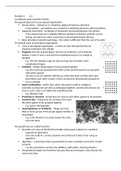
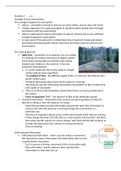
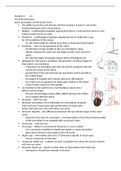
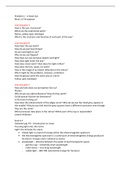
Problem 5 2.4
Constituent parts and their wholes
The gestalt approach to perceptual organisation
Structuralism – behaviour is created by adding elementary elements
- In perception – perceptions are created by combining elements called sensations
Apparent movement - an illusion of movement perceived between two stimuli
- if two stimuli that are in slightly different positions of flashed, with the correct
timing, one after the other, movement is perceived between the two
Basic principle of gestalt psychology - the whole is different than the sum of its parts
The gestalt Laws of perceptual organisation
Laws of perceptual organisation - a series of rules that specify how we
organise small parts into wholes
Pragnanz (the law of good figure/ the law of simplicity)- every stimulus
pattern is seen in such a way that the resulting structure is as simple as
possible
- E.g. The five Olympic rings are seen as rings are not other, more
complicated shapes
similarity - Similar things appear to be grouped together
- e.g. the circles are grouped with other circles and the squares are grouped
with other squares
- can also occur for auditory stimuli e.g. notes that have a similar pitch and
that follow each other closely in time can become perceptually grouped to
form a melody
Good continuation - points that, when connected, result in straight or
smoothly curving lines are seen as belonging together, and the lines tend to be
seen in such a way as to follow the smoothest path
- E.g. Olympic rings
Proximity or nearness - things that are near to each other appear to be grouped
Common fate - things that are moving in the same
direction appear to be grouped together
- E.g. dance choreography
meaningfulness or familiarity - things are more
likely to form groups if the groups appear familiar or
meaningful
- e.g. in the illusion if you look closely the rocks
turn into faces
the gestalt laws are really heuristics
heuristics are rules of thumb that provide a best-guess solution to a problem
- opposite of algorithms
- may not result in a correct solution every time but is faster than using an
algorithm
algorithm – a procedure that is guaranteed to solve a problem every time if used
correctly
- e.g. the procedures we learn for addition, subtraction, and long division
the gestalt principles are heuristics because they are best-guess rules that do not
work every time
, - e.g. we would expect it to be a single branch
hidden behind a tree (good continuation)
but this is not the case
- using an algorithm in this case would involve
looking at the branches from different
angles that aren’t obscured by the tree –
more accurate, but takes longer
we often need to know quickly what is going on in the environment, so perception
needs to be fast, and heuristics provide this speed
where do heuristics come from
could be evolutionary but also likely that learning would also be important as well
- we have been practicing perceptual problem solving since infancy and have
encountered many perceptual situations
it is likely that we have learned, during these perceptual encounters, that there are
certain regularities in the environment
- such as the way tree branches usually appear in the woods
Regardless of where they come from, it is clear that gestalt principles reflect
common regularities that we often see in our environment
More principles of perceptual organisation
Palmer, palmer, rock – proposed 3 new grouping principles
- Principle of common region
- Principle of element connectedness
- Principle of synchrony
Common region – elements that are within the same
region of space are grouped together
- E.g. the dots inside the ellipses are further apart
than the dots next to each other in the
neighbouring ellipses, but we see the dots inside
the ellipses as belonging together
- Each ellipse is seen as a separate region of space
Element correctness – things that are physically
connected are perceived as a unit
- E.g. we perceive a series of dumbbells rather than a pairs of dots, even though
the dots separated by the spaces are closer together than the connected lines
Synchrony – visual events that occur at the same time will be perceived as going
together
- The lights that blink together are seen as belonging together
Quantitative measurement of the grouping effects
The gestalt psychologists’ main method for studying perception was
phenomenological
Repetition discrimination task – a way to quantitatively measure the strength of
grouping
, - Subjects look at a series of objects and have
to find two identical shapes that are next to
each other in the series and then press a key if
they are squares and another if they are
circles
- E.g. in both A and B there are two squares
next to each other but in A they are grouped
by proximity and in B they are in different
groups
- The grouping in A resulted in a reaction time that was a lot quicker than
compered to B
- Grouping therefore not only affects the way a display looks but also our ability to
extract information from the display
Perceptual segregation- our ability to perceptually separate objects from one
another
Perceptual segregation
Figure-ground segregation – when we see a separate object, it is usually seen as a
figure that stands out from its background
- E.g. you see a book on your desk as figure and the surface of your desk as ground
The gestalt approach to figure-ground segregation
Reversible figure-ground – one that can be perceived alternately either as e.g. two
black faces looking at each other, in front of a white background, or as a white vase
on a black background
- It is difficult, if not impossible, to perceive both figures simultaneously
- When one figure is perceived, the other is seen as unformed material
Properties of the figure and ground:
1. The figure is more “thinglike” and more memorable than the ground
2. The figure is seen as being in front of the ground
3. The ground is seen as unformed material and seems to extend behind the figure
4. The contour separating the figure from the ground appears to belong to the
figure
Stimuli with comparatively smaller areas are more likely to be seen as
figure
- + figure x ground
Vertical or horizontal orientations are more likely to be seen as figure
than other orientations
- Vertical-horizontal propeller shape more likely to be seen as
figure compared to tilted propeller
Meaningful objects are more likely to be seen as figure
- Arrows tend to be seen as figure but if you add two more black
areas on either side, it makes it easier to see that the white areas
spell out a word, so these dominate our perception
Modern ideas about figure-ground segregation
Look more closely at the mechanisms underlying the figure-ground perception
1. Role of contours on figure-ground perception
2. Where in the perceptual process figure ground segregation occurs
Constituent parts and their wholes
The gestalt approach to perceptual organisation
Structuralism – behaviour is created by adding elementary elements
- In perception – perceptions are created by combining elements called sensations
Apparent movement - an illusion of movement perceived between two stimuli
- if two stimuli that are in slightly different positions of flashed, with the correct
timing, one after the other, movement is perceived between the two
Basic principle of gestalt psychology - the whole is different than the sum of its parts
The gestalt Laws of perceptual organisation
Laws of perceptual organisation - a series of rules that specify how we
organise small parts into wholes
Pragnanz (the law of good figure/ the law of simplicity)- every stimulus
pattern is seen in such a way that the resulting structure is as simple as
possible
- E.g. The five Olympic rings are seen as rings are not other, more
complicated shapes
similarity - Similar things appear to be grouped together
- e.g. the circles are grouped with other circles and the squares are grouped
with other squares
- can also occur for auditory stimuli e.g. notes that have a similar pitch and
that follow each other closely in time can become perceptually grouped to
form a melody
Good continuation - points that, when connected, result in straight or
smoothly curving lines are seen as belonging together, and the lines tend to be
seen in such a way as to follow the smoothest path
- E.g. Olympic rings
Proximity or nearness - things that are near to each other appear to be grouped
Common fate - things that are moving in the same
direction appear to be grouped together
- E.g. dance choreography
meaningfulness or familiarity - things are more
likely to form groups if the groups appear familiar or
meaningful
- e.g. in the illusion if you look closely the rocks
turn into faces
the gestalt laws are really heuristics
heuristics are rules of thumb that provide a best-guess solution to a problem
- opposite of algorithms
- may not result in a correct solution every time but is faster than using an
algorithm
algorithm – a procedure that is guaranteed to solve a problem every time if used
correctly
- e.g. the procedures we learn for addition, subtraction, and long division
the gestalt principles are heuristics because they are best-guess rules that do not
work every time
, - e.g. we would expect it to be a single branch
hidden behind a tree (good continuation)
but this is not the case
- using an algorithm in this case would involve
looking at the branches from different
angles that aren’t obscured by the tree –
more accurate, but takes longer
we often need to know quickly what is going on in the environment, so perception
needs to be fast, and heuristics provide this speed
where do heuristics come from
could be evolutionary but also likely that learning would also be important as well
- we have been practicing perceptual problem solving since infancy and have
encountered many perceptual situations
it is likely that we have learned, during these perceptual encounters, that there are
certain regularities in the environment
- such as the way tree branches usually appear in the woods
Regardless of where they come from, it is clear that gestalt principles reflect
common regularities that we often see in our environment
More principles of perceptual organisation
Palmer, palmer, rock – proposed 3 new grouping principles
- Principle of common region
- Principle of element connectedness
- Principle of synchrony
Common region – elements that are within the same
region of space are grouped together
- E.g. the dots inside the ellipses are further apart
than the dots next to each other in the
neighbouring ellipses, but we see the dots inside
the ellipses as belonging together
- Each ellipse is seen as a separate region of space
Element correctness – things that are physically
connected are perceived as a unit
- E.g. we perceive a series of dumbbells rather than a pairs of dots, even though
the dots separated by the spaces are closer together than the connected lines
Synchrony – visual events that occur at the same time will be perceived as going
together
- The lights that blink together are seen as belonging together
Quantitative measurement of the grouping effects
The gestalt psychologists’ main method for studying perception was
phenomenological
Repetition discrimination task – a way to quantitatively measure the strength of
grouping
, - Subjects look at a series of objects and have
to find two identical shapes that are next to
each other in the series and then press a key if
they are squares and another if they are
circles
- E.g. in both A and B there are two squares
next to each other but in A they are grouped
by proximity and in B they are in different
groups
- The grouping in A resulted in a reaction time that was a lot quicker than
compered to B
- Grouping therefore not only affects the way a display looks but also our ability to
extract information from the display
Perceptual segregation- our ability to perceptually separate objects from one
another
Perceptual segregation
Figure-ground segregation – when we see a separate object, it is usually seen as a
figure that stands out from its background
- E.g. you see a book on your desk as figure and the surface of your desk as ground
The gestalt approach to figure-ground segregation
Reversible figure-ground – one that can be perceived alternately either as e.g. two
black faces looking at each other, in front of a white background, or as a white vase
on a black background
- It is difficult, if not impossible, to perceive both figures simultaneously
- When one figure is perceived, the other is seen as unformed material
Properties of the figure and ground:
1. The figure is more “thinglike” and more memorable than the ground
2. The figure is seen as being in front of the ground
3. The ground is seen as unformed material and seems to extend behind the figure
4. The contour separating the figure from the ground appears to belong to the
figure
Stimuli with comparatively smaller areas are more likely to be seen as
figure
- + figure x ground
Vertical or horizontal orientations are more likely to be seen as figure
than other orientations
- Vertical-horizontal propeller shape more likely to be seen as
figure compared to tilted propeller
Meaningful objects are more likely to be seen as figure
- Arrows tend to be seen as figure but if you add two more black
areas on either side, it makes it easier to see that the white areas
spell out a word, so these dominate our perception
Modern ideas about figure-ground segregation
Look more closely at the mechanisms underlying the figure-ground perception
1. Role of contours on figure-ground perception
2. Where in the perceptual process figure ground segregation occurs