
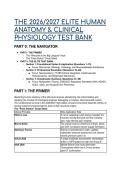
THE 2026/2027 ELITE HUMAN
ANATOMY & CLINICAL
PHYSIOLOGY TEST BANK
PART 0: THE NAVIGATOR
● PART I: THE PRIMER
○ The "Welcome to the Big Leagues" Hook
○ The "Panic Button" Cheat Sheet
● PART II: THE ELITE TEST BANK
○ Section 1: Foundational Syntax & Application (Questions 1–15)
■ Focus: Microscopic Histology, Osteology, and Musculoskeletal Architecture.
○ Section 2: Professional Simulation (Questions 16–40)
■ Focus: Neuroanatomy, 7T MRI Clinical Integration, Cardiovascular
Hemodynamics, and Respiratory Mechanics.
○ Section 3: Grandmaster Synthesis (Questions 41–66)
■ Focus: Multisystem Trauma, 2026/2027 Regulatory Standards (AHA, KDIGO,
GOLD, ADA), and Surgical Error Prevention.
PART I: THE PRIMER
Mastering human anatomy at the elite level requires abandoning rote memorization and
adopting the mindset of a biological engineer debugging a complex, interconnected system.
Your professional survival in the 2026/2027 high-stakes clinical environment depends entirely on
tracing systemic functional failures back to their structural origins.
The "Panic Button" Cheat Sheet
Clinical Principle Elite Application Rule
Hilton’s Law A nerve supplying a joint always supplies the
muscles moving that joint and the overlying
skin; map referred pain instantly.
Monro-Kellie The cranial vault is a fixed box of brain, blood,
and CSF. Increased volume equals herniation.
Starling’s Forces Edema is hydrodynamic math: capillary
hydrostatic pressure pushes fluid out, plasma
oncotic pressure pulls it in.
GOLD 2026 A single moderate exacerbation immediately
shifts a COPD patient to high-risk Group E.
AHA 2026 Mobile Stroke Units must administer
Tenecteplase within the 4.5-hour window
post-CT confirmation.
,PART II: THE ELITE TEST BANK
Section 1: Foundational Syntax & Application
Q1: A 54-year-old patient presents with a chronic, non-healing ulcer on the posterior heel. A
biopsy reveals cellular disruption in the avascular layer of the integument. Based on McKinley's
histological architecture, which layer is MOST LIKELY compromised, preventing adequate
epithelial regeneration? A) The papillary layer of the dermis, where loose areolar connective
tissue fails to support diffusion. B) The stratum basale of the epidermis, where mitotic stem cells
are failing to proliferate. C) The stratum corneum, where dead keratinocytes are failing to
desquamate properly. D) The reticular layer of the dermis, where dense irregular connective
tissue is deteriorating.
● The Answer: B (The stratum basale of the epidermis, where mitotic stem cells are failing
to proliferate.)
● Distractor Analysis:
○ A is incorrect: While the papillary layer supplies nutrients via diffusion, it is highly
vascularized, contradicting the stem's description of an avascular layer.
○ C is incorrect: The stratum corneum consists of dead cells and plays no active role
in regeneration.
○ D is incorrect: The reticular layer is vascular and deep; it provides structural
integrity, not primary epithelial cellular regeneration.
The Mentor's Analysis: The epidermis is strictly avascular and relies entirely on the underlying
dermis for nutrient diffusion. The stratum basale is the foundational "factory" of the skin. If the
factory floor shuts down, the upper layers inevitably ulcerate. Professional Intuition: Always
trace epithelial healing deficits directly to the basal layer's mitotic capacity and its underlying
vascular supply line.
Q2: A 12-year-old athlete sustains a severe inversion injury to the ankle. Radiography
demonstrates a fracture line passing strictly through the physis and exiting through the
metaphysis of the distal fibula. According to the Salter-Harris classification, what is the MOST
ACCURATE designation and prognosis for this injury? A) Type I; excellent prognosis with
minimal risk of growth arrest. B) Type II; excellent prognosis as it spares the epiphysis. C) Type
III; poor prognosis requiring surgical fixation to restore the joint surface. D) Type IV; high risk of
premature physeal closure and joint incongruity.
● The Answer: B (Type II; excellent prognosis as it spares the epiphysis.)
● Distractor Analysis:
○ A is incorrect: A Type I fracture goes straight across the physis only.
○ C is incorrect: A Type III fracture exits through the epiphysis, which is not described
here.
○ D is incorrect: A Type IV traverses the metaphysis, physis, and epiphysis
simultaneously.
The Mentor's Analysis: Use the mnemonic SALTR. Type II is "Above" (physis and metaphysis)
and is the most common pediatric growth plate fracture (75% of cases). Because the germinal
layer of the physis remains attached to the epiphysis, growth is rarely stunted. Professional
Intuition: If the epiphysis is spared, the joint space is safe, and the growth plate generally
survives.
Q3: A patient presents with classic mechanical anterior hip pain. However, physical examination
reveals isolated hyperesthesia over the anterior thigh. Applying Hilton’s Law, which nerve root is
, PRIMARILY responsible for both the joint pathology and the referred cutaneous sensation? A)
S1 B) L3 C) L5 D) S2
● The Answer: B (L3)
● Distractor Analysis:
○ A is incorrect: The S1 root innervates the posterior leg and lateral foot.
○ C is incorrect: L5 supplies the anterolateral leg and the dorsum of the foot.
○ D is incorrect: S2 innervates the posterior thigh and calf.
The Mentor's Analysis: Hilton's Law dictates that the nerve supplying a joint also supplies the
muscles moving that joint and the overlying skin. The hip joint is heavily innervated by the L3
root. Professional Intuition: Never isolate the skin from the joint. If the anterior thigh is burning,
the hip joint is screaming.
Q4: A 68-year-old female with a history of severe postmenopausal osteoporosis suffers a
low-impact fall resulting in a Colles' fracture. Which bone cell is MOST DIRECTLY hyperactive
in her baseline pathophysiology? A) Osteoblast B) Osteocyte C) Osteoclast D) Chondrocyte
● The Answer: C (Osteoclast)
● Distractor Analysis:
○ A is incorrect: Osteoblasts build bone. In osteoporosis, their activity is vastly
outpaced by bone resorption.
○ B is incorrect: Osteocytes are mature bone cells maintaining the matrix.
○ D is incorrect: Chondrocytes produce and maintain cartilage.
The Mentor's Analysis: Osteoporosis is a mathematical imbalance: resorption exceeds
deposition. The multinucleated osteoclasts become hyperactive in the absence of protective
estrogen. Professional Intuition: Treat osteoporosis as an overactive demolition crew, not just
a lazy construction team.
Q5: During a surgical neck dissection, the resident inadvertently damages a structure
composed of pseudostratified ciliated columnar epithelium. Based on microscopic anatomical
distribution, which structure has been MOST LIKELY breached? A) The esophagus B) The
trachea C) The alveoli D) The visceral pleura
● The Answer: B (The trachea)
● Distractor Analysis:
○ A is incorrect: The esophagus is lined with non-keratinized stratified squamous
epithelium to withstand mechanical abrasion.
○ C is incorrect: The alveoli require simple squamous epithelium to facilitate rapid gas
exchange.
○ D is incorrect: The pleura is a serous membrane lined by simple squamous
epithelium (mesothelium).
The Mentor's Analysis: Structure dictates function. Pseudostratified ciliated columnar
epithelium is the hallmark of the respiratory tract (the "mucociliary escalator"), designed to trap
and expel debris. Professional Intuition: If it has cilia in the neck, it belongs to the airway.
Q6: A 24-year-old mechanic sustains a crush injury to the hand. To assess motor unit integrity,
you test the flexor pollicis longus. According to McKinley's definition of a motor unit, which
combination of structures are you SPECIFICALLY evaluating? A) A single muscle fiber and all
the sensory neurons that innervate it. B) A single somatic motor neuron and all the muscle
fibers it innervates. C) A bundle of fascicles and their surrounding epimysium. D) The entire
muscle belly and its tendinous insertion.
● The Answer: B (A single somatic motor neuron and all the muscle fibers it innervates.)
● Distractor Analysis:
○ A is incorrect: Motor units are driven by motor (efferent) neurons, not sensory
ANATOMY & CLINICAL
PHYSIOLOGY TEST BANK
PART 0: THE NAVIGATOR
● PART I: THE PRIMER
○ The "Welcome to the Big Leagues" Hook
○ The "Panic Button" Cheat Sheet
● PART II: THE ELITE TEST BANK
○ Section 1: Foundational Syntax & Application (Questions 1–15)
■ Focus: Microscopic Histology, Osteology, and Musculoskeletal Architecture.
○ Section 2: Professional Simulation (Questions 16–40)
■ Focus: Neuroanatomy, 7T MRI Clinical Integration, Cardiovascular
Hemodynamics, and Respiratory Mechanics.
○ Section 3: Grandmaster Synthesis (Questions 41–66)
■ Focus: Multisystem Trauma, 2026/2027 Regulatory Standards (AHA, KDIGO,
GOLD, ADA), and Surgical Error Prevention.
PART I: THE PRIMER
Mastering human anatomy at the elite level requires abandoning rote memorization and
adopting the mindset of a biological engineer debugging a complex, interconnected system.
Your professional survival in the 2026/2027 high-stakes clinical environment depends entirely on
tracing systemic functional failures back to their structural origins.
The "Panic Button" Cheat Sheet
Clinical Principle Elite Application Rule
Hilton’s Law A nerve supplying a joint always supplies the
muscles moving that joint and the overlying
skin; map referred pain instantly.
Monro-Kellie The cranial vault is a fixed box of brain, blood,
and CSF. Increased volume equals herniation.
Starling’s Forces Edema is hydrodynamic math: capillary
hydrostatic pressure pushes fluid out, plasma
oncotic pressure pulls it in.
GOLD 2026 A single moderate exacerbation immediately
shifts a COPD patient to high-risk Group E.
AHA 2026 Mobile Stroke Units must administer
Tenecteplase within the 4.5-hour window
post-CT confirmation.
,PART II: THE ELITE TEST BANK
Section 1: Foundational Syntax & Application
Q1: A 54-year-old patient presents with a chronic, non-healing ulcer on the posterior heel. A
biopsy reveals cellular disruption in the avascular layer of the integument. Based on McKinley's
histological architecture, which layer is MOST LIKELY compromised, preventing adequate
epithelial regeneration? A) The papillary layer of the dermis, where loose areolar connective
tissue fails to support diffusion. B) The stratum basale of the epidermis, where mitotic stem cells
are failing to proliferate. C) The stratum corneum, where dead keratinocytes are failing to
desquamate properly. D) The reticular layer of the dermis, where dense irregular connective
tissue is deteriorating.
● The Answer: B (The stratum basale of the epidermis, where mitotic stem cells are failing
to proliferate.)
● Distractor Analysis:
○ A is incorrect: While the papillary layer supplies nutrients via diffusion, it is highly
vascularized, contradicting the stem's description of an avascular layer.
○ C is incorrect: The stratum corneum consists of dead cells and plays no active role
in regeneration.
○ D is incorrect: The reticular layer is vascular and deep; it provides structural
integrity, not primary epithelial cellular regeneration.
The Mentor's Analysis: The epidermis is strictly avascular and relies entirely on the underlying
dermis for nutrient diffusion. The stratum basale is the foundational "factory" of the skin. If the
factory floor shuts down, the upper layers inevitably ulcerate. Professional Intuition: Always
trace epithelial healing deficits directly to the basal layer's mitotic capacity and its underlying
vascular supply line.
Q2: A 12-year-old athlete sustains a severe inversion injury to the ankle. Radiography
demonstrates a fracture line passing strictly through the physis and exiting through the
metaphysis of the distal fibula. According to the Salter-Harris classification, what is the MOST
ACCURATE designation and prognosis for this injury? A) Type I; excellent prognosis with
minimal risk of growth arrest. B) Type II; excellent prognosis as it spares the epiphysis. C) Type
III; poor prognosis requiring surgical fixation to restore the joint surface. D) Type IV; high risk of
premature physeal closure and joint incongruity.
● The Answer: B (Type II; excellent prognosis as it spares the epiphysis.)
● Distractor Analysis:
○ A is incorrect: A Type I fracture goes straight across the physis only.
○ C is incorrect: A Type III fracture exits through the epiphysis, which is not described
here.
○ D is incorrect: A Type IV traverses the metaphysis, physis, and epiphysis
simultaneously.
The Mentor's Analysis: Use the mnemonic SALTR. Type II is "Above" (physis and metaphysis)
and is the most common pediatric growth plate fracture (75% of cases). Because the germinal
layer of the physis remains attached to the epiphysis, growth is rarely stunted. Professional
Intuition: If the epiphysis is spared, the joint space is safe, and the growth plate generally
survives.
Q3: A patient presents with classic mechanical anterior hip pain. However, physical examination
reveals isolated hyperesthesia over the anterior thigh. Applying Hilton’s Law, which nerve root is
, PRIMARILY responsible for both the joint pathology and the referred cutaneous sensation? A)
S1 B) L3 C) L5 D) S2
● The Answer: B (L3)
● Distractor Analysis:
○ A is incorrect: The S1 root innervates the posterior leg and lateral foot.
○ C is incorrect: L5 supplies the anterolateral leg and the dorsum of the foot.
○ D is incorrect: S2 innervates the posterior thigh and calf.
The Mentor's Analysis: Hilton's Law dictates that the nerve supplying a joint also supplies the
muscles moving that joint and the overlying skin. The hip joint is heavily innervated by the L3
root. Professional Intuition: Never isolate the skin from the joint. If the anterior thigh is burning,
the hip joint is screaming.
Q4: A 68-year-old female with a history of severe postmenopausal osteoporosis suffers a
low-impact fall resulting in a Colles' fracture. Which bone cell is MOST DIRECTLY hyperactive
in her baseline pathophysiology? A) Osteoblast B) Osteocyte C) Osteoclast D) Chondrocyte
● The Answer: C (Osteoclast)
● Distractor Analysis:
○ A is incorrect: Osteoblasts build bone. In osteoporosis, their activity is vastly
outpaced by bone resorption.
○ B is incorrect: Osteocytes are mature bone cells maintaining the matrix.
○ D is incorrect: Chondrocytes produce and maintain cartilage.
The Mentor's Analysis: Osteoporosis is a mathematical imbalance: resorption exceeds
deposition. The multinucleated osteoclasts become hyperactive in the absence of protective
estrogen. Professional Intuition: Treat osteoporosis as an overactive demolition crew, not just
a lazy construction team.
Q5: During a surgical neck dissection, the resident inadvertently damages a structure
composed of pseudostratified ciliated columnar epithelium. Based on microscopic anatomical
distribution, which structure has been MOST LIKELY breached? A) The esophagus B) The
trachea C) The alveoli D) The visceral pleura
● The Answer: B (The trachea)
● Distractor Analysis:
○ A is incorrect: The esophagus is lined with non-keratinized stratified squamous
epithelium to withstand mechanical abrasion.
○ C is incorrect: The alveoli require simple squamous epithelium to facilitate rapid gas
exchange.
○ D is incorrect: The pleura is a serous membrane lined by simple squamous
epithelium (mesothelium).
The Mentor's Analysis: Structure dictates function. Pseudostratified ciliated columnar
epithelium is the hallmark of the respiratory tract (the "mucociliary escalator"), designed to trap
and expel debris. Professional Intuition: If it has cilia in the neck, it belongs to the airway.
Q6: A 24-year-old mechanic sustains a crush injury to the hand. To assess motor unit integrity,
you test the flexor pollicis longus. According to McKinley's definition of a motor unit, which
combination of structures are you SPECIFICALLY evaluating? A) A single muscle fiber and all
the sensory neurons that innervate it. B) A single somatic motor neuron and all the muscle
fibers it innervates. C) A bundle of fascicles and their surrounding epimysium. D) The entire
muscle belly and its tendinous insertion.
● The Answer: B (A single somatic motor neuron and all the muscle fibers it innervates.)
● Distractor Analysis:
○ A is incorrect: Motor units are driven by motor (efferent) neurons, not sensory

