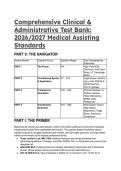
Comprehensive Clinical &
Administrative Test Bank:
2026/2027 Medical Assisting
Standards
PART 0: THE NAVIGATOR
Section Marker Cognitive Focus Question Range Core Competencies
Addressed
PART I The Primer N/A High-Yield 2026
Directives, Hard Deck
Rules, UT Cambridge
Ethics
PART II Foundational Syntax Q1 – Q15 Legal Scope (Jenifer's
& Application Law), AHA 2026 BLS,
OSHA HazCom,
ICD-10 Updates
PART II Professional Q16 – Q40 Clinical Workflow, AI
Simulation Scribes, Remote
Patient Monitoring
(RPM), EKG,
Phlebotomy
PART II Grandmaster Q41 – Q66 Multi-System Failure,
Synthesis High-Stakes
Malpractice, Triage
Ethics, Advanced
Compliance
PART I: THE PRIMER
Mastering the clinical and administrative matrix of the 2026 healthcare environment separates
indispensable assets from replaceable technicians. This gauntlet forges the precise clinical
intuition required to navigate advanced care models, zero-fail safety protocols, and high-stakes
liability environments at the highest professional levels.
● Texas Jenifer's Law (HB 3749): Medical Assistants are strictly prohibited from
administering elective IV therapy; only RNs, APRNs, PAs, or Physicians may execute this
delegated act.
● AHA 2026 BLS: Choking protocols mandate alternating 5 back blows with 5 abdominal
thrusts. Opioid arrests require immediate CPR concurrent with Naloxone.
● ICD-10 2026 E11.A: Type 2 Diabetes is billable as "in remission" (A1c <6.5% for 3+
, months, zero medications).
● Shadow AI & HIPAA: Entering PHI into unauthorized AI tools without a Business
Associate Agreement (BAA) is a severe compliance violation.
● CMS 2026 RPM: CPT 99445 bills 2-15 days of data; CPT 99470 bills 10-19 minutes of
management.
PART II: THE ELITE TEST BANK
Q1: A wellness clinic delegates the administration of a requested elective vitamin B complex IV
infusion to an experienced Medical Assistant. Under the 2026 provisions of Jenifer’s Law (HB
3749), what is the MOST APPROPRIATE assessment of this delegation? A) It is permitted
provided a physician is physically present in the facility. B) It is prohibited; only RNs, APRNs,
PAs, or Physicians may administer elective IV therapy. C) It is permitted if the Medical Assistant
has completed a specialized 10-hour IV certification course. D) It is prohibited unless a
prescriptive authority agreement is signed directly by the Medical Assistant.
● The Answer: B (It is prohibited; only RNs, APRNs, PAs, or Physicians may administer
elective IV therapy.)
● Distractor Analysis:
○ A is incorrect: While supervision is required for approved delegates, MAs are
explicitly excluded from administering elective IVs regardless of physician proximity.
○ C is incorrect: No amount of specialized certification overrides state law prohibiting
unlicensed personnel (MAs) from this scope.
○ D is incorrect: MAs cannot hold prescriptive authority agreements; these are
exclusively for PAs and APRNs.
The Mentor's Analysis: Scope of practice is an absolute hard deck. Jenifer’s Law reclassified
elective IV therapy following catastrophic outcomes from unsupervised clinics, placing it strictly
in the hands of licensed nurses and advanced practitioners.
Authorized Delegates Prohibited Personnel
Registered Nurses (RNs) Medical Assistants (MAs)
Physician Assistants (PAs) Licensed Vocational Nurses (LVNs)
Advanced Practice RNs (APRNs) Paramedics & Aestheticians
Professional Intuition: Never allow an employer's operational convenience to pressure you
into a felony-level scope violation.
Q2: You are managing the clinical floor when a 45-year-old patient suddenly begins grasping
their throat, unable to speak or cough. Applying the IMMEDIATE AHA 2025/2026 BLS
guidelines, what is your first sequence of actions? A) Administer 5 abdominal thrusts followed
by a visual airway sweep. B) Initiate continuous chest compressions at 100-120 beats per
minute. C) Alternate 5 back blows with 5 abdominal thrusts until the object is cleared or the
patient becomes unresponsive. D) Administer 5 back slaps followed by 5 chest thrusts.
● The Answer: C (Alternate 5 back blows with 5 abdominal thrusts until the object is
cleared or the patient becomes unresponsive.)
● Distractor Analysis:
○ A is incorrect: This represents outdated legacy guidance; the 2026 standard
integrates back blows for adults and children.
○ B is incorrect: Compressions begin only if the patient becomes completely
unresponsive and cardiac arrest protocols are triggered.
○ D is incorrect: Back slaps and chest thrusts are the specific protocol for infants, not
, adults.
The Mentor's Analysis: The AHA updated the choking protocol to maximize mechanical
pressure variations to dislodge obstructions. Alternating back blows with abdominal thrusts
creates distinct types of intrathoracic pressure spikes. Professional Intuition: Do not rely on
old muscle memory; integrate the dual-action clearing protocol immediately.
Q3: A patient is found unresponsive in the clinic restroom with shallow, agonal breathing,
pinpoint pupils, and a pulse of 40 bpm. Following the 2026 AHA guidelines for opioid-related
emergencies, what is your FIRST coordinated action? A) Administer a sternal rub and
immediately check a blood glucose level. B) Initiate high-quality CPR concurrent with the
administration of Naloxone. C) Provide rescue breathing at 1 breath every 6 seconds and wait
for EMS. D) Administer intramuscular Epinephrine to reverse the respiratory depression.
● The Answer: B (Initiate high-quality CPR concurrent with the administration of Naloxone.)
● Distractor Analysis:
○ A is incorrect: While hypoglycemia can cause unresponsiveness, the clinical triad
(pinpoint pupils, depressed respiration) demands opioid protocols.
○ C is incorrect: While rescue breathing is critical, the 2026 AHA guidelines
emphasize rapid naloxone integration concurrently with resuscitation efforts.
○ D is incorrect: Epinephrine is for anaphylaxis or pulseless arrest rhythms, not
primary opioid reversal.
The Mentor's Analysis: Opioid arrest destroys the respiratory drive, rapidly leading to cardiac
hypoxia. You cannot wait for an antagonist to circulate via a failing heart. Professional
Intuition: Compressions move the Naloxone. Administer the antagonist, but pump the chest to
deliver it to the brain.
Q4: A patient returns for a follow-up. Their HbA1c has been 5.6% for the past 14 months, and
they have not taken any antidiabetic medications for a year, managing their condition entirely
through diet. According to the 2026 ICD-10-CM updates, which code BEST captures this clinical
picture? A) E11.9 (Type 2 diabetes mellitus without complications) B) E11.A (Type 2 diabetes
mellitus without complications in remission) C) Z79.4 (Long term (current) use of insulin) D)
R73.09 (Other abnormal glucose)
● The Answer: B (E11.A (Type 2 diabetes mellitus without complications in remission))
● Distractor Analysis:
○ A is incorrect: This fails to capture the newly introduced clinical specificity of a
patient who has achieved glycemic control without pharmacological intervention.
○ C is incorrect: The patient is explicitly documented as being off all medications.
○ D is incorrect: The patient has a historic diagnosis of Type 2 Diabetes, which
requires the E11 series, not a generic abnormal finding code.
The Mentor's Analysis: The introduction of E11.A in 2026 acknowledges that diabetes can
achieve remission through aggressive lifestyle modification. However, "remission" is not a
"cure," and the semantic distinction matters for tracking relapse risk.
Remission Criteria (E11.A) Requirement
HbA1c Level < 6.5%
Duration At least 6 months
Medications ZERO antidiabetic meds
Professional Intuition: Always look for the absence of pharmacologic therapy and sustained
A1c <6.5% when applying this code.
Q5: The clinical team wants to bill for a patient's Remote Patient Monitoring (RPM) data. The
patient transmitted data for exactly 12 days in the past 30-day period. Under 2026 CMS billing
Administrative Test Bank:
2026/2027 Medical Assisting
Standards
PART 0: THE NAVIGATOR
Section Marker Cognitive Focus Question Range Core Competencies
Addressed
PART I The Primer N/A High-Yield 2026
Directives, Hard Deck
Rules, UT Cambridge
Ethics
PART II Foundational Syntax Q1 – Q15 Legal Scope (Jenifer's
& Application Law), AHA 2026 BLS,
OSHA HazCom,
ICD-10 Updates
PART II Professional Q16 – Q40 Clinical Workflow, AI
Simulation Scribes, Remote
Patient Monitoring
(RPM), EKG,
Phlebotomy
PART II Grandmaster Q41 – Q66 Multi-System Failure,
Synthesis High-Stakes
Malpractice, Triage
Ethics, Advanced
Compliance
PART I: THE PRIMER
Mastering the clinical and administrative matrix of the 2026 healthcare environment separates
indispensable assets from replaceable technicians. This gauntlet forges the precise clinical
intuition required to navigate advanced care models, zero-fail safety protocols, and high-stakes
liability environments at the highest professional levels.
● Texas Jenifer's Law (HB 3749): Medical Assistants are strictly prohibited from
administering elective IV therapy; only RNs, APRNs, PAs, or Physicians may execute this
delegated act.
● AHA 2026 BLS: Choking protocols mandate alternating 5 back blows with 5 abdominal
thrusts. Opioid arrests require immediate CPR concurrent with Naloxone.
● ICD-10 2026 E11.A: Type 2 Diabetes is billable as "in remission" (A1c <6.5% for 3+
, months, zero medications).
● Shadow AI & HIPAA: Entering PHI into unauthorized AI tools without a Business
Associate Agreement (BAA) is a severe compliance violation.
● CMS 2026 RPM: CPT 99445 bills 2-15 days of data; CPT 99470 bills 10-19 minutes of
management.
PART II: THE ELITE TEST BANK
Q1: A wellness clinic delegates the administration of a requested elective vitamin B complex IV
infusion to an experienced Medical Assistant. Under the 2026 provisions of Jenifer’s Law (HB
3749), what is the MOST APPROPRIATE assessment of this delegation? A) It is permitted
provided a physician is physically present in the facility. B) It is prohibited; only RNs, APRNs,
PAs, or Physicians may administer elective IV therapy. C) It is permitted if the Medical Assistant
has completed a specialized 10-hour IV certification course. D) It is prohibited unless a
prescriptive authority agreement is signed directly by the Medical Assistant.
● The Answer: B (It is prohibited; only RNs, APRNs, PAs, or Physicians may administer
elective IV therapy.)
● Distractor Analysis:
○ A is incorrect: While supervision is required for approved delegates, MAs are
explicitly excluded from administering elective IVs regardless of physician proximity.
○ C is incorrect: No amount of specialized certification overrides state law prohibiting
unlicensed personnel (MAs) from this scope.
○ D is incorrect: MAs cannot hold prescriptive authority agreements; these are
exclusively for PAs and APRNs.
The Mentor's Analysis: Scope of practice is an absolute hard deck. Jenifer’s Law reclassified
elective IV therapy following catastrophic outcomes from unsupervised clinics, placing it strictly
in the hands of licensed nurses and advanced practitioners.
Authorized Delegates Prohibited Personnel
Registered Nurses (RNs) Medical Assistants (MAs)
Physician Assistants (PAs) Licensed Vocational Nurses (LVNs)
Advanced Practice RNs (APRNs) Paramedics & Aestheticians
Professional Intuition: Never allow an employer's operational convenience to pressure you
into a felony-level scope violation.
Q2: You are managing the clinical floor when a 45-year-old patient suddenly begins grasping
their throat, unable to speak or cough. Applying the IMMEDIATE AHA 2025/2026 BLS
guidelines, what is your first sequence of actions? A) Administer 5 abdominal thrusts followed
by a visual airway sweep. B) Initiate continuous chest compressions at 100-120 beats per
minute. C) Alternate 5 back blows with 5 abdominal thrusts until the object is cleared or the
patient becomes unresponsive. D) Administer 5 back slaps followed by 5 chest thrusts.
● The Answer: C (Alternate 5 back blows with 5 abdominal thrusts until the object is
cleared or the patient becomes unresponsive.)
● Distractor Analysis:
○ A is incorrect: This represents outdated legacy guidance; the 2026 standard
integrates back blows for adults and children.
○ B is incorrect: Compressions begin only if the patient becomes completely
unresponsive and cardiac arrest protocols are triggered.
○ D is incorrect: Back slaps and chest thrusts are the specific protocol for infants, not
, adults.
The Mentor's Analysis: The AHA updated the choking protocol to maximize mechanical
pressure variations to dislodge obstructions. Alternating back blows with abdominal thrusts
creates distinct types of intrathoracic pressure spikes. Professional Intuition: Do not rely on
old muscle memory; integrate the dual-action clearing protocol immediately.
Q3: A patient is found unresponsive in the clinic restroom with shallow, agonal breathing,
pinpoint pupils, and a pulse of 40 bpm. Following the 2026 AHA guidelines for opioid-related
emergencies, what is your FIRST coordinated action? A) Administer a sternal rub and
immediately check a blood glucose level. B) Initiate high-quality CPR concurrent with the
administration of Naloxone. C) Provide rescue breathing at 1 breath every 6 seconds and wait
for EMS. D) Administer intramuscular Epinephrine to reverse the respiratory depression.
● The Answer: B (Initiate high-quality CPR concurrent with the administration of Naloxone.)
● Distractor Analysis:
○ A is incorrect: While hypoglycemia can cause unresponsiveness, the clinical triad
(pinpoint pupils, depressed respiration) demands opioid protocols.
○ C is incorrect: While rescue breathing is critical, the 2026 AHA guidelines
emphasize rapid naloxone integration concurrently with resuscitation efforts.
○ D is incorrect: Epinephrine is for anaphylaxis or pulseless arrest rhythms, not
primary opioid reversal.
The Mentor's Analysis: Opioid arrest destroys the respiratory drive, rapidly leading to cardiac
hypoxia. You cannot wait for an antagonist to circulate via a failing heart. Professional
Intuition: Compressions move the Naloxone. Administer the antagonist, but pump the chest to
deliver it to the brain.
Q4: A patient returns for a follow-up. Their HbA1c has been 5.6% for the past 14 months, and
they have not taken any antidiabetic medications for a year, managing their condition entirely
through diet. According to the 2026 ICD-10-CM updates, which code BEST captures this clinical
picture? A) E11.9 (Type 2 diabetes mellitus without complications) B) E11.A (Type 2 diabetes
mellitus without complications in remission) C) Z79.4 (Long term (current) use of insulin) D)
R73.09 (Other abnormal glucose)
● The Answer: B (E11.A (Type 2 diabetes mellitus without complications in remission))
● Distractor Analysis:
○ A is incorrect: This fails to capture the newly introduced clinical specificity of a
patient who has achieved glycemic control without pharmacological intervention.
○ C is incorrect: The patient is explicitly documented as being off all medications.
○ D is incorrect: The patient has a historic diagnosis of Type 2 Diabetes, which
requires the E11 series, not a generic abnormal finding code.
The Mentor's Analysis: The introduction of E11.A in 2026 acknowledges that diabetes can
achieve remission through aggressive lifestyle modification. However, "remission" is not a
"cure," and the semantic distinction matters for tracking relapse risk.
Remission Criteria (E11.A) Requirement
HbA1c Level < 6.5%
Duration At least 6 months
Medications ZERO antidiabetic meds
Professional Intuition: Always look for the absence of pharmacologic therapy and sustained
A1c <6.5% when applying this code.
Q5: The clinical team wants to bill for a patient's Remote Patient Monitoring (RPM) data. The
patient transmitted data for exactly 12 days in the past 30-day period. Under 2026 CMS billing