

Name: Ryan Villani
Date: 02/15/2017 Student Exploration: Calorimetry Lab Vocabulary
:
calorie, calori meter, joule, specific heat capacity Prior Knowledge Quest ions
(Do these BEFORE using the Gizmo
.) 1.
The Latin word
calor
means “heat,” and
meter
comes from the Greek word meaning “to measure.” What do yo u think a
calorimeter
does?
Measures heat. 2.
Where have you hear d the word
calorie
before? What do you think a calorie is?
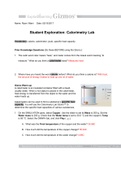
With food, the amount of energy it takes to heat up one ml of water. Gizmo Warm-up A calorimeter is an insula ted container filled with a liquid, usually water. When a ho t object is placed in the calorimeter, heat energy is transferred from the object to the water and the water heats up. Calorimeters can be used to find a substance’s
specific heat capacity
. You will use the
Calorimetry Lab
Gizmo™ to determine the specific hea t capacities of various substances. 1.
On the SIMULATION pane, select
Copper
. Use the slider to set its
Mass
to 200 g. Set the Water mass
to 200 g. Check that the
Water temp
is set to 30.0 °C and the copper’s
Temp is 90 °C. Select the G RAPH tab, and click
Play
(
). A.
What was the
Final temperature
of the copper and the water?
34.96C B.
How much did the temperature of the copper change?
55.04C C.
How much did the temperature of the water change?
4.96C 2.
Specific heat capacity can be described as a substance’s resistance to temperature changes. Which subst ance has a greater specific heat capacity, copper or water? Explain. Water, the temperature of the water changed the least amount, therefore its resistance is greater.
Date: 02/15/2017 Student Exploration: Calorimetry Lab Vocabulary
:
calorie, calori meter, joule, specific heat capacity Prior Knowledge Quest ions
(Do these BEFORE using the Gizmo
.) 1.
The Latin word
calor
means “heat,” and
meter
comes from the Greek word meaning “to measure.” What do yo u think a
calorimeter
does?
Measures heat. 2.
Where have you hear d the word
calorie
before? What do you think a calorie is?
With food, the amount of energy it takes to heat up one ml of water. Gizmo Warm-up A calorimeter is an insula ted container filled with a liquid, usually water. When a ho t object is placed in the calorimeter, heat energy is transferred from the object to the water and the water heats up. Calorimeters can be used to find a substance’s
specific heat capacity
. You will use the
Calorimetry Lab
Gizmo™ to determine the specific hea t capacities of various substances. 1.
On the SIMULATION pane, select
Copper
. Use the slider to set its
Mass
to 200 g. Set the Water mass
to 200 g. Check that the
Water temp
is set to 30.0 °C and the copper’s
Temp is 90 °C. Select the G RAPH tab, and click
Play
(
). A.
What was the
Final temperature
of the copper and the water?
34.96C B.
How much did the temperature of the copper change?
55.04C C.
How much did the temperature of the water change?
4.96C 2.
Specific heat capacity can be described as a substance’s resistance to temperature changes. Which subst ance has a greater specific heat capacity, copper or water? Explain. Water, the temperature of the water changed the least amount, therefore its resistance is greater.


