

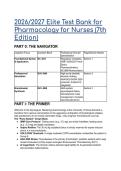
2026/2027 Elite Test Bank for
Pharmacology for Nurses (7th
Edition)
PART 0: THE NAVIGATOR
Cognitive Focus Question Block Professional Domain Page/Section Marker
Specialization
Foundational Syntax Q1–Q15 Regulatory mandates, Section 1
& Application ISMP 2026/2027 Hard
Decks,
Pharmacokinetics,
NCJMM Nomenclature
Professional Q16–Q40 High-acuity bedside Section 2
Simulation decision-making,
AHA/GOLD/ADA 2026
protocols, Ambient AI
integration
Grandmaster Q41–Q66 Multi-system Section 3
Synthesis physiological failure,
Hemodynamic crisis
management, Complex
pharmacodynamics
PART I: THE PRIMER
Welcome to the big leagues. Mastering pharmacology at the University of Texas demands a
transition from passive memorization to the aggressive anticipation of physiological collapse;
elite practitioners do not merely administer drugs—they engineer hemodynamic survival.
The "Panic Button" Cheat Sheet:
● ISMP Zero Protocol: Trailing zeros (e.g., 5.0 mg) are strictly forbidden; leading zeros
(e.g., 0.5 mg) are legally mandatory.
● Sepsis Redline: The 30 mL/kg crystalloid bolus is strictly reserved for sepsis-induced
shock; it is not prophylactic.
● GOLD 2026 Threshold: A single moderate COPD exacerbation reclassifies the patient to
Group E.
● AHA 2026 Stroke: Tenecteplase is the primary thrombolytic; pediatric patients with Large
Vessel Occlusions (LVOs) require emergent Endovascular Thrombectomy (EVT).
● AI Legal Deck: The clinician retains absolute legal liability for AI-generated ambient
documentation hallucinations.
,PART II: THE ELITE TEST BANK
Section 1: Foundational Syntax & Application
Q1: A provider enters an electronic medication order for "Morphine.50 mg IV push."
According to the 2026/2027 Institute for Safe Medication Practices (ISMP) standards,
what is the immediate required clinical action? A) Administer the medication as written to
prevent delays in pain management. B) Modify the electronic medication administration record
to include a leading zero and administer 0.5 mg. C) Refuse the order and mandate the provider
rewrite the prescription to eliminate the trailing decimal format and include a leading zero. D)
Convert the dosage to 500 mcg and administer it orally to bypass the intravenous risk profile.
● The Answer: C (Refuse the order and mandate the provider rewrite the prescription to
eliminate the trailing decimal format and include a leading zero).
● Distractor Analysis: Option A guarantees a tenfold overdose if the naked decimal is
misread as 50 mg. Option B violates the legal scope of practice; nurses cannot alter
provider prescriptions. Option D constitutes practicing medicine without a license.
● The Mentor's Analysis: The ISMP strictly forbids naked decimals (e.g.,.50) and
mandates leading zeros (e.g., 0.5) to prevent catastrophic tenfold overdosing errors.
Professional intuition dictates that an improperly formatted order is a legally invalid order.
Q2: During an admission assessment, a patient states they weigh "about 160 pounds."
What is the fundamental 2026/2027 ISMP standard for weight documentation before
calculating a weight-based high-alert medication? A) Document the stated weight and
mathematically convert it to 72.7 kg for immediate dosing. B) Weigh the patient using a
metric-only scale and document the exact kilogram value in the medical record. C) Estimate the
weight visually and document it in both pounds and kilograms to provide clinical context. D)
Utilize the historical weight from the patient's previous admission two months prior.
● The Answer: B (Weigh the patient using a metric-only scale and document the exact
kilogram value in the medical record).
● Distractor Analysis: Options A, C, and D directly violate ISMP standards. Relying on
stated, estimated, or historical weights leads to profound dosing errors, particularly in
narrow-therapeutic-index drugs.
● The Mentor's Analysis: The 2026 ISMP Best Practices mandate that all patient weights
be physically measured using metric-only scales upon admission.
Acceptable Weight Metrics (2026 ISMP) Unacceptable Weight Metrics
Direct measurement via metric scale (kg) Stated weight by patient/family
Electronic transfer from metric bed scale Historical weight from prior visits
Q3: The National Council of State Boards of Nursing (NCSBN) Clinical Judgment
Measurement Model (CJMM) governs 2026 clinical taxonomy. Which terminology
officially replaces the archaic NANDA-I "Nursing Diagnosis" framework in high-level
clinical planning? A) Medical Diagnoses B) Clinical Problems C) Pathophysiologic Indicators
D) Collaborative Interventions
● The Answer: B (Clinical Problems).
● Distractor Analysis: Option A remains the strict domain of licensed independent
practitioners. Options C and D are components of care, not the overarching diagnostic
taxonomy.
● The Mentor's Analysis: The transition to the CJMM replaces isolated, proprietary
, nursing language with interprofessional "Clinical Problems" to ensure seamless
communication across the healthcare continuum.
Q4: An ambient AI clinical scribe summarizes a multidisciplinary rounding session,
documenting that a patient "denies chest pain," when the patient actually reported
intermittent angina. What is the clinician's liability regarding this AI hallucination? A) The
software vendor assumes liability due to algorithmic error. B) The hospital informatics
department assumes liability for software deployment. C) The clinician retains absolute legal
liability and must visually verify and edit all AI outputs before signing. D) Liability is waived under
2026 safe-harbor AI documentation laws.
● The Answer: C (The clinician retains absolute legal liability and must visually verify and
edit all AI outputs before signing).
● Distractor Analysis: Options A, B, and D represent dangerous misunderstandings of
2026 medical-legal standards. Safe-harbor laws do not protect against unverified
algorithmic errors.
● The Mentor's Analysis: AI scribes are tools, not autonomous practitioners. Clinicians are
legally responsible for every word in the chart attached to their signature.
"Human-in-the-loop" verification is the ultimate firewall against lethal documentation
omissions.
Q5: A provider orders an intravenous vinca alkaloid (e.g., vincristine) for an oncology
patient. According to targeted ISMP safety practices, how must this medication be
prepared and administered? A) Diluted in a 5 mL syringe for rapid IV push. B) Diluted in an IV
minibag (e.g., 50 mL for adults) for intravenous infusion only. C) Administered intrathecally via
lumbar puncture. D) Drawn up in a concentrated syringe to minimize fluid volume.
● The Answer: B (Diluted in an IV minibag (e.g., 50 mL for adults) for intravenous infusion
only).
● Distractor Analysis: Option C is uniformly fatal. Options A and D facilitate the
mechanical possibility of inadvertent intrathecal administration.
● The Mentor's Analysis: Vinca alkaloids cause fatal neurological destruction if given
intrathecally. ISMP mandates preparation in a minibag because it physically prevents the
medication from being mistakenly attached to a spinal needle.
Q6: A patient prescribed oral daily methotrexate for severe rheumatoid arthritis presents
for discharge. What systemic safety feature must be activated in the electronic health
record (EHR) before this order is processed? A) A hard stop requiring verification of an
appropriate oncologic indication. B) An automatic conversion to an intravenous route. C) A
mandatory pharmacy consult for dietary restrictions. D) An alert to increase folic acid to 100 mg
daily.
● The Answer: A (A hard stop requiring verification of an appropriate oncologic indication).
● Distractor Analysis: Methotrexate is dosed weekly for autoimmune conditions like
rheumatoid arthritis, and daily for certain cancers. Option A triggers the necessary review
to prevent fatal marrow suppression.
● The Mentor's Analysis: Inadvertent daily dosing of methotrexate for non-oncologic
indications is a lethal error. ISMP requires a hard-stop verification to force the clinician to
confirm the diagnosis matches the aggressive daily frequency.
Q7: Pharmacokinetics relies on ADME principles. Which physiologic change in the
geriatric population most directly necessitates downward dose adjustments for
hepatically metabolized drugs? A) Increased gastric motility and rapid transit times. B)
Decreased first-pass effect and reduced hepatic blood flow. C) Increased glomerular filtration
rate. D) Decreased total body fat percentage.
Pharmacology for Nurses (7th
Edition)
PART 0: THE NAVIGATOR
Cognitive Focus Question Block Professional Domain Page/Section Marker
Specialization
Foundational Syntax Q1–Q15 Regulatory mandates, Section 1
& Application ISMP 2026/2027 Hard
Decks,
Pharmacokinetics,
NCJMM Nomenclature
Professional Q16–Q40 High-acuity bedside Section 2
Simulation decision-making,
AHA/GOLD/ADA 2026
protocols, Ambient AI
integration
Grandmaster Q41–Q66 Multi-system Section 3
Synthesis physiological failure,
Hemodynamic crisis
management, Complex
pharmacodynamics
PART I: THE PRIMER
Welcome to the big leagues. Mastering pharmacology at the University of Texas demands a
transition from passive memorization to the aggressive anticipation of physiological collapse;
elite practitioners do not merely administer drugs—they engineer hemodynamic survival.
The "Panic Button" Cheat Sheet:
● ISMP Zero Protocol: Trailing zeros (e.g., 5.0 mg) are strictly forbidden; leading zeros
(e.g., 0.5 mg) are legally mandatory.
● Sepsis Redline: The 30 mL/kg crystalloid bolus is strictly reserved for sepsis-induced
shock; it is not prophylactic.
● GOLD 2026 Threshold: A single moderate COPD exacerbation reclassifies the patient to
Group E.
● AHA 2026 Stroke: Tenecteplase is the primary thrombolytic; pediatric patients with Large
Vessel Occlusions (LVOs) require emergent Endovascular Thrombectomy (EVT).
● AI Legal Deck: The clinician retains absolute legal liability for AI-generated ambient
documentation hallucinations.
,PART II: THE ELITE TEST BANK
Section 1: Foundational Syntax & Application
Q1: A provider enters an electronic medication order for "Morphine.50 mg IV push."
According to the 2026/2027 Institute for Safe Medication Practices (ISMP) standards,
what is the immediate required clinical action? A) Administer the medication as written to
prevent delays in pain management. B) Modify the electronic medication administration record
to include a leading zero and administer 0.5 mg. C) Refuse the order and mandate the provider
rewrite the prescription to eliminate the trailing decimal format and include a leading zero. D)
Convert the dosage to 500 mcg and administer it orally to bypass the intravenous risk profile.
● The Answer: C (Refuse the order and mandate the provider rewrite the prescription to
eliminate the trailing decimal format and include a leading zero).
● Distractor Analysis: Option A guarantees a tenfold overdose if the naked decimal is
misread as 50 mg. Option B violates the legal scope of practice; nurses cannot alter
provider prescriptions. Option D constitutes practicing medicine without a license.
● The Mentor's Analysis: The ISMP strictly forbids naked decimals (e.g.,.50) and
mandates leading zeros (e.g., 0.5) to prevent catastrophic tenfold overdosing errors.
Professional intuition dictates that an improperly formatted order is a legally invalid order.
Q2: During an admission assessment, a patient states they weigh "about 160 pounds."
What is the fundamental 2026/2027 ISMP standard for weight documentation before
calculating a weight-based high-alert medication? A) Document the stated weight and
mathematically convert it to 72.7 kg for immediate dosing. B) Weigh the patient using a
metric-only scale and document the exact kilogram value in the medical record. C) Estimate the
weight visually and document it in both pounds and kilograms to provide clinical context. D)
Utilize the historical weight from the patient's previous admission two months prior.
● The Answer: B (Weigh the patient using a metric-only scale and document the exact
kilogram value in the medical record).
● Distractor Analysis: Options A, C, and D directly violate ISMP standards. Relying on
stated, estimated, or historical weights leads to profound dosing errors, particularly in
narrow-therapeutic-index drugs.
● The Mentor's Analysis: The 2026 ISMP Best Practices mandate that all patient weights
be physically measured using metric-only scales upon admission.
Acceptable Weight Metrics (2026 ISMP) Unacceptable Weight Metrics
Direct measurement via metric scale (kg) Stated weight by patient/family
Electronic transfer from metric bed scale Historical weight from prior visits
Q3: The National Council of State Boards of Nursing (NCSBN) Clinical Judgment
Measurement Model (CJMM) governs 2026 clinical taxonomy. Which terminology
officially replaces the archaic NANDA-I "Nursing Diagnosis" framework in high-level
clinical planning? A) Medical Diagnoses B) Clinical Problems C) Pathophysiologic Indicators
D) Collaborative Interventions
● The Answer: B (Clinical Problems).
● Distractor Analysis: Option A remains the strict domain of licensed independent
practitioners. Options C and D are components of care, not the overarching diagnostic
taxonomy.
● The Mentor's Analysis: The transition to the CJMM replaces isolated, proprietary
, nursing language with interprofessional "Clinical Problems" to ensure seamless
communication across the healthcare continuum.
Q4: An ambient AI clinical scribe summarizes a multidisciplinary rounding session,
documenting that a patient "denies chest pain," when the patient actually reported
intermittent angina. What is the clinician's liability regarding this AI hallucination? A) The
software vendor assumes liability due to algorithmic error. B) The hospital informatics
department assumes liability for software deployment. C) The clinician retains absolute legal
liability and must visually verify and edit all AI outputs before signing. D) Liability is waived under
2026 safe-harbor AI documentation laws.
● The Answer: C (The clinician retains absolute legal liability and must visually verify and
edit all AI outputs before signing).
● Distractor Analysis: Options A, B, and D represent dangerous misunderstandings of
2026 medical-legal standards. Safe-harbor laws do not protect against unverified
algorithmic errors.
● The Mentor's Analysis: AI scribes are tools, not autonomous practitioners. Clinicians are
legally responsible for every word in the chart attached to their signature.
"Human-in-the-loop" verification is the ultimate firewall against lethal documentation
omissions.
Q5: A provider orders an intravenous vinca alkaloid (e.g., vincristine) for an oncology
patient. According to targeted ISMP safety practices, how must this medication be
prepared and administered? A) Diluted in a 5 mL syringe for rapid IV push. B) Diluted in an IV
minibag (e.g., 50 mL for adults) for intravenous infusion only. C) Administered intrathecally via
lumbar puncture. D) Drawn up in a concentrated syringe to minimize fluid volume.
● The Answer: B (Diluted in an IV minibag (e.g., 50 mL for adults) for intravenous infusion
only).
● Distractor Analysis: Option C is uniformly fatal. Options A and D facilitate the
mechanical possibility of inadvertent intrathecal administration.
● The Mentor's Analysis: Vinca alkaloids cause fatal neurological destruction if given
intrathecally. ISMP mandates preparation in a minibag because it physically prevents the
medication from being mistakenly attached to a spinal needle.
Q6: A patient prescribed oral daily methotrexate for severe rheumatoid arthritis presents
for discharge. What systemic safety feature must be activated in the electronic health
record (EHR) before this order is processed? A) A hard stop requiring verification of an
appropriate oncologic indication. B) An automatic conversion to an intravenous route. C) A
mandatory pharmacy consult for dietary restrictions. D) An alert to increase folic acid to 100 mg
daily.
● The Answer: A (A hard stop requiring verification of an appropriate oncologic indication).
● Distractor Analysis: Methotrexate is dosed weekly for autoimmune conditions like
rheumatoid arthritis, and daily for certain cancers. Option A triggers the necessary review
to prevent fatal marrow suppression.
● The Mentor's Analysis: Inadvertent daily dosing of methotrexate for non-oncologic
indications is a lethal error. ISMP requires a hard-stop verification to force the clinician to
confirm the diagnosis matches the aggressive daily frequency.
Q7: Pharmacokinetics relies on ADME principles. Which physiologic change in the
geriatric population most directly necessitates downward dose adjustments for
hepatically metabolized drugs? A) Increased gastric motility and rapid transit times. B)
Decreased first-pass effect and reduced hepatic blood flow. C) Increased glomerular filtration
rate. D) Decreased total body fat percentage.

