
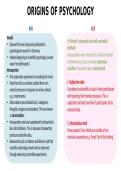
ORIGINS OF PSYCHOLOGY
Wundt
(+) Wundt’s systematic and well-controlled
• Opened first ever lab purely dedicated to
psychological research in Germany
methods
• Marked beginning of scientific psychology (moved Introspections were recorded in a well-controlled
away from philosophy) environment of a lab, removing extraneous
Introspection variables. Procedures were standardized.
• First systematic experiment on studying the mind.
• Wundt and his co-workers studied their own (-) Subjective data
mental processes in response to various stimuli Considered unscientific as data is from participants
e.g. a metronome. self-reporting their mental processes. This is
• Observations were divided into 3 categories: subjective and may have bias if participants fail to
thoughts, images and sensations. This was known reveal all data.
as structuralism.
• Introspection was later questioned by behaviorists (-) Unconscious mind
like John B Watson. This is because introspection Many aspects if our minds are outside of our
produces subjective data. conscious awareness e.g. Freud ‘tip of the iceburg’
• Behaviorists such as Watson and Skinner said that
scientific psychology should only be observed
through observing controlled experiments.
, BEHAVIOURIST APPROACH
Classical conditioning
• Learning through association. (+) Research has scientific validity
• Pavlov showed how dogs could be conditioned to Research was objective using observable behavior
salivate to the sound of a bell. They associated within highly controlled lab settings = helped
the sound of the bell with getting food which established psychology as a science.
caused a salivation response every time they rang
the bell. (+) Real-world application
Principles have been applied to real-world
Operant conditioning
behaviors and problems. Used in the development
• Maintenance through consequences
• Positive reinforcement – involves receiving a
of token economy systems used in institutions,
reward for performing a behavior. psychiatric wards and prisons.
• Negative reinforcement – when an animal avoids
something unpleasant. (-) Strong determinism view
• Punishment is an unpleasant consequence of Suggests all behavior is caused by past conditioning
behavior. experiences (reinforcement history). This ignores
• Vicarious reinforcement - any possible influence of free will on our behavior.
• Skinner’s box: Rat placed in a box. Every time the
rat pushed the lever, food was dispensed. The rats
continued to do so. This shows that positive
reinforcement encourages repitition.
Wundt
(+) Wundt’s systematic and well-controlled
• Opened first ever lab purely dedicated to
psychological research in Germany
methods
• Marked beginning of scientific psychology (moved Introspections were recorded in a well-controlled
away from philosophy) environment of a lab, removing extraneous
Introspection variables. Procedures were standardized.
• First systematic experiment on studying the mind.
• Wundt and his co-workers studied their own (-) Subjective data
mental processes in response to various stimuli Considered unscientific as data is from participants
e.g. a metronome. self-reporting their mental processes. This is
• Observations were divided into 3 categories: subjective and may have bias if participants fail to
thoughts, images and sensations. This was known reveal all data.
as structuralism.
• Introspection was later questioned by behaviorists (-) Unconscious mind
like John B Watson. This is because introspection Many aspects if our minds are outside of our
produces subjective data. conscious awareness e.g. Freud ‘tip of the iceburg’
• Behaviorists such as Watson and Skinner said that
scientific psychology should only be observed
through observing controlled experiments.
, BEHAVIOURIST APPROACH
Classical conditioning
• Learning through association. (+) Research has scientific validity
• Pavlov showed how dogs could be conditioned to Research was objective using observable behavior
salivate to the sound of a bell. They associated within highly controlled lab settings = helped
the sound of the bell with getting food which established psychology as a science.
caused a salivation response every time they rang
the bell. (+) Real-world application
Principles have been applied to real-world
Operant conditioning
behaviors and problems. Used in the development
• Maintenance through consequences
• Positive reinforcement – involves receiving a
of token economy systems used in institutions,
reward for performing a behavior. psychiatric wards and prisons.
• Negative reinforcement – when an animal avoids
something unpleasant. (-) Strong determinism view
• Punishment is an unpleasant consequence of Suggests all behavior is caused by past conditioning
behavior. experiences (reinforcement history). This ignores
• Vicarious reinforcement - any possible influence of free will on our behavior.
• Skinner’s box: Rat placed in a box. Every time the
rat pushed the lever, food was dispensed. The rats
continued to do so. This shows that positive
reinforcement encourages repitition.


