Student number:
BTE2601
ASSIGNMENT 02
UNIQUE NO.: 629125
YEAR MODULE
DUE DATE: / 2020
, QUESTION 01:
1.1 Critical Theory in South Africa
a. Unlike many other educational theories, the Critical Education Theory is not just one
particular idea, but consists of a culmination of views which motivates a person’s
actions in the classroom.
This means that, as a teacher, your teaching method in the classroom will be affected
by your own personal views and convictions on education, especially with regards to
the teaching method, the discipline and other educational theories and much more.
The fact that this theory is based on a set of your own personal views and ideals, it
serves as a good “blank canvas” that acts as the basis for where different approaches
can be applied as to your own discretion.
b. Critical Education Theory allows teachers to have the ability to use different
approaches in the classroom as a type of “trial-and-error”, in order to discern which
would be the optimal approach for the teachers, as well as the learners.
Through this process a person can develop your own optimal teaching style that is best
suited to your environment and is conductive to an optimal teaching and learning
environment.
This also serves to encourage the development of educators who are able to easily
adapt to the needs of their environment and their learners.
This is especially useful and necessary in a time such as now, where normal life has
been situated into an uncertainty. In 2020 with the COVID-19 situation, a teacher must
especially be able to improvise and adapt constantly, in order to accommodate the
lifestyle where the world is dealing with an international health-crisis.
In a South-African context, it’s invaluable to have educators who are able to adapt to
certain circumstances and situations in order to ensure that the learners still receive
quality education that prepares them for further education – undeterred by the social
or economic environment or backgrounds of the learners.
Considering that South Africa is a country that has a large “gap” between urban and
rural schools that houses several socioeconomic differences which needs to be taken
into consideration. Therefore, Critical Education Theory in this case then serves as a
resource to bridge this “gap” between economic classes in the schools and in the social
environment.
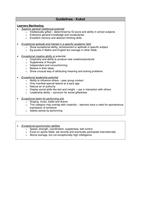
c. Herewith Follows a list of the advantages of the Critical Education Theory, according
to Gravett:
1 STUDENT NO.: 62191411
BTE2601
ASSIGNMENT 02
UNIQUE NO.: 629125
YEAR MODULE
DUE DATE: / 2020
, QUESTION 01:
1.1 Critical Theory in South Africa
a. Unlike many other educational theories, the Critical Education Theory is not just one
particular idea, but consists of a culmination of views which motivates a person’s
actions in the classroom.
This means that, as a teacher, your teaching method in the classroom will be affected
by your own personal views and convictions on education, especially with regards to
the teaching method, the discipline and other educational theories and much more.
The fact that this theory is based on a set of your own personal views and ideals, it
serves as a good “blank canvas” that acts as the basis for where different approaches
can be applied as to your own discretion.
b. Critical Education Theory allows teachers to have the ability to use different
approaches in the classroom as a type of “trial-and-error”, in order to discern which
would be the optimal approach for the teachers, as well as the learners.
Through this process a person can develop your own optimal teaching style that is best
suited to your environment and is conductive to an optimal teaching and learning
environment.
This also serves to encourage the development of educators who are able to easily
adapt to the needs of their environment and their learners.
This is especially useful and necessary in a time such as now, where normal life has
been situated into an uncertainty. In 2020 with the COVID-19 situation, a teacher must
especially be able to improvise and adapt constantly, in order to accommodate the
lifestyle where the world is dealing with an international health-crisis.
In a South-African context, it’s invaluable to have educators who are able to adapt to
certain circumstances and situations in order to ensure that the learners still receive
quality education that prepares them for further education – undeterred by the social
or economic environment or backgrounds of the learners.
Considering that South Africa is a country that has a large “gap” between urban and
rural schools that houses several socioeconomic differences which needs to be taken
into consideration. Therefore, Critical Education Theory in this case then serves as a
resource to bridge this “gap” between economic classes in the schools and in the social
environment.
c. Herewith Follows a list of the advantages of the Critical Education Theory, according
to Gravett:
1 STUDENT NO.: 62191411