
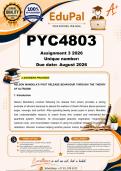
PYC4803
Assignment 3 2026
Unique number:
Due date: August 2026
2 ANSWERS PROVIDED
NELSON MANDELA’S POST RELEASE BEHAVIOUR THROUGH THE THEORY
OF ALTRUISM
1. Introduction
Nelson Mandela’s conduct following his release from prison provides a strong
example of altruism because he placed the welfare of South Africans above personal
anger, revenge, and comfort. After spending twenty seven years in prison, Mandela
had understandable reasons to resent those who created and maintained the
apartheid system. However, he encouraged peaceful negotiation, forgiveness,
national unity, and reconciliation instead of using his political influence to promote
retaliation. Altruism involves helping another person mainly because of concern for
, 2 ANSWERS PROVIDED
NELSON MANDELA’S POST RELEASE BEHAVIOUR THROUGH THE THEORY
OF ALTRUISM
1. Introduction
Nelson Mandela’s conduct following his release from prison provides a strong
example of altruism because he placed the welfare of South Africans above personal
anger, revenge, and comfort. After spending twenty seven years in prison, Mandela
had understandable reasons to resent those who created and maintained the
apartheid system. However, he encouraged peaceful negotiation, forgiveness,
national unity, and reconciliation instead of using his political influence to promote
retaliation. Altruism involves helping another person mainly because of concern for
that person’s welfare, even where helping requires sacrifice or produces no direct
personal reward (Branscombe & Baron, 2017). Mandela’s behaviour also reflected a
lasting commitment to people facing poverty, racial discrimination, poor education,
political violence, and limited opportunities. His personal account shows that he
understood freedom as a shared condition rather than an individual achievement
(Mandela, 1994). This discussion explains his post release behaviour through
empathy, personal sacrifice, moral responsibility, suffering, inclusive concern,
reconciliation, and practical service.
2. Understanding Altruism
2.1 The Meaning of Altruism
Altruism refers to voluntary behaviour that is mainly intended to benefit another
person, although the helper may carry a personal cost and receive no direct reward.
It forms part of prosocial behaviour, which includes helping, sharing, cooperating,
comforting, donating, and protecting people who are experiencing hardship
(Branscombe & Baron, 2017). Prosocial conduct is broader than altruism because
some helpful actions may be encouraged by praise, social approval, personal
satisfaction, political advantage, or an expectation of receiving help later. Altruistic
behaviour is more closely connected with genuine concern for another person’s
welfare rather than the helper’s immediate interests. Research also shows that
Assignment 3 2026
Unique number:
Due date: August 2026
2 ANSWERS PROVIDED
NELSON MANDELA’S POST RELEASE BEHAVIOUR THROUGH THE THEORY
OF ALTRUISM
1. Introduction
Nelson Mandela’s conduct following his release from prison provides a strong
example of altruism because he placed the welfare of South Africans above personal
anger, revenge, and comfort. After spending twenty seven years in prison, Mandela
had understandable reasons to resent those who created and maintained the
apartheid system. However, he encouraged peaceful negotiation, forgiveness,
national unity, and reconciliation instead of using his political influence to promote
retaliation. Altruism involves helping another person mainly because of concern for
, 2 ANSWERS PROVIDED
NELSON MANDELA’S POST RELEASE BEHAVIOUR THROUGH THE THEORY
OF ALTRUISM
1. Introduction
Nelson Mandela’s conduct following his release from prison provides a strong
example of altruism because he placed the welfare of South Africans above personal
anger, revenge, and comfort. After spending twenty seven years in prison, Mandela
had understandable reasons to resent those who created and maintained the
apartheid system. However, he encouraged peaceful negotiation, forgiveness,
national unity, and reconciliation instead of using his political influence to promote
retaliation. Altruism involves helping another person mainly because of concern for
that person’s welfare, even where helping requires sacrifice or produces no direct
personal reward (Branscombe & Baron, 2017). Mandela’s behaviour also reflected a
lasting commitment to people facing poverty, racial discrimination, poor education,
political violence, and limited opportunities. His personal account shows that he
understood freedom as a shared condition rather than an individual achievement
(Mandela, 1994). This discussion explains his post release behaviour through
empathy, personal sacrifice, moral responsibility, suffering, inclusive concern,
reconciliation, and practical service.
2. Understanding Altruism
2.1 The Meaning of Altruism
Altruism refers to voluntary behaviour that is mainly intended to benefit another
person, although the helper may carry a personal cost and receive no direct reward.
It forms part of prosocial behaviour, which includes helping, sharing, cooperating,
comforting, donating, and protecting people who are experiencing hardship
(Branscombe & Baron, 2017). Prosocial conduct is broader than altruism because
some helpful actions may be encouraged by praise, social approval, personal
satisfaction, political advantage, or an expectation of receiving help later. Altruistic
behaviour is more closely connected with genuine concern for another person’s
welfare rather than the helper’s immediate interests. Research also shows that



