Use exam PPQs to make notes. Add pics for the very last point.
5.1.3 NEURONAL COMMUNICATION
a. the roles of mammalian sensory receptors in converting different
types of stimuli into nerve impulses
Sensory receptors – specialised cells that detect changes in the environment
(stimuli).
They respond to stimuli by creating an electrical signal, i.e. a nerve impulse.
Most sensory receptors act as receptors.
o Transducers convert one form of energy into electrical energy (a nerve
impulse).
o Each type of transducer is adapted to detect changes in a particular
form of energy.
Other receptors detect the presence of chemicals, e.g. Na +, H+.
There are four main types of sensory receptors.
o Mechanoreceptors – detect mechanical energy.
o Chemoreceptors – detect chemicals, e.g. Na +.
o Thermoreceptors – detect changes in temperature.
o Photoreceptors – detect light.
Examples of types of sensory receptors:
Stimulus Sensory receptor Energy change involved
Change in light Photoreceptors, e.g. rods Light electrical
intensity and cones in retina
Change in Thermoreceptors in the skin Thermal electrical
temperature and hypothalamus
Pressure Pacinian corpuscles in the Kinetic/mechanical
changes in skin skin electrical
Sound vibrations Vibration receptors in the Kinetic/mechanical
cochlea electrical
Movement Hair cells in the ear’s semi- Kinetic/mechanical
circular canals electrical
Change in muscle Proprioreceptors/stretch Kinetic/mechanical
length receptors in muscles electrical
Chemicals in the Olfactory cells in the These receptors detect the
air epithelium lining the nose presence pf a chemical
Chemicals in Chemoreceptors in the taste and create an electrical
food buds on the tongue impulse
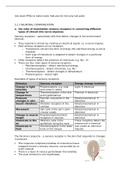
The Pacinian corpuscle – a sensory receptor in the skin that responds to changes
in pressure.
The corpuscle comprises lamellae of connective tissue
wrapped around a sensory neurone, surrounded by an
outer capsule.
There is a layer of viscous gel between the lamellae.
The axon terminal is non-myelinated.
, A pressure on the skin deforms the rings of connective tissue, which push
against the nerve ending.
These are only sensitive to changing pressure; they do not respond to
constant pressure.
How the Pacinian corpuscle responds to changes in pressure:
At rest, most of the stretch-mediated and voltage-gated Na + ion channels in
the Pacinian corpuscle membrane are closed.
The inside of the cell is more negative than the outside – the cell membrane
is polarised.
When sufficient pressure is applied to the corpuscle, the membrane becomes
deformed.
This pressure change activates a second messenger, which causes the
stretch-mediated Na+ ion channels to open.
Na+ ions diffuse into the cell from the surrounding gel.
The potential difference across the membrane decreases – depolarisation
occurs.
A generator potential is produced – this is the change in potential across a
receptor membrane.
If greater pressure is applied, then more stretch-mediated Na + ion channels
will be opened. More Na+ ions enter and greater depolarisation occurs.
If this stimulus is large enough that the threshold potential difference is
reached, the voltage-gated Na+ ion channels open and an action potential is
generated.
b. the structure and functions of sensory, relay and motor neurones
Nerves vs neurones:
A nerve is a bundle of neurones.
Nerves may contain motor neurones, sensory neurones or both.
Connective tissue surrounds the entire nerve, the different bundles of
neurones, and the neurones within the bundles.
Functions of sensory, relay and motor neurones:
Sensory neurones – carry an action potential from a sensory receptor to the
CNS.
Relay/intermediate neurones – connect the sensory and motor neurones.
Motor neurones – carry an action potential from the CNS to an effector (e.g.
muscle, gland).
5.1.3 NEURONAL COMMUNICATION
a. the roles of mammalian sensory receptors in converting different
types of stimuli into nerve impulses
Sensory receptors – specialised cells that detect changes in the environment
(stimuli).
They respond to stimuli by creating an electrical signal, i.e. a nerve impulse.
Most sensory receptors act as receptors.
o Transducers convert one form of energy into electrical energy (a nerve
impulse).
o Each type of transducer is adapted to detect changes in a particular
form of energy.
Other receptors detect the presence of chemicals, e.g. Na +, H+.
There are four main types of sensory receptors.
o Mechanoreceptors – detect mechanical energy.
o Chemoreceptors – detect chemicals, e.g. Na +.
o Thermoreceptors – detect changes in temperature.
o Photoreceptors – detect light.
Examples of types of sensory receptors:
Stimulus Sensory receptor Energy change involved
Change in light Photoreceptors, e.g. rods Light electrical
intensity and cones in retina
Change in Thermoreceptors in the skin Thermal electrical
temperature and hypothalamus
Pressure Pacinian corpuscles in the Kinetic/mechanical
changes in skin skin electrical
Sound vibrations Vibration receptors in the Kinetic/mechanical
cochlea electrical
Movement Hair cells in the ear’s semi- Kinetic/mechanical
circular canals electrical
Change in muscle Proprioreceptors/stretch Kinetic/mechanical
length receptors in muscles electrical
Chemicals in the Olfactory cells in the These receptors detect the
air epithelium lining the nose presence pf a chemical
Chemicals in Chemoreceptors in the taste and create an electrical
food buds on the tongue impulse
The Pacinian corpuscle – a sensory receptor in the skin that responds to changes
in pressure.
The corpuscle comprises lamellae of connective tissue
wrapped around a sensory neurone, surrounded by an
outer capsule.
There is a layer of viscous gel between the lamellae.
The axon terminal is non-myelinated.
, A pressure on the skin deforms the rings of connective tissue, which push
against the nerve ending.
These are only sensitive to changing pressure; they do not respond to
constant pressure.
How the Pacinian corpuscle responds to changes in pressure:
At rest, most of the stretch-mediated and voltage-gated Na + ion channels in
the Pacinian corpuscle membrane are closed.
The inside of the cell is more negative than the outside – the cell membrane
is polarised.
When sufficient pressure is applied to the corpuscle, the membrane becomes
deformed.
This pressure change activates a second messenger, which causes the
stretch-mediated Na+ ion channels to open.
Na+ ions diffuse into the cell from the surrounding gel.
The potential difference across the membrane decreases – depolarisation
occurs.
A generator potential is produced – this is the change in potential across a
receptor membrane.
If greater pressure is applied, then more stretch-mediated Na + ion channels
will be opened. More Na+ ions enter and greater depolarisation occurs.
If this stimulus is large enough that the threshold potential difference is
reached, the voltage-gated Na+ ion channels open and an action potential is
generated.
b. the structure and functions of sensory, relay and motor neurones
Nerves vs neurones:
A nerve is a bundle of neurones.
Nerves may contain motor neurones, sensory neurones or both.
Connective tissue surrounds the entire nerve, the different bundles of
neurones, and the neurones within the bundles.
Functions of sensory, relay and motor neurones:
Sensory neurones – carry an action potential from a sensory receptor to the
CNS.
Relay/intermediate neurones – connect the sensory and motor neurones.
Motor neurones – carry an action potential from the CNS to an effector (e.g.
muscle, gland).