

NU 673 Assessment Midterm Exam – Questions With
Accurate Solutions
Save
Students also studied
WSC 2026: Are we there yet? SS10 Nationalism FRE L4
Teacher 156 terms Teacher 25 terms Teacher 421 terms
Amy_Woodall4 Preview Alicia_Zents Preview CoreGlossaries
Terms in this set (30)
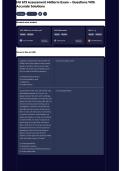
A patient is suspected to have COPD. The B. Forced expiratory time
APRN instructs the patient to take a deep
breath in, and then with his mouth open,
breathe out as fast and completely as he
can. For what is the APRN checking?
A. Whispered pectoriloquy
B. Forced expiratory time
C. Egophony
D. Tactile fremitus
A pt presents to the clinic with severe right A. Acute appendicitis
sided abdominal pain for 12 hours. He
began having a "stomach ache" yesterday,
with decreased appetite, but today the pain
seems to be just on the lower right side. He
has had some nausea & vomiting, but no
constipation or diarrhea. His last BM was
last night and was normal. He has had no
fever or chills. He denies any recent illness
or injuries. His PMH is unremarkable. He
denies any tobacco or drug use and drinks
4-6 beers/week. on exam, he appears ill
and is lying on his right side. His temp is
100.4 F and HR is 110. His bowel sounds are
decreased and he has rebound pain and
guarding one third of the way between
anterior superior iliac spine and the
umbilicus in the right lower quadrant. What
is the most likely cause of his pain?
A. Acute appendicitis
B. Mesenteric ischemia
C. Acute mechanical intestinal obstruction
D. Acute cholecystitis
, An APRN notes a 12 mm Hg difference in C. Paradoxical pulse
systolic BP during inspiration. How should
the APRN document this finding?
A. Acute stenosis
B. Carotid arterial disease
C. Paradoxical pulse
D. Pulsus alternans
Which of the following percussion notes is C. Tympany
obtained over a gastric bubble?
A. Flatness
B. Hyperresonance
C. Tympany
D. Resonance
The APRN is performing a cardiac exam on A. Mitral
a pt with SOB and palpitations. She listens to
the heart with the pt sitting upright, then has
the pt change to a supine position, and
finally she has the pt turn onto the left side
in the left lateral decubitus position. Which
of the following valvular defects is best
heard in this position?
A. Mitral
B. Aortic
C. Tricuspid
D. Pulmonic
A 20 year old male has a history of leukemia B. It is a splenic rub
and an enlarged spleen. Today he presents
with a fairly significant left upper quadrant
pain. On exam of the area a rough grating
noise is heard. What is this sound known as?
A. It is a variant of bowel noise
B. It is a splenic rub
C. Vascular noise
D. It represents borborygmi
An elderly pt with a history of smoking 2 D. Pulmonary hypertension
packs/day for 50 years reports to the APRN
prolonged shortness of breath. On cardiac
exam, the APRN feels the most prominent
palpable impulse to be in the xiphoid area.
This is most likely a result of what condition?
A. COPD
B. Aortic stenosis
C. Mitral regurgitation
D. Pulmonary hypertension
Accurate Solutions
Save
Students also studied
WSC 2026: Are we there yet? SS10 Nationalism FRE L4
Teacher 156 terms Teacher 25 terms Teacher 421 terms
Amy_Woodall4 Preview Alicia_Zents Preview CoreGlossaries
Terms in this set (30)
A patient is suspected to have COPD. The B. Forced expiratory time
APRN instructs the patient to take a deep
breath in, and then with his mouth open,
breathe out as fast and completely as he
can. For what is the APRN checking?
A. Whispered pectoriloquy
B. Forced expiratory time
C. Egophony
D. Tactile fremitus
A pt presents to the clinic with severe right A. Acute appendicitis
sided abdominal pain for 12 hours. He
began having a "stomach ache" yesterday,
with decreased appetite, but today the pain
seems to be just on the lower right side. He
has had some nausea & vomiting, but no
constipation or diarrhea. His last BM was
last night and was normal. He has had no
fever or chills. He denies any recent illness
or injuries. His PMH is unremarkable. He
denies any tobacco or drug use and drinks
4-6 beers/week. on exam, he appears ill
and is lying on his right side. His temp is
100.4 F and HR is 110. His bowel sounds are
decreased and he has rebound pain and
guarding one third of the way between
anterior superior iliac spine and the
umbilicus in the right lower quadrant. What
is the most likely cause of his pain?
A. Acute appendicitis
B. Mesenteric ischemia
C. Acute mechanical intestinal obstruction
D. Acute cholecystitis
, An APRN notes a 12 mm Hg difference in C. Paradoxical pulse
systolic BP during inspiration. How should
the APRN document this finding?
A. Acute stenosis
B. Carotid arterial disease
C. Paradoxical pulse
D. Pulsus alternans
Which of the following percussion notes is C. Tympany
obtained over a gastric bubble?
A. Flatness
B. Hyperresonance
C. Tympany
D. Resonance
The APRN is performing a cardiac exam on A. Mitral
a pt with SOB and palpitations. She listens to
the heart with the pt sitting upright, then has
the pt change to a supine position, and
finally she has the pt turn onto the left side
in the left lateral decubitus position. Which
of the following valvular defects is best
heard in this position?
A. Mitral
B. Aortic
C. Tricuspid
D. Pulmonic
A 20 year old male has a history of leukemia B. It is a splenic rub
and an enlarged spleen. Today he presents
with a fairly significant left upper quadrant
pain. On exam of the area a rough grating
noise is heard. What is this sound known as?
A. It is a variant of bowel noise
B. It is a splenic rub
C. Vascular noise
D. It represents borborygmi
An elderly pt with a history of smoking 2 D. Pulmonary hypertension
packs/day for 50 years reports to the APRN
prolonged shortness of breath. On cardiac
exam, the APRN feels the most prominent
palpable impulse to be in the xiphoid area.
This is most likely a result of what condition?
A. COPD
B. Aortic stenosis
C. Mitral regurgitation
D. Pulmonary hypertension

