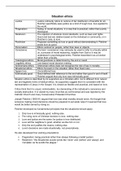
Situation ethics
Justice Justice ordinarily refers to notions of fair distribution of benefits for all.
Fletcher specifically sees justice as a kind of tough love; love applied to
the world.
Pragmatism Acting, in moral situations, in a way that is practical, rather than purely
ideological.
Relativism The rejection of absolute moral standards, such as laws and rights.
Good and bad are relative based on the individual or community, or in
Fletcher’s case, to love.
Positivism Proposes something as true or good without demonstrating it. Fletcher
posits love as good.
Personalism Ethics centred on people, rather than laws or objects.
Conscience The term ‘conscience’ may variously be used to refer to a faculty within
us, a process of moral reasoning, insights from God or it may be
understood in psychological terms. Fletcher described it as a function
rather than a faculty.
Teleological ethics Moral goodness is determined by the end or result.
Legalistic ethics Law-based moral decision making.
Antinomians ethics Antinomian ethics does not recognise the role of law in morality.
Situational ethics Ethics focused on the situation rather than fixed rules.
Agape love Unconditional love.
Extrinsically good Good defined with reference to the end rather than good in and of itself.
Fletcher argued that only love was intrinsically good.
Situation ethics is described by its supporters as a Christian ethic, but is different from natural
law and legalistic forms of biblical ethics. Its supporters suggest that it is consistent with the
representation of Jesus in the Gospel. It is viewed as flexible and practical, and based on love.
Critics think that it is unjust, individualistic, too demanding of the individual’s conscience and
socially destructive. It is viewed by many churches as controversial and was rejected by the
Catholic Church and many Conservative Protestant Churches.
Joseph Fletcher (1905-91) argued that love was what morality should serve. He thought that
someone making moral decisions should be prepared to set aside rules if it seemed that love
would be better served by doing so.
Fletcher developed six fundamental principles that the situationist should apply:
1. Only love is intrinsically good; nothing else.
2. The ruling norm of Christian decision is love; nothing else.
3. Love and justice are the same; for justice is love distributed.
4. Love will the neighbour’s good, whether we like him or not.
5. Only the end justifies the means; nothing else.
6. Love's decisions are made situationally, not prescriptively.
He also developed four working propositions:
Pragmatism: being practical rather than always following a belief system.
Relativism: “the Situationist avoids words like ‘never’ and ‘perfect’ and ‘always’ and
‘complete’ as he avoids the plague.”
, Positivism: love is posited as true or good without demonstrating this is the case.
Personalism: the legalist puts the law first, but the situationist puts people first, the
person takes responsibility for the other person. It is person centred.
For the situationist, conscience describes the weighing up of the possible action before it’s
taken, kind of like moral deliberation, rather than a faculty within a human being. It is informed
by the situation and love.
A teleological Christian ethic
Religious ethics tend to be thought of in terms of moral rules, which should not be broken, or
certain behaviours or virtues that should be practiced as part of a ‘religious way of life’. It is often
seen as deontological, focused on the rightness or wrongness of certain actions.
Ethics can also be teleological, with rightness and wrongness determined by the ends, or
consequences instead. Rightness is extrinsic to the action.
Situation ethics identifies its roots in the New Testament with references to Jesus setting aside
the law or breaking established rules. For Fletcher, situation ethics was a Christian ethic, but
many Churches rejected it.
Fletcher and his three approaches to moral thinking
Joseph Fletcher was ordained and was an American academic who taught Christian and
medical ethics. For a time, he was President of the Euthanasia Society of America. Fletcher
divides moral thinking into legalistic, antinomian and situational ethics.
Legalistic ethics has a set of predefined rules and regulations which direct how you should
behave. Christianity shows legalistic features, based on biblical commandments and the
precepts that Aquinas proposed. Due to the complications that life throws up, laws accumulate
to cover all eventualities. Once murder has been prohibited, you then have to clarify killing in
self-defence, killing in war, abortions and so on. The legalist must continually add law to cover
every eventuality, resulting in a web of laws. To be moral means following the appropriate moral
law, or applying the predetermined moral laws. For Fletcher, this mistake is found in both
Catholicism and Christianity through adherence to natural law. Fletcher rejected these legalistic
approaches that were based on fixed laws.
Antinomian ethics is the reverse of legalistic ethics; it does not use any law, rule or principle,
or any system of ethics at all. Each attempt at moral decision making is unique. Fletcher was
critical of this as it is too anarchical.
A third approach is situational, where moral decisions are based on the situation. The
situationist enters into the moral dilemma with the ethics, rules and principles of their community
or tradition. However, the situationist is prepared to set aside those if love seems better served
by doing so. They are more interested in loving people than laws. Situation ethics agrees that
reason is the instrument of moral judgements, but disagrees that the good is to be discerned
from the nature of things or the love of things. All moral decisions are hypothetical. We may
never come to a conclusion on the right thing to do, but we need to come to a decision.
Situationism presents itself as a principled approach to ethics which is based on circumstances
and love, rather than actions and rules.
Justice Justice ordinarily refers to notions of fair distribution of benefits for all.
Fletcher specifically sees justice as a kind of tough love; love applied to
the world.
Pragmatism Acting, in moral situations, in a way that is practical, rather than purely
ideological.
Relativism The rejection of absolute moral standards, such as laws and rights.
Good and bad are relative based on the individual or community, or in
Fletcher’s case, to love.
Positivism Proposes something as true or good without demonstrating it. Fletcher
posits love as good.
Personalism Ethics centred on people, rather than laws or objects.
Conscience The term ‘conscience’ may variously be used to refer to a faculty within
us, a process of moral reasoning, insights from God or it may be
understood in psychological terms. Fletcher described it as a function
rather than a faculty.
Teleological ethics Moral goodness is determined by the end or result.
Legalistic ethics Law-based moral decision making.
Antinomians ethics Antinomian ethics does not recognise the role of law in morality.
Situational ethics Ethics focused on the situation rather than fixed rules.
Agape love Unconditional love.
Extrinsically good Good defined with reference to the end rather than good in and of itself.
Fletcher argued that only love was intrinsically good.
Situation ethics is described by its supporters as a Christian ethic, but is different from natural
law and legalistic forms of biblical ethics. Its supporters suggest that it is consistent with the
representation of Jesus in the Gospel. It is viewed as flexible and practical, and based on love.
Critics think that it is unjust, individualistic, too demanding of the individual’s conscience and
socially destructive. It is viewed by many churches as controversial and was rejected by the
Catholic Church and many Conservative Protestant Churches.
Joseph Fletcher (1905-91) argued that love was what morality should serve. He thought that
someone making moral decisions should be prepared to set aside rules if it seemed that love
would be better served by doing so.
Fletcher developed six fundamental principles that the situationist should apply:
1. Only love is intrinsically good; nothing else.
2. The ruling norm of Christian decision is love; nothing else.
3. Love and justice are the same; for justice is love distributed.
4. Love will the neighbour’s good, whether we like him or not.
5. Only the end justifies the means; nothing else.
6. Love's decisions are made situationally, not prescriptively.
He also developed four working propositions:
Pragmatism: being practical rather than always following a belief system.
Relativism: “the Situationist avoids words like ‘never’ and ‘perfect’ and ‘always’ and
‘complete’ as he avoids the plague.”
, Positivism: love is posited as true or good without demonstrating this is the case.
Personalism: the legalist puts the law first, but the situationist puts people first, the
person takes responsibility for the other person. It is person centred.
For the situationist, conscience describes the weighing up of the possible action before it’s
taken, kind of like moral deliberation, rather than a faculty within a human being. It is informed
by the situation and love.
A teleological Christian ethic
Religious ethics tend to be thought of in terms of moral rules, which should not be broken, or
certain behaviours or virtues that should be practiced as part of a ‘religious way of life’. It is often
seen as deontological, focused on the rightness or wrongness of certain actions.
Ethics can also be teleological, with rightness and wrongness determined by the ends, or
consequences instead. Rightness is extrinsic to the action.
Situation ethics identifies its roots in the New Testament with references to Jesus setting aside
the law or breaking established rules. For Fletcher, situation ethics was a Christian ethic, but
many Churches rejected it.
Fletcher and his three approaches to moral thinking
Joseph Fletcher was ordained and was an American academic who taught Christian and
medical ethics. For a time, he was President of the Euthanasia Society of America. Fletcher
divides moral thinking into legalistic, antinomian and situational ethics.
Legalistic ethics has a set of predefined rules and regulations which direct how you should
behave. Christianity shows legalistic features, based on biblical commandments and the
precepts that Aquinas proposed. Due to the complications that life throws up, laws accumulate
to cover all eventualities. Once murder has been prohibited, you then have to clarify killing in
self-defence, killing in war, abortions and so on. The legalist must continually add law to cover
every eventuality, resulting in a web of laws. To be moral means following the appropriate moral
law, or applying the predetermined moral laws. For Fletcher, this mistake is found in both
Catholicism and Christianity through adherence to natural law. Fletcher rejected these legalistic
approaches that were based on fixed laws.
Antinomian ethics is the reverse of legalistic ethics; it does not use any law, rule or principle,
or any system of ethics at all. Each attempt at moral decision making is unique. Fletcher was
critical of this as it is too anarchical.
A third approach is situational, where moral decisions are based on the situation. The
situationist enters into the moral dilemma with the ethics, rules and principles of their community
or tradition. However, the situationist is prepared to set aside those if love seems better served
by doing so. They are more interested in loving people than laws. Situation ethics agrees that
reason is the instrument of moral judgements, but disagrees that the good is to be discerned
from the nature of things or the love of things. All moral decisions are hypothetical. We may
never come to a conclusion on the right thing to do, but we need to come to a decision.
Situationism presents itself as a principled approach to ethics which is based on circumstances
and love, rather than actions and rules.