
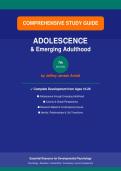
COMPREHENSIVE STUDY GUIDE
ADOLESCENCE
& Emerging Adulthood
7th
EDITION
by Jeffrey Jensen Arnett
✓ Complete Development from Ages 10-29
■ Adolescence through Emerging Adulthood
■ Cultural & Global Perspectives
■ Research-Based & Contemporary Issues
■ Identity, Relationships & Life Transitions
Essential Resource for Developmental Psychology
Psychology • Education • Social Work • Counseling • Human Development
,Ages 10-29: Complete Developmental Coverage
■ Comprehensive Topic Coverage:
✓ Biological Foundations & Puberty
✓ Cognitive Development & Brain Maturation
✓ Cultural Contexts & Global Perspectives
✓ Self-Concept & Identity Formation
✓ Gender Identity & Sexual Development
✓ Family Relationships & Dynamics
✓ Peer & Romantic Relationships
✓ School, Work & Achievement
✓ Media Use & Digital Technology
✓ Moral Development & Spirituality
✓ Problems & Resilience
✓ Emerging Adulthood (Ages 18-29)
✓ Love & Work in Emerging Adulthood
✓ Cultural Variations in Development
■ Unique Focus: Emerging Adulthood
• Groundbreaking coverage of ages 18-29 as distinct life stage
• Identity exploration in love, work, and worldviews
• Instability and frequent changes characteristic of this period
• Self-focused time before adult commitments
• Feeling in-between adolescence and adulthood
■ Perfect For:
• Developmental Psychology Students
• Adolescent Psychology Courses
• Educational Psychology Programs
• Social Work & Counseling Students
• College Student Development Professionals
• Youth Program Coordinators & Advisors
• Anyone Studying Ages 10-29
Educational Study Material • Copyright-Free Content • For Academic Use
, TOTAL
Chapter 1
ASSESSMENT
GUIDE Adolescent Development in Today’s World
Topic Remember Understand Apply What Analyze It
the Facts the Concepts You Know
A Demographic Multiple Choice 1, 4, 8, 11, 12 2, 3, 7, 9, 10, 5, 6, 16
Profile of 13, 14, 15
Adolescents True/False 91-94
Short Essay 111 110
Adolescence Multiple Choice 17-26 27
Around the True/False 95, 98-99 96, 97
World: A Brief
Short Essay
Regional
Overview
A Brief History Multiple Choice 28-33, 35-39 34, 40, 41
of Adolescence True/False 100-101
in Western Short Essay 112, 113
Cultures
From Multiple Choice 43, 45-47 42, 50, 54-56 44, 48, 49,
Adolescence to 51, 52, 53
Emerging True/False 102-105
Adulthood Short Essay
The Transition Multiple Choice 58, 60-62 57, 59
to Adulthood True/False 106
Short Essay 114
The Scientific Multiple Choice 63-65, 67, 69 66, 68 70, 71
Study of True/False 107
Adolescence and Short Essay 115
Emerging
Adulthood
Research Multiple Choice 72, 75, 79, 82, 81, 84 77, 80, 85 73, 74, 76,
Measurements 86-90 78, 83
and Designs True/False 108-109
Short Essay 116
1
Copyright © 2024, 2020, 2017 by Pearson Education, Inc. All rights reserved.
, Arnett/Jensen, Adolescence and Emerging Adulthood 7e Test Bank
Multiple Choice Questions
1. A developed country is one of the world’s most __________ developed countries, with the
highest median levels of income, while a developing country is one that has lower levels of
__________ than developed countries but is experiencing rapid economic growth.
a. economically; income
b. technologically; technology development
c. industrially; employment
d. technologically; income
Answer: a
LO: 1.1 Distinguish between adolescents in developing and developed countries in terms of
income, education, and cultural values.
Topic: A Demographic Profile of Adolescents
Difficulty: Easy
Skill: Remember the Facts
APA LO: 1.1 Describe key concepts, principles, and overarching themes in psychology.
2. About what percent of adolescents go on to tertiary education in developed countries?
a. 25%
b. 40%
c. 50%
d. 68%
Answer: c
LO: 1.1 Distinguish between adolescents in developing and developed countries in terms of
income, education, and cultural values.
Topic: A Demographic Profile of Adolescents
Difficulty: Moderate
Skill: Understand the Concepts
APA LO: 1.1 Describe key concepts, principles, and overarching themes in psychology.
3. Schlossa is an adolescent in a developing country. On average, what percent chance does
Schlossa have of not completing primary schooling?
a. 35%
b. 65%
c. 20%
d. 8%
Answer: c
LO: 1.1 Distinguish between adolescents in developing and developed countries in terms of
income, education, and cultural values.
Topic: A Demographic Profile of Adolescents
Difficulty: Moderate
Skill: Understand the Concepts
APA LO: 1.1 Describe key concepts, principles, and overarching themes in psychology.
2
Copyright © 2024, 2020, 2017 by Pearson Education, Inc. All rights reserved.
ADOLESCENCE
& Emerging Adulthood
7th
EDITION
by Jeffrey Jensen Arnett
✓ Complete Development from Ages 10-29
■ Adolescence through Emerging Adulthood
■ Cultural & Global Perspectives
■ Research-Based & Contemporary Issues
■ Identity, Relationships & Life Transitions
Essential Resource for Developmental Psychology
Psychology • Education • Social Work • Counseling • Human Development
,Ages 10-29: Complete Developmental Coverage
■ Comprehensive Topic Coverage:
✓ Biological Foundations & Puberty
✓ Cognitive Development & Brain Maturation
✓ Cultural Contexts & Global Perspectives
✓ Self-Concept & Identity Formation
✓ Gender Identity & Sexual Development
✓ Family Relationships & Dynamics
✓ Peer & Romantic Relationships
✓ School, Work & Achievement
✓ Media Use & Digital Technology
✓ Moral Development & Spirituality
✓ Problems & Resilience
✓ Emerging Adulthood (Ages 18-29)
✓ Love & Work in Emerging Adulthood
✓ Cultural Variations in Development
■ Unique Focus: Emerging Adulthood
• Groundbreaking coverage of ages 18-29 as distinct life stage
• Identity exploration in love, work, and worldviews
• Instability and frequent changes characteristic of this period
• Self-focused time before adult commitments
• Feeling in-between adolescence and adulthood
■ Perfect For:
• Developmental Psychology Students
• Adolescent Psychology Courses
• Educational Psychology Programs
• Social Work & Counseling Students
• College Student Development Professionals
• Youth Program Coordinators & Advisors
• Anyone Studying Ages 10-29
Educational Study Material • Copyright-Free Content • For Academic Use
, TOTAL
Chapter 1
ASSESSMENT
GUIDE Adolescent Development in Today’s World
Topic Remember Understand Apply What Analyze It
the Facts the Concepts You Know
A Demographic Multiple Choice 1, 4, 8, 11, 12 2, 3, 7, 9, 10, 5, 6, 16
Profile of 13, 14, 15
Adolescents True/False 91-94
Short Essay 111 110
Adolescence Multiple Choice 17-26 27
Around the True/False 95, 98-99 96, 97
World: A Brief
Short Essay
Regional
Overview
A Brief History Multiple Choice 28-33, 35-39 34, 40, 41
of Adolescence True/False 100-101
in Western Short Essay 112, 113
Cultures
From Multiple Choice 43, 45-47 42, 50, 54-56 44, 48, 49,
Adolescence to 51, 52, 53
Emerging True/False 102-105
Adulthood Short Essay
The Transition Multiple Choice 58, 60-62 57, 59
to Adulthood True/False 106
Short Essay 114
The Scientific Multiple Choice 63-65, 67, 69 66, 68 70, 71
Study of True/False 107
Adolescence and Short Essay 115
Emerging
Adulthood
Research Multiple Choice 72, 75, 79, 82, 81, 84 77, 80, 85 73, 74, 76,
Measurements 86-90 78, 83
and Designs True/False 108-109
Short Essay 116
1
Copyright © 2024, 2020, 2017 by Pearson Education, Inc. All rights reserved.
, Arnett/Jensen, Adolescence and Emerging Adulthood 7e Test Bank
Multiple Choice Questions
1. A developed country is one of the world’s most __________ developed countries, with the
highest median levels of income, while a developing country is one that has lower levels of
__________ than developed countries but is experiencing rapid economic growth.
a. economically; income
b. technologically; technology development
c. industrially; employment
d. technologically; income
Answer: a
LO: 1.1 Distinguish between adolescents in developing and developed countries in terms of
income, education, and cultural values.
Topic: A Demographic Profile of Adolescents
Difficulty: Easy
Skill: Remember the Facts
APA LO: 1.1 Describe key concepts, principles, and overarching themes in psychology.
2. About what percent of adolescents go on to tertiary education in developed countries?
a. 25%
b. 40%
c. 50%
d. 68%
Answer: c
LO: 1.1 Distinguish between adolescents in developing and developed countries in terms of
income, education, and cultural values.
Topic: A Demographic Profile of Adolescents
Difficulty: Moderate
Skill: Understand the Concepts
APA LO: 1.1 Describe key concepts, principles, and overarching themes in psychology.
3. Schlossa is an adolescent in a developing country. On average, what percent chance does
Schlossa have of not completing primary schooling?
a. 35%
b. 65%
c. 20%
d. 8%
Answer: c
LO: 1.1 Distinguish between adolescents in developing and developed countries in terms of
income, education, and cultural values.
Topic: A Demographic Profile of Adolescents
Difficulty: Moderate
Skill: Understand the Concepts
APA LO: 1.1 Describe key concepts, principles, and overarching themes in psychology.
2
Copyright © 2024, 2020, 2017 by Pearson Education, Inc. All rights reserved.

