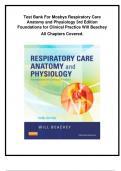
Test Bank For Crash Course Pharmacology, 6th Edition
For the MLA and Medical Exams
Series Editors : Catrin Page & Clive P. Page & Philip Xiu
,Chapter 1: Introduction to Pharmacology
1. Pharmacology is the study of:
A. Herbal medicine only
B. Drugs and their effects on biological systems
C. Surgical treatment
D. Disease diagnosis
ANS: B
Rationale:
Pharmacology examines how drugs interact with living systems — including mechanisms,
effects, uses, and risks.
A — Too narrow
C — Surgery ≠ pharmacology
D — Diagnosis ≠ drug science
2. A drug is best defined as a substance that:
A. Always cures disease
B. Produces a biological effect
C. Must be synthetic
D. Requires a prescription
ANS: B
Rationale:
A drug is any chemical that alters biological function — therapeutic or not.
A — Many drugs manage, not cure
C — Many drugs are natural
D — OTC drugs exist
3. Pharmacodynamics refers to:
,A. Drug absorption
B. Drug metabolism
C. What the drug does to the body
D. What the body does to the drug
ANS: C
Rationale:
Pharmacodynamics = mechanism + effect of drugs.
A, B — Pharmacokinetics
D — Definition of pharmacokinetics
4. Pharmacokinetics describes:
A. Drug mechanism
B. Drug targets
C. ADME processes
D. Drug naming
ANS: C
Rationale:
Pharmacokinetics = Absorption, Distribution, Metabolism, Excretion.
Other options belong to pharmacodynamics or regulation.
5. Most drug targets are:
A. Carbohydrates
B. Proteins
C. Lipids
D. Vitamins
ANS: B
Rationale:
Receptors, enzymes, ion channels, and transporters are proteins.
Other molecules are rarely direct targets.
, 6. A drug that activates a receptor is called a:
A. Blocker
B. Antagonist
C. Agonist
D. Inhibitor
ANS: C
Rationale:
Agonists bind and activate receptors.
B — Blocks receptor
D — Often enzyme related
A — Non-specific term
Drug–Receptor Interactions
7. Affinity refers to a drug’s:
A. Maximum effect
B. Binding strength to receptor
C. Toxicity
D. Duration
ANS: B
Rationale:
Affinity = how tightly a drug binds.
A — Efficacy
C — Safety issue
D — Time parameter
8. Efficacy describes:
A. Binding ability
B. Maximum effect produced
For the MLA and Medical Exams
Series Editors : Catrin Page & Clive P. Page & Philip Xiu
,Chapter 1: Introduction to Pharmacology
1. Pharmacology is the study of:
A. Herbal medicine only
B. Drugs and their effects on biological systems
C. Surgical treatment
D. Disease diagnosis
ANS: B
Rationale:
Pharmacology examines how drugs interact with living systems — including mechanisms,
effects, uses, and risks.
A — Too narrow
C — Surgery ≠ pharmacology
D — Diagnosis ≠ drug science
2. A drug is best defined as a substance that:
A. Always cures disease
B. Produces a biological effect
C. Must be synthetic
D. Requires a prescription
ANS: B
Rationale:
A drug is any chemical that alters biological function — therapeutic or not.
A — Many drugs manage, not cure
C — Many drugs are natural
D — OTC drugs exist
3. Pharmacodynamics refers to:
,A. Drug absorption
B. Drug metabolism
C. What the drug does to the body
D. What the body does to the drug
ANS: C
Rationale:
Pharmacodynamics = mechanism + effect of drugs.
A, B — Pharmacokinetics
D — Definition of pharmacokinetics
4. Pharmacokinetics describes:
A. Drug mechanism
B. Drug targets
C. ADME processes
D. Drug naming
ANS: C
Rationale:
Pharmacokinetics = Absorption, Distribution, Metabolism, Excretion.
Other options belong to pharmacodynamics or regulation.
5. Most drug targets are:
A. Carbohydrates
B. Proteins
C. Lipids
D. Vitamins
ANS: B
Rationale:
Receptors, enzymes, ion channels, and transporters are proteins.
Other molecules are rarely direct targets.
, 6. A drug that activates a receptor is called a:
A. Blocker
B. Antagonist
C. Agonist
D. Inhibitor
ANS: C
Rationale:
Agonists bind and activate receptors.
B — Blocks receptor
D — Often enzyme related
A — Non-specific term
Drug–Receptor Interactions
7. Affinity refers to a drug’s:
A. Maximum effect
B. Binding strength to receptor
C. Toxicity
D. Duration
ANS: B
Rationale:
Affinity = how tightly a drug binds.
A — Efficacy
C — Safety issue
D — Time parameter
8. Efficacy describes:
A. Binding ability
B. Maximum effect produced