

MATH 120 WEEK 6 EXAM 2026 QUESTIONS AND
ANSWERS WITH COMPREHENSIVE SOLUTIONS –
FULLY UPDATED GUARANTEED SUCCESS
Statistical Models Exam
93%
1.
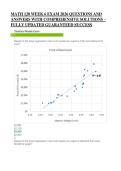
Based on the linear regression, how much would you expect a 0.55 carat diamond to
cost?
$1,800
$2,100
$2,500
$2,900
2.
Based on the linear regression, how much would you expect a diamond that costs
$5,500 to weigh?
, 0.72 carats
0.78 carats
0.81 carats 0.90
carats
3.
You're surprised to learn that instead of ~$100, a 0.30 carat costs ~$800 carats. Which
explanation would make sense?
The linear regression is not accurate at predicting the cost of diamonds below 0.40
carats.
There is a fixed cost associated with procuring the diamond and offering it for sale,
meaning that small diamonds have a relatively high price.
The diamond is very high quality as measured by other metrics (e.g., cut, clarity, color).
All of the above.
4.
If a residual is negative, what does it mean about the observed value?
The predicted value is greater than the observed value.
The predicted value is equal to the observed value.
The predicted value is less than the observed value.
It cannot be determined from the data provided.
5.
If the expected value of a diamond is $3,500, but the observed value is $3,800, what is
the residual?
ANSWERS WITH COMPREHENSIVE SOLUTIONS –
FULLY UPDATED GUARANTEED SUCCESS
Statistical Models Exam
93%
1.
Based on the linear regression, how much would you expect a 0.55 carat diamond to
cost?
$1,800
$2,100
$2,500
$2,900
2.
Based on the linear regression, how much would you expect a diamond that costs
$5,500 to weigh?
, 0.72 carats
0.78 carats
0.81 carats 0.90
carats
3.
You're surprised to learn that instead of ~$100, a 0.30 carat costs ~$800 carats. Which
explanation would make sense?
The linear regression is not accurate at predicting the cost of diamonds below 0.40
carats.
There is a fixed cost associated with procuring the diamond and offering it for sale,
meaning that small diamonds have a relatively high price.
The diamond is very high quality as measured by other metrics (e.g., cut, clarity, color).
All of the above.
4.
If a residual is negative, what does it mean about the observed value?
The predicted value is greater than the observed value.
The predicted value is equal to the observed value.
The predicted value is less than the observed value.
It cannot be determined from the data provided.
5.
If the expected value of a diamond is $3,500, but the observed value is $3,800, what is
the residual?

