

Shabaan Ali
Task 1
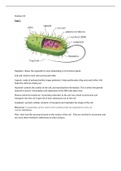
Flagellum- allows the organelle to move depending on its chemical agent.
Cell wall- binds to host cells and transfer DNA
Capsule- made of polysaccharides (sugar polymers). Helps prokaryotes cling onto each other, this
helps the cell from drying out.
Nucleoid- controls the activity of the cell, and reproduction information. This is where the genetic
material is stored. Transcription and replication of the DNA take place here.
Plasma nutrients membrane- it provides protection to the cell, has a fixed environment and
transports into the cell. It gets rid of toxic substances out of the cell.
Cytoplasm- protects cellular contents. It transports and maintains the shape of the cell.
Ribosomes- It assembles amino acid to form proteins that are essential to carry out
cellular functions.
Pilus- short hair like structures found on the surface of the cell. They are involved in movement and
are more often involved in adherence to other surfaces.
, DNA nucleic acid- contain, store and express genetic
information.
Capsid- to protect and encounter other host cells.
Collar domain- compresses and punctures the cell.
Deposits the DNA into the bacterial cell.
Sheath- it compresses and DNA into the bacterial
cell.
Base plate- initiates infection when the tail fibres
bind to the host cell.
cap.
gills
ring
stem
volva
mycelium
References: https://www.ncbi.nlm.nih.gov/pmc/articles/PMC4009794/#:~:text=Flagellum%20is
%20primarily%20a%20motility,flagella%20all%20over%20the%20bacterium).
https://www.news-medical.net/life-sciences/Structure-and-Role-of-Pili-in-Prokaryotes.aspx
https://www.khanacademy.org/science/ap-biology/gene-expression-and-regulation/dna-and-rna-
structure/a/prokaryote-structure#:~:text=Many%20prokaryotes%20have%20a%20sticky,the%20cell
%20from%20drying%20out.
http://faculty.ccbcmd.edu/courses/bio141/lecguide/unit1/prostruct/pili.html#:~:text=to
%20Bacterial%20Pathogenicity-,The%20short%20attachment%20pili%20or%20fimbriae%20are
%20organelles%20of%20adhesion,of%20a%20protein%20called%20pilin.
Task 1
Flagellum- allows the organelle to move depending on its chemical agent.
Cell wall- binds to host cells and transfer DNA
Capsule- made of polysaccharides (sugar polymers). Helps prokaryotes cling onto each other, this
helps the cell from drying out.
Nucleoid- controls the activity of the cell, and reproduction information. This is where the genetic
material is stored. Transcription and replication of the DNA take place here.
Plasma nutrients membrane- it provides protection to the cell, has a fixed environment and
transports into the cell. It gets rid of toxic substances out of the cell.
Cytoplasm- protects cellular contents. It transports and maintains the shape of the cell.
Ribosomes- It assembles amino acid to form proteins that are essential to carry out
cellular functions.
Pilus- short hair like structures found on the surface of the cell. They are involved in movement and
are more often involved in adherence to other surfaces.
, DNA nucleic acid- contain, store and express genetic
information.
Capsid- to protect and encounter other host cells.
Collar domain- compresses and punctures the cell.
Deposits the DNA into the bacterial cell.
Sheath- it compresses and DNA into the bacterial
cell.
Base plate- initiates infection when the tail fibres
bind to the host cell.
cap.
gills
ring
stem
volva
mycelium
References: https://www.ncbi.nlm.nih.gov/pmc/articles/PMC4009794/#:~:text=Flagellum%20is
%20primarily%20a%20motility,flagella%20all%20over%20the%20bacterium).
https://www.news-medical.net/life-sciences/Structure-and-Role-of-Pili-in-Prokaryotes.aspx
https://www.khanacademy.org/science/ap-biology/gene-expression-and-regulation/dna-and-rna-
structure/a/prokaryote-structure#:~:text=Many%20prokaryotes%20have%20a%20sticky,the%20cell
%20from%20drying%20out.
http://faculty.ccbcmd.edu/courses/bio141/lecguide/unit1/prostruct/pili.html#:~:text=to
%20Bacterial%20Pathogenicity-,The%20short%20attachment%20pili%20or%20fimbriae%20are
%20organelles%20of%20adhesion,of%20a%20protein%20called%20pilin.


