1
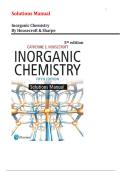
Solutions Manual
Inorganic Chemistry
By Housecroft & Sharpe
5th edition
,2 Basic concepts: atoms
1 Basic concepts: atoms
1.1 the notation:
50
24
Cr
Shows that the atomic number, z, is 24 and the mass number for the isotope is
50.
Number of protons = number of electrons = z = 24
number of neutrons = mass number – z = 50 – 24 = 26
For each isotope, z = 24 and so there are 24 electrons and 24 protons. For
mass numbers 52, 53 and 54, there are 28, 29 and 30 neutrons,
respectively.
1.2 ‘monotopic’ means that the element possesses only one isotope. Examples
See appendix 5 in h&s ▶ other than as include p, na and be.
1.3 (a) Al is monotopic, i.e. There is only one naturally occurring isotope.
Z = 13 mass number = 27
Number of electrons = number of protons = 13
Notation: ▶
27 number of neutrons = 27 – 13 = 14
13 Al (b) Br (z = 35) has 2 naturally occurring
Isotopes.
Each isotope has 35 electrons and 35 protons.
79 81 for the isotope with mass number 79: number of neutrons = 79 – 35 =
80 Br
Br
35 35 44 for the isotope with mass number 81: number of neutrons
57
54 56 fe fe 5 fe = 81 – 35 = 46
26 Fe 8 (c) Fe (z = 26) has 4 naturally occurring isotopes.
2 26
6 2 each isotope has 26 electrons and 26 protons.
6
For the isotope with mass number 54: number of neutrons = 54 – 26
= 28 for the isotope with mass number 56: number of neutrons
= 56 – 26 = 30 for the isotope with mass number 57: number of
neutrons = 57 – 26 = 31 for the isotope with mass number 58:
1.4 number of neutrons = 58 – 26 = 32
Assume that 3h can be ignored since abundance is so low; error introduced by
this assumption is negligible. The mass numbers of 1h and 2h are 1 and 2
respectively. Let % 1h = x, and % 2h = 100 – x
Then:
x 1
A = 1.008 = 100 x
r
100 2 100
+
100.8 = x + – 2x
200
X = 99.2
This result gives 99.2 % 1h and 0.8 % 2h. The values do not agree with those
in appendix 5 (99.985 % 1h and 0.015 % 2h) because we have used
, 1
Integral atomic masses for the isotopes. The accurate masses (5 sig. Fig.)
Are 1.0078 and 2.0141, and if you work through the above calculation
again, this gives 99.98 % 1h and
0.02 % 2h.
, 4 Basic concepts: atoms
1. (a) isotopic abundances: 32s 95.02 %, 33s 0.75 %, 34s 4.21 %, 36s 0.02 %.
5 Relative intensities of peaks containing these isotopes must reflect their
relative abundances.
s M/z = 256 is assigned to (32s)8 – the most abundant peak.
S s
M/z = 257 is assigned to (32s)7(33s).
s s
M/z = 258 is assigned to (32s)6(33s)2 and (32s)7(34s).
m/z = 259 is assigned to (32s) (633s)(34s).
M/z = 260 is assigned to (32s) (34s) .
6 2
s s (b) The structure of s8 is shown in 1.1; the parent ion arises from s8.
S Fragmentation by s–s bond cleavage produces s7, s6, s5, s4 ... And gives
(1.1) lower mass peaks.
1.6 (a) c
C
C in m s–1, in m, in hz (s–1)
4
2.997 108
1.0 10 m
3.0 1012
▶ This lies in the far infrared region of the electromagnetic spectrum.
see appendix 4 in
h&s
(b) 2.997 108 10
3.0 10 m
18
1.0 10
This lies in the x-ray region of the electromagnetic spectrum.
(c)
2.997 108 6.0 10 7 m
5.0 101
4
This electromagnetic radiation is in the visible region.
1.7 Refer to fig. 1.3 in h&s and the accompanying discussion.
Transitions to the level n = 1 belong to the lyman series, therefore (a) and
(e). Transitions to the level n = 2 belong to the balmer series, therefore (b) and
(d). Transitions to the level n = 2 belong to the paschen series, therefore (c).
1.8 E units: in m 450 nm = 450 × 10–9 m
H c
E 4.41 10 22 kj
For the energy per mole, multiply by the avogadro number:
E 4.41 10 22 6.022 1023 266 kj mol 1
1.9 Equation 1.4 in h&s is:
1 1
Solutions Manual
Inorganic Chemistry
By Housecroft & Sharpe
5th edition
,2 Basic concepts: atoms
1 Basic concepts: atoms
1.1 the notation:
50
24
Cr
Shows that the atomic number, z, is 24 and the mass number for the isotope is
50.
Number of protons = number of electrons = z = 24
number of neutrons = mass number – z = 50 – 24 = 26
For each isotope, z = 24 and so there are 24 electrons and 24 protons. For
mass numbers 52, 53 and 54, there are 28, 29 and 30 neutrons,
respectively.
1.2 ‘monotopic’ means that the element possesses only one isotope. Examples
See appendix 5 in h&s ▶ other than as include p, na and be.
1.3 (a) Al is monotopic, i.e. There is only one naturally occurring isotope.
Z = 13 mass number = 27
Number of electrons = number of protons = 13
Notation: ▶
27 number of neutrons = 27 – 13 = 14
13 Al (b) Br (z = 35) has 2 naturally occurring
Isotopes.
Each isotope has 35 electrons and 35 protons.
79 81 for the isotope with mass number 79: number of neutrons = 79 – 35 =
80 Br
Br
35 35 44 for the isotope with mass number 81: number of neutrons
57
54 56 fe fe 5 fe = 81 – 35 = 46
26 Fe 8 (c) Fe (z = 26) has 4 naturally occurring isotopes.
2 26
6 2 each isotope has 26 electrons and 26 protons.
6
For the isotope with mass number 54: number of neutrons = 54 – 26
= 28 for the isotope with mass number 56: number of neutrons
= 56 – 26 = 30 for the isotope with mass number 57: number of
neutrons = 57 – 26 = 31 for the isotope with mass number 58:
1.4 number of neutrons = 58 – 26 = 32
Assume that 3h can be ignored since abundance is so low; error introduced by
this assumption is negligible. The mass numbers of 1h and 2h are 1 and 2
respectively. Let % 1h = x, and % 2h = 100 – x
Then:
x 1
A = 1.008 = 100 x
r
100 2 100
+
100.8 = x + – 2x
200
X = 99.2
This result gives 99.2 % 1h and 0.8 % 2h. The values do not agree with those
in appendix 5 (99.985 % 1h and 0.015 % 2h) because we have used
, 1
Integral atomic masses for the isotopes. The accurate masses (5 sig. Fig.)
Are 1.0078 and 2.0141, and if you work through the above calculation
again, this gives 99.98 % 1h and
0.02 % 2h.
, 4 Basic concepts: atoms
1. (a) isotopic abundances: 32s 95.02 %, 33s 0.75 %, 34s 4.21 %, 36s 0.02 %.
5 Relative intensities of peaks containing these isotopes must reflect their
relative abundances.
s M/z = 256 is assigned to (32s)8 – the most abundant peak.
S s
M/z = 257 is assigned to (32s)7(33s).
s s
M/z = 258 is assigned to (32s)6(33s)2 and (32s)7(34s).
m/z = 259 is assigned to (32s) (633s)(34s).
M/z = 260 is assigned to (32s) (34s) .
6 2
s s (b) The structure of s8 is shown in 1.1; the parent ion arises from s8.
S Fragmentation by s–s bond cleavage produces s7, s6, s5, s4 ... And gives
(1.1) lower mass peaks.
1.6 (a) c
C
C in m s–1, in m, in hz (s–1)
4
2.997 108
1.0 10 m
3.0 1012
▶ This lies in the far infrared region of the electromagnetic spectrum.
see appendix 4 in
h&s
(b) 2.997 108 10
3.0 10 m
18
1.0 10
This lies in the x-ray region of the electromagnetic spectrum.
(c)
2.997 108 6.0 10 7 m
5.0 101
4
This electromagnetic radiation is in the visible region.
1.7 Refer to fig. 1.3 in h&s and the accompanying discussion.
Transitions to the level n = 1 belong to the lyman series, therefore (a) and
(e). Transitions to the level n = 2 belong to the balmer series, therefore (b) and
(d). Transitions to the level n = 2 belong to the paschen series, therefore (c).
1.8 E units: in m 450 nm = 450 × 10–9 m
H c
E 4.41 10 22 kj
For the energy per mole, multiply by the avogadro number:
E 4.41 10 22 6.022 1023 266 kj mol 1
1.9 Equation 1.4 in h&s is:
1 1