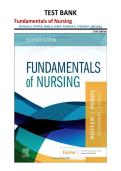
TEST BANK
Fundamentals of Nursing
PATRICIA A. POTTER, ANNE G. PERRY, PATRICIA A. STOCKERT, AMY HALL
11th Edition
,Welcome to Your Ultimate Nursing Foundations Test Bank
This is your all-in-one study weapon — built for the modern nursing student grinding with
purpose and stepping into a legacy bigger than themselves. It mixes timeless nursing
wisdom with today’s practical reality, giving you the exact kind of mastery your exams
demand.
No fluff. No outdated noise. Just clean, original questions with rationales that actually teach
you how to think like a nurse, not just memorize one.
You’ll also find a few 100% free test bank links inside — handpicked gems to boost your
prep even further. No paywalls, no sign-ups, just extra ammo for your study journey.
The entire document is fully searchable — hit Ctrl + F (Windows) or Command + F (Mac)
and type whatever you need. Every chapter, topic, and question is optimized to show up
instantly.
Step in bold. Study smart. Let’s get you exam-ready.
CHAPTER 1 — High-Yield Nursing Fundamentals: Must-Know Questions
1.- A 65-year-old patient presents with confusion, fever 39°C, HR 128, BP 85/50, RR
28, SpO₂ 91% on room air. What is the priority nursing action?
Administer acetaminophen
Initiate sepsis protocol
Notify the physician
Draw blood cultures
Answer: B — Initiate sepsis protocol
⭐ Rational:
This patient meets SIRS criteria and shows early severe sepsis signs
(hypotension + confusion = organ hypoperfusion).
Immediate initiation of sepsis protocol (IV fluids, oxygen, labs, prepare
antibiotics) is priority to prevent multi-organ failure.
Option Analysis:
A ✗ Reduces fever but does not treat underlying infection.
B ✓ Correct — addresses ABCs and sepsis management immediately.
C ✗ Notify physician important but protocol begins immediately.
D ✗ Blood cultures necessary but after initiating fluids/oxygen.
Step Action Rationale
1 Assess ABC Ensure airway, breathing,
circulation
2 Start sepsis protocol Fluids, labs, antibiotics
3 Oxygen therapy Correct hypoxia
4 Notify physician Collaborative care
5 Draw cultures After initial interventions
2|P age
,Clinical Pearl: Confusion in sepsis often precedes hypotension — early recognition
saves lives.
2.- A nurse identifies a patient is at risk for falls. Priority nursing action?
Encourage independence
Raise all side rails
Keep frequently used items within reach
Restrain the patient
Answer: C — Keep frequently used items within reach
⭐ Rational:
Reduces unnecessary movement while maintaining safety and dignity.
A ✗ Independence unsafe if patient is unstable.
B ✗ Side rails may cause climbing and injury.
D ✗ Restraints = last resort, strict legal/ethical limits.
3.- SATA: Interventions to reduce fall risk:
Non-slip socks
Keep call light within reach
Dim lighting at night
Encourage rapid ambulation
Bed alarms
Answer: A, B, E
Rational:
Non-slip socks and bed alarms prevent falls.
Dim lighting helps vision, but patient still needs supervision.
Rapid ambulation is unsafe in high-risk patients.
4.- Adult patient with RR 28/min. Breathing pattern?
Eupnea
Bradypnea
Tachypnea
Hyperventilation
Answer: C — Tachypnea
⭐ Rational:
3|P age
, Tachypnea = fast breathing >20/min.
Causes: fever, pain, anxiety, hypoxia.
Hyperventilation = fast + deep; bradypnea = <12/min; eupnea = 12–20/min.
Pattern Rate Notes
(breaths/min)
Eupnea 12–20 Normal breathing
Bradypnea <12 Slow breathing
Tachypnea >20 Rapid breathing
Hyperventilation >20 + deep Excessive ventilation
5.- After administering antihypertensive medication, BP normalized. Nursing process step?
Assessment
Diagnosis
Planning
Evaluation
Answer: D — Evaluation
⭐ Rational:
Evaluation = measures effectiveness of interventions.
Assessment = data collection; Diagnosis = problem identification; Planning = goal
setting.
Page 4 — Infection Control & PPE
6.- Patient on droplet precautions requires which primary PPE?
N95 respirator
Surgical mask
Gown only
Gloves only
Answer: B — Surgical mask
⭐ Rational:
Droplet infections = large particles traveling short distances.
N95 = airborne (TB, measles).
Gown/gloves = situational.
Option Explanation
A Airborne only
B Correct — blocks droplets
C Optional if fluids expected
D Not primary protection
7.- Patient refuses medication. Best action?
4|P age
Fundamentals of Nursing
PATRICIA A. POTTER, ANNE G. PERRY, PATRICIA A. STOCKERT, AMY HALL
11th Edition
,Welcome to Your Ultimate Nursing Foundations Test Bank
This is your all-in-one study weapon — built for the modern nursing student grinding with
purpose and stepping into a legacy bigger than themselves. It mixes timeless nursing
wisdom with today’s practical reality, giving you the exact kind of mastery your exams
demand.
No fluff. No outdated noise. Just clean, original questions with rationales that actually teach
you how to think like a nurse, not just memorize one.
You’ll also find a few 100% free test bank links inside — handpicked gems to boost your
prep even further. No paywalls, no sign-ups, just extra ammo for your study journey.
The entire document is fully searchable — hit Ctrl + F (Windows) or Command + F (Mac)
and type whatever you need. Every chapter, topic, and question is optimized to show up
instantly.
Step in bold. Study smart. Let’s get you exam-ready.
CHAPTER 1 — High-Yield Nursing Fundamentals: Must-Know Questions
1.- A 65-year-old patient presents with confusion, fever 39°C, HR 128, BP 85/50, RR
28, SpO₂ 91% on room air. What is the priority nursing action?
Administer acetaminophen
Initiate sepsis protocol
Notify the physician
Draw blood cultures
Answer: B — Initiate sepsis protocol
⭐ Rational:
This patient meets SIRS criteria and shows early severe sepsis signs
(hypotension + confusion = organ hypoperfusion).
Immediate initiation of sepsis protocol (IV fluids, oxygen, labs, prepare
antibiotics) is priority to prevent multi-organ failure.
Option Analysis:
A ✗ Reduces fever but does not treat underlying infection.
B ✓ Correct — addresses ABCs and sepsis management immediately.
C ✗ Notify physician important but protocol begins immediately.
D ✗ Blood cultures necessary but after initiating fluids/oxygen.
Step Action Rationale
1 Assess ABC Ensure airway, breathing,
circulation
2 Start sepsis protocol Fluids, labs, antibiotics
3 Oxygen therapy Correct hypoxia
4 Notify physician Collaborative care
5 Draw cultures After initial interventions
2|P age
,Clinical Pearl: Confusion in sepsis often precedes hypotension — early recognition
saves lives.
2.- A nurse identifies a patient is at risk for falls. Priority nursing action?
Encourage independence
Raise all side rails
Keep frequently used items within reach
Restrain the patient
Answer: C — Keep frequently used items within reach
⭐ Rational:
Reduces unnecessary movement while maintaining safety and dignity.
A ✗ Independence unsafe if patient is unstable.
B ✗ Side rails may cause climbing and injury.
D ✗ Restraints = last resort, strict legal/ethical limits.
3.- SATA: Interventions to reduce fall risk:
Non-slip socks
Keep call light within reach
Dim lighting at night
Encourage rapid ambulation
Bed alarms
Answer: A, B, E
Rational:
Non-slip socks and bed alarms prevent falls.
Dim lighting helps vision, but patient still needs supervision.
Rapid ambulation is unsafe in high-risk patients.
4.- Adult patient with RR 28/min. Breathing pattern?
Eupnea
Bradypnea
Tachypnea
Hyperventilation
Answer: C — Tachypnea
⭐ Rational:
3|P age
, Tachypnea = fast breathing >20/min.
Causes: fever, pain, anxiety, hypoxia.
Hyperventilation = fast + deep; bradypnea = <12/min; eupnea = 12–20/min.
Pattern Rate Notes
(breaths/min)
Eupnea 12–20 Normal breathing
Bradypnea <12 Slow breathing
Tachypnea >20 Rapid breathing
Hyperventilation >20 + deep Excessive ventilation
5.- After administering antihypertensive medication, BP normalized. Nursing process step?
Assessment
Diagnosis
Planning
Evaluation
Answer: D — Evaluation
⭐ Rational:
Evaluation = measures effectiveness of interventions.
Assessment = data collection; Diagnosis = problem identification; Planning = goal
setting.
Page 4 — Infection Control & PPE
6.- Patient on droplet precautions requires which primary PPE?
N95 respirator
Surgical mask
Gown only
Gloves only
Answer: B — Surgical mask
⭐ Rational:
Droplet infections = large particles traveling short distances.
N95 = airborne (TB, measles).
Gown/gloves = situational.
Option Explanation
A Airborne only
B Correct — blocks droplets
C Optional if fluids expected
D Not primary protection
7.- Patient refuses medication. Best action?
4|P age