
Lecture 9 permeability of vascular
endothelium
Where in the vasculature is permeability
most relevant?
Aorta 25 millimeter
Capillaries 6micrometer – have the most
surface area and thus the most volume
Vena cava 30 millimeter
Build-up of endothelium: endothelial (single cell layer) → basal
lamina → internal elastic → smooth muscle (different layers) →
external elastic → tunica adventitia
Functions of vascular endothelium:
- Semi-permeable barrier between plasma and tissues.
The permeability is related in the capillaries
The vascular permeability has to be limited to prevent oedema (damaging for
tissues because it blocks the circulation)
Problem in the lymphatic system will also lead to oedema because lymphatic
system drain away the fluid
- Regulates vascular tone indirectly; signals to smooth muscle cells to relax or
contract
- Prevents coagulation (bloedstolling)
- Controls leukocyte traffic to tissues/organs during inflammation
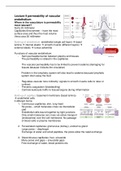
Build-up of capillary: basement membrane (basal lamina)
→ endothelial cells
3 different forms:
1. Continuous capillaries; skin, lung heart
No pores – small molecules cross via intercellular
cleft
Endothelial cells bound together by tight junctions
Only small molecules can cross via active transport
(endosomes) over the cell membrane. No passage
of blood cells or plasma membranes
2. Fenestrated capillaries; glomerulus (kidney), endocrine gland
Large pores – diaphragm
Exchange of water and small peptides, the pores allow the rapid exchange
3. Discontinuous capillaries: liver, sinusoids
Many pores and gaps – sinusoidal gaps
Free exchange of water, blood proteins etc.
endothelium
Where in the vasculature is permeability
most relevant?
Aorta 25 millimeter
Capillaries 6micrometer – have the most
surface area and thus the most volume
Vena cava 30 millimeter
Build-up of endothelium: endothelial (single cell layer) → basal
lamina → internal elastic → smooth muscle (different layers) →
external elastic → tunica adventitia
Functions of vascular endothelium:
- Semi-permeable barrier between plasma and tissues.
The permeability is related in the capillaries
The vascular permeability has to be limited to prevent oedema (damaging for
tissues because it blocks the circulation)
Problem in the lymphatic system will also lead to oedema because lymphatic
system drain away the fluid
- Regulates vascular tone indirectly; signals to smooth muscle cells to relax or
contract
- Prevents coagulation (bloedstolling)
- Controls leukocyte traffic to tissues/organs during inflammation
Build-up of capillary: basement membrane (basal lamina)
→ endothelial cells
3 different forms:
1. Continuous capillaries; skin, lung heart
No pores – small molecules cross via intercellular
cleft
Endothelial cells bound together by tight junctions
Only small molecules can cross via active transport
(endosomes) over the cell membrane. No passage
of blood cells or plasma membranes
2. Fenestrated capillaries; glomerulus (kidney), endocrine gland
Large pores – diaphragm
Exchange of water and small peptides, the pores allow the rapid exchange
3. Discontinuous capillaries: liver, sinusoids
Many pores and gaps – sinusoidal gaps
Free exchange of water, blood proteins etc.


