CHEM 135 WS (Prof. Beaupre)
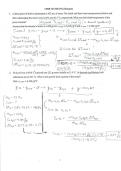
1. A 360 g piece of steel is submerged in 425 mL of water. The initial and final water terriperatures (before and
after submerging the steel) were 24.00°Cand 42.7 °C respectlvely
What was the initial temperature of the
piece of metal? AS.SUlMe
: T{, H,0 = T}: .sL{,d.l (c# themal e&wllmdm)
| B T e s e ——s
Assume that the density of water is 1.000 g/cm3 cs sreel= 0.449 //g"C' and Cs water = 4.184 ]/2°C
et gl © Fuo = O~ |Fui<e- oGusl
ol £ g AT
Msiee) 23609 0
Cs stezl = o.v*(‘lgr% Msteel €, 54l AT""“" = "My,0 G, M0 ATu.o
ATstel = 42.3°C-T; 4
‘ ' : ® Solve for ATsreal *
Myoo = 4250 o) 1.0903 - 455 ATorg) = o S, H0 AT 0 -
[Ma 7
-
Cs, m,0 = 4.184 7¢
Psteal
chbon . ek
- )
!
A ol °
ATi0 = yp 3% -24.0C=1%.7% @423"‘: T = T 425035 ) e )W ‘T.=2%’°
\SDe
& T (360/?)(O L e
2. 55.0gofironat99.8 °C‘is placed into 225 g water initially at 21.0 °C. At thermal equilibrium, both
substances are at 23.1 °C. What is the specific heat capacity of the metal?
Note: Cs water = 4.184 J/2°C
fre” Fro= @~ pr="Fno & F=meAT
Me, = 55.03 N T~
CsFe = ? ( Mre Cs,Fe Alpe = ~ mflzo Cs,H,0 ATH?_ o
AVe = 230%-99.8%C = -H 3%
So\@. ‘COY CS) Fo 2
My, 0 = Z'ZSJ
Cs Fo = ~Mue0 S5 H,0 Diliio
Cs,h0= 4. 189 scc
Mre Ol
}
Nlyyo = 231°C-21.0%= 2.\
L S G Ie o CS g
X
(55—03 ) _(‘?6 7 "C) WL___~,_
, \[ %: CO”S+GY1")' ( m= CO”Shfl'I' \(—r; = COY\S+QrT+2
3. A fixed amount of heat is added to one-gram samples of carbon and copper, both originally at room
temperature. Which statement is correct?
AT Substance Specific Heat (J-.g-K'1) 8/ .
Higher <&— Higher &—¢<—| Copper 0.385
_ .73; = Cs AT» w AT
Tg Carbon 0.709
A SRS
t
a.
|
Copper would absorb the same amount of energy as carbon and attain the same final temperature
as carbon.
@ Copper would absorb the same amount of energy as carbon and attain a higher final temperature
than carbon. :
c. Copper would absorb less energy than carbon and attain the same final temperature as carbon.
d. Copper would absorb more energy than carbon and attain the same final temperature as carbon.
Know: g= mcAT and know that if both metals come to equilibrium in the water, the final temperature of the metals
will beand understand that for samples of the same mass that are exposed to the same amount of heat, the c
(specific heat) values will determine the final equilibrium temperatures (consider the units for c: J-.g:K* or J-g°C1)
4. The standard enthalpy of formation, AH;, for NO2(g) is the enthalpy change for which reaction?
a. N(g) +0(g) = NO2(g)
@ 15 N2(g) + 02(g) — NO2(g)
c. % N204(g) —» NO2(g)
d. NO(g) + % 02(g) —» NO2(g)
5. The molar enthalpy of formation for H,0(#) is -258.8 k]-mol-L. Which expression describes the enthalpy
change for the reaction:
2H,0(8) » 2Hy(g) +0:(8) AHS=
RXN
T
a. —% (AHp)
b. — (AHp) Wate AHe v H0 ()2
(©) —2(8Hp) 1 &
HZ (7) v 202 (3) s H?.O (7) AHF,HLO
d. 1/(AHf°)
Tf revesed & mulbplied by 2, we get
2 Thus -2 AH¢ w0 = AH e
1. A 360 g piece of steel is submerged in 425 mL of water. The initial and final water terriperatures (before and
after submerging the steel) were 24.00°Cand 42.7 °C respectlvely
What was the initial temperature of the
piece of metal? AS.SUlMe
: T{, H,0 = T}: .sL{,d.l (c# themal e&wllmdm)
| B T e s e ——s
Assume that the density of water is 1.000 g/cm3 cs sreel= 0.449 //g"C' and Cs water = 4.184 ]/2°C
et gl © Fuo = O~ |Fui<e- oGusl
ol £ g AT
Msiee) 23609 0
Cs stezl = o.v*(‘lgr% Msteel €, 54l AT""“" = "My,0 G, M0 ATu.o
ATstel = 42.3°C-T; 4
‘ ' : ® Solve for ATsreal *
Myoo = 4250 o) 1.0903 - 455 ATorg) = o S, H0 AT 0 -
[Ma 7
-
Cs, m,0 = 4.184 7¢
Psteal
chbon . ek
- )
!
A ol °
ATi0 = yp 3% -24.0C=1%.7% @423"‘: T = T 425035 ) e )W ‘T.=2%’°
\SDe
& T (360/?)(O L e
2. 55.0gofironat99.8 °C‘is placed into 225 g water initially at 21.0 °C. At thermal equilibrium, both
substances are at 23.1 °C. What is the specific heat capacity of the metal?
Note: Cs water = 4.184 J/2°C
fre” Fro= @~ pr="Fno & F=meAT
Me, = 55.03 N T~
CsFe = ? ( Mre Cs,Fe Alpe = ~ mflzo Cs,H,0 ATH?_ o
AVe = 230%-99.8%C = -H 3%
So\@. ‘COY CS) Fo 2
My, 0 = Z'ZSJ
Cs Fo = ~Mue0 S5 H,0 Diliio
Cs,h0= 4. 189 scc
Mre Ol
}
Nlyyo = 231°C-21.0%= 2.\
L S G Ie o CS g
X
(55—03 ) _(‘?6 7 "C) WL___~,_
, \[ %: CO”S+GY1")' ( m= CO”Shfl'I' \(—r; = COY\S+QrT+2
3. A fixed amount of heat is added to one-gram samples of carbon and copper, both originally at room
temperature. Which statement is correct?
AT Substance Specific Heat (J-.g-K'1) 8/ .
Higher <&— Higher &—¢<—| Copper 0.385
_ .73; = Cs AT» w AT
Tg Carbon 0.709
A SRS
t
a.
|
Copper would absorb the same amount of energy as carbon and attain the same final temperature
as carbon.
@ Copper would absorb the same amount of energy as carbon and attain a higher final temperature
than carbon. :
c. Copper would absorb less energy than carbon and attain the same final temperature as carbon.
d. Copper would absorb more energy than carbon and attain the same final temperature as carbon.
Know: g= mcAT and know that if both metals come to equilibrium in the water, the final temperature of the metals
will beand understand that for samples of the same mass that are exposed to the same amount of heat, the c
(specific heat) values will determine the final equilibrium temperatures (consider the units for c: J-.g:K* or J-g°C1)
4. The standard enthalpy of formation, AH;, for NO2(g) is the enthalpy change for which reaction?
a. N(g) +0(g) = NO2(g)
@ 15 N2(g) + 02(g) — NO2(g)
c. % N204(g) —» NO2(g)
d. NO(g) + % 02(g) —» NO2(g)
5. The molar enthalpy of formation for H,0(#) is -258.8 k]-mol-L. Which expression describes the enthalpy
change for the reaction:
2H,0(8) » 2Hy(g) +0:(8) AHS=
RXN
T
a. —% (AHp)
b. — (AHp) Wate AHe v H0 ()2
(©) —2(8Hp) 1 &
HZ (7) v 202 (3) s H?.O (7) AHF,HLO
d. 1/(AHf°)
Tf revesed & mulbplied by 2, we get
2 Thus -2 AH¢ w0 = AH e