

Kayla Humphries
SETTLEMEN
T
A place where a group of people live.
A. The concept of settlement
Where people live (buildings, infrastructure etc.) = function as single connected
system.
Consider the following when classifying settlements:
1. Number of people in the settlement
2. Functions offered by the settlement (uni-functional/multifunctional)
B. Site and situation
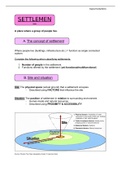
Site: The physical space (actual ground) that a settlement occupies.
- Described using FACTORS that influence the site.
Situation: The position of settlement in relation to surrounding environment.
- Human-made and natural resources
- Described using PROXIMITY & ACCESSBILITY
Source: Shuters Top Class Geography Grade 12 Learners book
, Kayla Humphries
C. Rural & Urban settlements
Rural settlements Urban Settlements
Primary economic activity = Secondary & tertiary activities.
Economic large land needed. E.g. E.g processing, services, tourism
activity farming, fishing etc. etc.
- Unifunctional - Multifunctional
Dispersed – buildings
located far from each
Settlement
other. Nucleated
pattern
Nucleated – Buildings
close together.
Universities, hospitals, large
Infrastructur Smaller roads (dust), small
schools, malls, pipelines,
e & services schools, small shops (spaza).
transport links etc.
Population
Low High
density
SETTLEMENT CLASSIFICATION IN SOUTH AFRICA:
Deep rural:
- Poor communities, limited access to services.
- No water sanitation/electricity.
- Live rural lifestyles.
- Subsistence communities, migrant labourers who send money home.
Rural:
- Rural characteristics.
- Access to basic services.
- Farms/small rural villages/towns.
Peri-urban:
- Part of rural-urban fringe.
- Less dense.
- Live rural lifestyle with some urban characteristics.
- Household members work in urban centres.
- Located on edge of cities
SETTLEMEN
T
A place where a group of people live.
A. The concept of settlement
Where people live (buildings, infrastructure etc.) = function as single connected
system.
Consider the following when classifying settlements:
1. Number of people in the settlement
2. Functions offered by the settlement (uni-functional/multifunctional)
B. Site and situation
Site: The physical space (actual ground) that a settlement occupies.
- Described using FACTORS that influence the site.
Situation: The position of settlement in relation to surrounding environment.
- Human-made and natural resources
- Described using PROXIMITY & ACCESSBILITY
Source: Shuters Top Class Geography Grade 12 Learners book
, Kayla Humphries
C. Rural & Urban settlements
Rural settlements Urban Settlements
Primary economic activity = Secondary & tertiary activities.
Economic large land needed. E.g. E.g processing, services, tourism
activity farming, fishing etc. etc.
- Unifunctional - Multifunctional
Dispersed – buildings
located far from each
Settlement
other. Nucleated
pattern
Nucleated – Buildings
close together.
Universities, hospitals, large
Infrastructur Smaller roads (dust), small
schools, malls, pipelines,
e & services schools, small shops (spaza).
transport links etc.
Population
Low High
density
SETTLEMENT CLASSIFICATION IN SOUTH AFRICA:
Deep rural:
- Poor communities, limited access to services.
- No water sanitation/electricity.
- Live rural lifestyles.
- Subsistence communities, migrant labourers who send money home.
Rural:
- Rural characteristics.
- Access to basic services.
- Farms/small rural villages/towns.
Peri-urban:
- Part of rural-urban fringe.
- Less dense.
- Live rural lifestyle with some urban characteristics.
- Household members work in urban centres.
- Located on edge of cities



