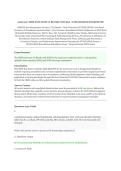
2026/2027 HESI EXIT EXAM V2 RETAKE NGN Q&A | CASE-BASED SCENARIOS PDF
HESI RN Exit Examination Version 2 (V2) Retake - Next Generation NCLEX® (NGN) Case-Based
Scenarios & Remediation Question Bank | Core Domains: Remediated Clinical Judgment via NGN Items
(Extended Multiple Response, Matrix, Bow-Tie), Targeted Unfolding Case Studies Addressing Common
Knowledge Gaps, Integrated Pharmacology & Pathophysiology Review, Prioritization & Delegation in
Remediation Scenarios, Patient Safety & Risk Management Focus, Ethical/Legal Reasoning in
Corrective Contexts, and Performance Improvement Strategies for NCLEX-RN® Success |
NCLEX-RN® Remediation & Readiness Focus | Targeted Retake PDF Format
Exam Structure
The HESI Exit Exam V2 Retake with NGN for the 2026/2027 academic cycle is a 150-question,
multiple-choice question (MCQ) and NGN item-type examination.
Introduction
This HESI Exit Exam V2 Retake NGN Q&A PDF for the 2026/2027 cycle is designed specifically for
students requiring remediation and a second comprehensive assessment. It provides targeted case-based
scenarios that focus on common areas of weakness, reinforcing clinical judgment, critical thinking, and
application of nursing knowledge through the Next Generation NCLEX® framework to ensure readiness
for both the HESI retake and the updated licensure examination.
Answer Format
All correct answers and remediated clinical actions must be presented in bold and green, followed by
detailed rationales that explicitly correct previous misconceptions, reinforce the NGN Clinical Judgment
Measurement Model steps, integrate reviewed content from identified weak areas, justify revised priority
decisions, and explain the evidence-based rationale for improved patient management strategies.
Questions (150 Total)
1.
A student previously confused hypokalemia with hyperkalemia. Now, a 68-year-old male with heart
failure has K⁺ 3.1 mEq/L, BP 168/94 mm Hg, HR 112 bpm, and SpO₂ 90%. He is on furosemide and
lisinopril.
What is the priority action to prevent a life-threatening complication?
A. Administer oxygen
B. Give potassium chloride as ordered and monitor ECG for arrhythmias
C. Increase IV fluids
,D. Encourage ambulation
Rationale (Remediation Focus):
Correcting Misconception: Hypokalemia (K⁺ <3.5) causes U waves, flat T waves, and increases risk
of digoxin toxicity and ventricular arrhythmias—not peaked T waves (which occur in hyperkalemia).
Recognize Cues: K⁺ 3.1, tachycardia, HF meds (diuretics cause K⁺ loss).
Analyze Cues: Arrhythmia risk outweighs mild hypoxia.
Prioritize Hypotheses: Cardiac safety > respiratory status.
Take Action: Replace K⁺ per protocol; continuous ECG monitoring.
Evaluate Outcomes: K⁺ normalizes; no dysrhythmias occur.
2.
A student previously misinterpreted Apgar scoring. Now, a newborn at 1 minute has HR 110, slow
respirations, some flexion, grimace, and acrocyanosis.
What is the correct Apgar score and action?
A. Score 5; begin CPR
B. Score 6; provide routine care with stimulation and monitoring
C. Score 7; discharge immediately
D. Score 8; no intervention needed
Rationale (Remediation Focus):
Correcting Misconception: Acrocyanosis is normal in newborns and scores 1 point—not 0. Full
cyanosis scores 0.
Scoring Breakdown: HR >100 = 2; slow resp = 1; some flexion = 1; grimace = 1; acrocyanosis = 1 →
Total = 6.
Recognize Cues: Moderate transition difficulty.
Analyze Cues: No need for resuscitation—only supportive care.
Take Action: Dry, warm, stimulate, reassess at 5 minutes.
,Evaluate Outcomes: Score improves to 8–9 by 5 minutes.
3.
A student previously prioritized medication administration over airway. Now, a 6-year-old with asthma
has SpO₂ 82%, RR 52, silent chest, and poor response to albuterol.
What is the priority intervention?
A. Give another nebulizer treatment
B. Prepare for intubation due to impending respiratory arrest
C. Obtain peak flow measurement
D. Administer oral steroids
Rationale (Remediation Focus):
Correcting Misconception: ABCs always come first—airway before medications.
Recognize Cues: Silent chest = no air movement = exhaustion.
Analyze Cues: Medical therapy is failing; arrest is imminent.
Prioritize Hypotheses: Secure airway > drug administration.
Take Action: Call rapid response; prepare for intubation.
Evaluate Outcomes: Airway secured; oxygenation restored.
4.
A student previously delegated a complex task to unlicensed staff. Now, four patients need attention.
Which task can be safely delegated to a UAP?
A. Assess post-op wound drainage
B. Assist a stable client with ambulation
C. Evaluate pain response to medication
D. Teach discharge instructions
, Rationale (Remediation Focus):
Correcting Misconception: Only non-assessment, non-teaching, routine tasks may be delegated.
Recognize Cues: Ambulation of stable patient requires no clinical judgment.
Analyze Cues: Wound assessment, pain evaluation, and teaching require RN licensure.
Prioritize Hypotheses: Safe delegation preserves patient safety and role clarity.
Take Action: Assign ambulation to UAP; retain complex tasks.
Evaluate Outcomes: Patient mobilized safely; RN focuses on critical assessments.
5.
A student previously missed signs of delirium. Now, a 75-year-old 2 days post-op is confused, pulling IV,
and calling nurse “mom.” Urinalysis shows WBCs.
What condition should the nurse suspect?
A. Dementia progression
B. Delirium secondary to UTI
C. Stroke
D. Depression
Rationale (Remediation Focus):
Correcting Misconception: Delirium is acute and fluctuating; dementia is chronic.
HESI RN Exit Examination Version 2 (V2) Retake - Next Generation NCLEX® (NGN) Case-Based
Scenarios & Remediation Question Bank | Core Domains: Remediated Clinical Judgment via NGN Items
(Extended Multiple Response, Matrix, Bow-Tie), Targeted Unfolding Case Studies Addressing Common
Knowledge Gaps, Integrated Pharmacology & Pathophysiology Review, Prioritization & Delegation in
Remediation Scenarios, Patient Safety & Risk Management Focus, Ethical/Legal Reasoning in
Corrective Contexts, and Performance Improvement Strategies for NCLEX-RN® Success |
NCLEX-RN® Remediation & Readiness Focus | Targeted Retake PDF Format
Exam Structure
The HESI Exit Exam V2 Retake with NGN for the 2026/2027 academic cycle is a 150-question,
multiple-choice question (MCQ) and NGN item-type examination.
Introduction
This HESI Exit Exam V2 Retake NGN Q&A PDF for the 2026/2027 cycle is designed specifically for
students requiring remediation and a second comprehensive assessment. It provides targeted case-based
scenarios that focus on common areas of weakness, reinforcing clinical judgment, critical thinking, and
application of nursing knowledge through the Next Generation NCLEX® framework to ensure readiness
for both the HESI retake and the updated licensure examination.
Answer Format
All correct answers and remediated clinical actions must be presented in bold and green, followed by
detailed rationales that explicitly correct previous misconceptions, reinforce the NGN Clinical Judgment
Measurement Model steps, integrate reviewed content from identified weak areas, justify revised priority
decisions, and explain the evidence-based rationale for improved patient management strategies.
Questions (150 Total)
1.
A student previously confused hypokalemia with hyperkalemia. Now, a 68-year-old male with heart
failure has K⁺ 3.1 mEq/L, BP 168/94 mm Hg, HR 112 bpm, and SpO₂ 90%. He is on furosemide and
lisinopril.
What is the priority action to prevent a life-threatening complication?
A. Administer oxygen
B. Give potassium chloride as ordered and monitor ECG for arrhythmias
C. Increase IV fluids
,D. Encourage ambulation
Rationale (Remediation Focus):
Correcting Misconception: Hypokalemia (K⁺ <3.5) causes U waves, flat T waves, and increases risk
of digoxin toxicity and ventricular arrhythmias—not peaked T waves (which occur in hyperkalemia).
Recognize Cues: K⁺ 3.1, tachycardia, HF meds (diuretics cause K⁺ loss).
Analyze Cues: Arrhythmia risk outweighs mild hypoxia.
Prioritize Hypotheses: Cardiac safety > respiratory status.
Take Action: Replace K⁺ per protocol; continuous ECG monitoring.
Evaluate Outcomes: K⁺ normalizes; no dysrhythmias occur.
2.
A student previously misinterpreted Apgar scoring. Now, a newborn at 1 minute has HR 110, slow
respirations, some flexion, grimace, and acrocyanosis.
What is the correct Apgar score and action?
A. Score 5; begin CPR
B. Score 6; provide routine care with stimulation and monitoring
C. Score 7; discharge immediately
D. Score 8; no intervention needed
Rationale (Remediation Focus):
Correcting Misconception: Acrocyanosis is normal in newborns and scores 1 point—not 0. Full
cyanosis scores 0.
Scoring Breakdown: HR >100 = 2; slow resp = 1; some flexion = 1; grimace = 1; acrocyanosis = 1 →
Total = 6.
Recognize Cues: Moderate transition difficulty.
Analyze Cues: No need for resuscitation—only supportive care.
Take Action: Dry, warm, stimulate, reassess at 5 minutes.
,Evaluate Outcomes: Score improves to 8–9 by 5 minutes.
3.
A student previously prioritized medication administration over airway. Now, a 6-year-old with asthma
has SpO₂ 82%, RR 52, silent chest, and poor response to albuterol.
What is the priority intervention?
A. Give another nebulizer treatment
B. Prepare for intubation due to impending respiratory arrest
C. Obtain peak flow measurement
D. Administer oral steroids
Rationale (Remediation Focus):
Correcting Misconception: ABCs always come first—airway before medications.
Recognize Cues: Silent chest = no air movement = exhaustion.
Analyze Cues: Medical therapy is failing; arrest is imminent.
Prioritize Hypotheses: Secure airway > drug administration.
Take Action: Call rapid response; prepare for intubation.
Evaluate Outcomes: Airway secured; oxygenation restored.
4.
A student previously delegated a complex task to unlicensed staff. Now, four patients need attention.
Which task can be safely delegated to a UAP?
A. Assess post-op wound drainage
B. Assist a stable client with ambulation
C. Evaluate pain response to medication
D. Teach discharge instructions
, Rationale (Remediation Focus):
Correcting Misconception: Only non-assessment, non-teaching, routine tasks may be delegated.
Recognize Cues: Ambulation of stable patient requires no clinical judgment.
Analyze Cues: Wound assessment, pain evaluation, and teaching require RN licensure.
Prioritize Hypotheses: Safe delegation preserves patient safety and role clarity.
Take Action: Assign ambulation to UAP; retain complex tasks.
Evaluate Outcomes: Patient mobilized safely; RN focuses on critical assessments.
5.
A student previously missed signs of delirium. Now, a 75-year-old 2 days post-op is confused, pulling IV,
and calling nurse “mom.” Urinalysis shows WBCs.
What condition should the nurse suspect?
A. Dementia progression
B. Delirium secondary to UTI
C. Stroke
D. Depression
Rationale (Remediation Focus):
Correcting Misconception: Delirium is acute and fluctuating; dementia is chronic.