Lecture 1.3 – case 1 eggs
Self – study:
Composition and structure
Activities are aimed at survival of the individual and the species, reproduction is
essential for the ladder, this process starts amongst others with the egg cell
(ovum).
- Mammalian egg cells have very little yolk, oligolecithal egg cells.
- Insects, fish, reptiles and birds have large egg cells, with the yolk filling the
largest part of the cell, telolecithal egg cells.
- Eggs for consumption are usually unfertilised.
- The egg shell consists to 93-98% of calcium carbonate (CaCO3).
oviparous; the females lay eggs from which the young later emerges.
viviparous; they give birth to live young.
ovoviviparous; they produce eggs with a lot of yolk that develop further within
the female’s reproductive organs. The embryos are not attached to the wall of
the oviduct (or the uterus) and do not receive any further nutrients from the
mother animal.
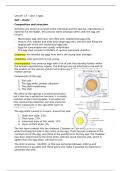
Components of the egg:
1. The yolk
2. The egg white, protein; albumen
3. The shell membranes
4. The shell
The white of the egg has a nutritional function,
but it also has a protective function; it is elastic,
.
cushions impact and insulates. It provides not
only mechanical protection, but also chemical:
certain substances in the egg white have an
antibacterial effect.
The egg white consist of 4 layers, around the yolk:
1. Outer thin layer, 23%
2. Thick layer, 57%
3. Innermost layer of thin white, 17%
4. Layer of thick white, 3%
The last layer extends into the chalazas. Chalazas are spiralling strands of egg
white that keep the yolk in the centre of the egg. There are two chalazas at the
rounded end of the egg, and three at the pointed end. As they age, the chalazas
lose their attachment to the thick white, with the result that the yolk, which is
lighter than the egg white, will start to rise.
The shell is porous (10,000), so that gas exchange between embryo and
environment is possible. But these pores also make it possible for bacteria to
penetrate the shell.
Self – study:
Composition and structure
Activities are aimed at survival of the individual and the species, reproduction is
essential for the ladder, this process starts amongst others with the egg cell
(ovum).
- Mammalian egg cells have very little yolk, oligolecithal egg cells.
- Insects, fish, reptiles and birds have large egg cells, with the yolk filling the
largest part of the cell, telolecithal egg cells.
- Eggs for consumption are usually unfertilised.
- The egg shell consists to 93-98% of calcium carbonate (CaCO3).
oviparous; the females lay eggs from which the young later emerges.
viviparous; they give birth to live young.
ovoviviparous; they produce eggs with a lot of yolk that develop further within
the female’s reproductive organs. The embryos are not attached to the wall of
the oviduct (or the uterus) and do not receive any further nutrients from the
mother animal.
Components of the egg:
1. The yolk
2. The egg white, protein; albumen
3. The shell membranes
4. The shell
The white of the egg has a nutritional function,
but it also has a protective function; it is elastic,
.
cushions impact and insulates. It provides not
only mechanical protection, but also chemical:
certain substances in the egg white have an
antibacterial effect.
The egg white consist of 4 layers, around the yolk:
1. Outer thin layer, 23%
2. Thick layer, 57%
3. Innermost layer of thin white, 17%
4. Layer of thick white, 3%
The last layer extends into the chalazas. Chalazas are spiralling strands of egg
white that keep the yolk in the centre of the egg. There are two chalazas at the
rounded end of the egg, and three at the pointed end. As they age, the chalazas
lose their attachment to the thick white, with the result that the yolk, which is
lighter than the egg white, will start to rise.
The shell is porous (10,000), so that gas exchange between embryo and
environment is possible. But these pores also make it possible for bacteria to
penetrate the shell.