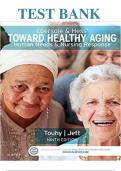
Nurse's Pocket Guide, 16th Edition
Diagnoses, Prioritized Interventions,
And Rationales
16th Edition
• Author(S)Marilynn E. Doenges; Mary
Frances Moorhouse; Alice C. Murr
TEST BANK
Q1 — Reference
The Nursing Process — Steps of the Nursing Process & Their
Purposes.
Stem: A nurse performs a focused interview, records vital signs,
inspects a surgical dressing, and documents the findings in the
chart. Which step of the nursing process is the nurse
performing?
,A. Diagnosis
B. Assessment
C. Planning
D. Evaluation
Correct answer: B
Rationales
• Correct (B): Assessment is the systematic gathering,
sorting, organizing, and documentation of data to form a
database for subsequent steps. The actions listed
(interview, vitals, inspection, documentation) are
assessment tasks that produce data for diagnosis and
planning.
• Incorrect (A): Diagnosis requires analysis and clustering of
collected data to identify patient responses; it does not
describe the data-gathering actions in the stem.
• Incorrect (C): Planning uses diagnostic statements and
desired outcomes to select interventions — it follows
assessment and diagnosis, not data collection.
• Incorrect (D): Evaluation measures achievement of
outcomes after interventions; it requires comparing
expected outcomes with actual client responses, not initial
data collection.
Teaching point: Assessment = systematic data gathering,
documentation, and organization.
,Citation: Doenges, M. E., Moorhouse, M. F., & Murr, A. C.
(2022). Nurse’s Pocket Guide (16th ed.). The Nursing Process
and Planning Client Care.
Q2 — Reference
Diagnosis — Formulating a Diagnostic Statement (ND label +
related factor + cues).
Stem: A postoperative client reports "I can’t catch my breath,"
has respiratory rate 28/min, SpO₂ 88% on room air, and
auscultation with bilateral crackles. Which nursing diagnostic
statement most correctly follows the format emphasized in
Chapter 1?
A. Ineffective airway clearance related to crackles.
B. Impaired gas exchange related to retained secretions as
evidenced by SpO₂ 88% and dyspnea.
C. Respiratory distress as evidenced by crackles and increased
respiratory rate.
D. Oxygenation deficit related to surgery.
Correct answer: B
Rationales
• Correct (B): Chapter 1 emphasizes diagnostic statements
that pair a NANDA-I label with related (etiologic) factors
and defining characteristics (evidence). "Impaired gas
exchange" plus a plausible related factor and the objective
, cues (SpO₂ 88%, dyspnea) matches the recommended
format.
• Incorrect (A): "Ineffective airway clearance related to
crackles" uses a sign (crackles) as a related factor rather
than an etiologic/contributing factor; crackles are a
defining characteristic, not a cause.
• Incorrect (C): "Respiratory distress" is not a standardized
NANDA-I diagnostic label and the stem lacks an etiologic
related factor; it is therefore not in the textbook-
recommended diagnostic format.
• Incorrect (D): Vague label ("Oxygenation deficit") and lacks
specific defining characteristics and related factors
required by the chapter’s diagnostic statement format.
Teaching point: Diagnostic statement = NANDA label + related
factor + defining characteristics (evidence).
Citation: Doenges et al. (2022).
Q3 — Reference
Planning Care — Desired Outcomes: incremental steps and
evaluation criteria.
Stem: A client with new diagnosis of impaired mobility needs a
desired outcome. Which outcome best reflects the chapter’s
guidance that outcomes be incremental, measurable, and direct
nursing care evaluation?
Diagnoses, Prioritized Interventions,
And Rationales
16th Edition
• Author(S)Marilynn E. Doenges; Mary
Frances Moorhouse; Alice C. Murr
TEST BANK
Q1 — Reference
The Nursing Process — Steps of the Nursing Process & Their
Purposes.
Stem: A nurse performs a focused interview, records vital signs,
inspects a surgical dressing, and documents the findings in the
chart. Which step of the nursing process is the nurse
performing?
,A. Diagnosis
B. Assessment
C. Planning
D. Evaluation
Correct answer: B
Rationales
• Correct (B): Assessment is the systematic gathering,
sorting, organizing, and documentation of data to form a
database for subsequent steps. The actions listed
(interview, vitals, inspection, documentation) are
assessment tasks that produce data for diagnosis and
planning.
• Incorrect (A): Diagnosis requires analysis and clustering of
collected data to identify patient responses; it does not
describe the data-gathering actions in the stem.
• Incorrect (C): Planning uses diagnostic statements and
desired outcomes to select interventions — it follows
assessment and diagnosis, not data collection.
• Incorrect (D): Evaluation measures achievement of
outcomes after interventions; it requires comparing
expected outcomes with actual client responses, not initial
data collection.
Teaching point: Assessment = systematic data gathering,
documentation, and organization.
,Citation: Doenges, M. E., Moorhouse, M. F., & Murr, A. C.
(2022). Nurse’s Pocket Guide (16th ed.). The Nursing Process
and Planning Client Care.
Q2 — Reference
Diagnosis — Formulating a Diagnostic Statement (ND label +
related factor + cues).
Stem: A postoperative client reports "I can’t catch my breath,"
has respiratory rate 28/min, SpO₂ 88% on room air, and
auscultation with bilateral crackles. Which nursing diagnostic
statement most correctly follows the format emphasized in
Chapter 1?
A. Ineffective airway clearance related to crackles.
B. Impaired gas exchange related to retained secretions as
evidenced by SpO₂ 88% and dyspnea.
C. Respiratory distress as evidenced by crackles and increased
respiratory rate.
D. Oxygenation deficit related to surgery.
Correct answer: B
Rationales
• Correct (B): Chapter 1 emphasizes diagnostic statements
that pair a NANDA-I label with related (etiologic) factors
and defining characteristics (evidence). "Impaired gas
exchange" plus a plausible related factor and the objective
, cues (SpO₂ 88%, dyspnea) matches the recommended
format.
• Incorrect (A): "Ineffective airway clearance related to
crackles" uses a sign (crackles) as a related factor rather
than an etiologic/contributing factor; crackles are a
defining characteristic, not a cause.
• Incorrect (C): "Respiratory distress" is not a standardized
NANDA-I diagnostic label and the stem lacks an etiologic
related factor; it is therefore not in the textbook-
recommended diagnostic format.
• Incorrect (D): Vague label ("Oxygenation deficit") and lacks
specific defining characteristics and related factors
required by the chapter’s diagnostic statement format.
Teaching point: Diagnostic statement = NANDA label + related
factor + defining characteristics (evidence).
Citation: Doenges et al. (2022).
Q3 — Reference
Planning Care — Desired Outcomes: incremental steps and
evaluation criteria.
Stem: A client with new diagnosis of impaired mobility needs a
desired outcome. Which outcome best reflects the chapter’s
guidance that outcomes be incremental, measurable, and direct
nursing care evaluation?