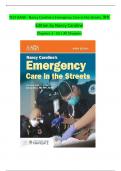
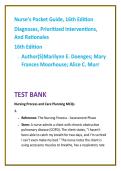
Nurse's Pocket Guide, 16th Edition
Diagnoses, Prioritized Interventions,
And Rationales
16th Edition
• Author(S)Marilynn E. Doenges; Mary
Frances Moorhouse; Alice C. Murr
TEST BANK
1⃣
Reference
Nursing Process — Assessment vs. Diagnosis (Chapter 1 focus:
Data collection and clustering)
Stem
A 68-year-old man is admitted with shortness of breath. You
find decreased breath sounds at the bases, respiratory rate
28/min, SpO₂ 90% on room air, and he reports "I can't catch my
,breath." Which action reflects the assessment phase of the
nursing process as described in Chapter 1 of the Nurse’s Pocket
Guide?
A. Formulate the nursing diagnosis “Impaired Gas Exchange.”
B. Administer oxygen per standing order.
C. Auscultate lung sounds and record SpO₂ values.
D. Set the outcome: "Patient will maintain SpO₂ ≥ 94% within 2
hours."
Correct Answer: C
Rationales
Correct (C): Auscultation and SpO₂ measurement are objective
data collection activities that belong to the assessment phase.
Chapter 1 emphasizes systematic gathering and documentation
of subjective and objective data before diagnosing.
A: Formulating a nursing diagnosis is the next step after
assessment; it is not an assessment action.
B: Administering oxygen is an intervention
(planning/implementation), not assessment.
D: Writing outcomes is part of planning, not assessment.
Teaching Point: Assessment = gather and document subjective
and objective cues before diagnosing.
Citation: Doenges, M. E., Moorhouse, M. F., & Murr, A. C.
(2022). Nurse’s Pocket Guide (16th ed.). Chapter 1.
2️⃣
,Reference
Nursing Process — Diagnostic Reasoning (Chapter 1 focus: Data
clustering & diagnostic formulation)
Stem
A nurse documents: "Client reports 7/10 pain after surgery,
grimacing, tachycardia 110/min, guarding abdomen." According
to the guidance in Chapter 1, which is the best immediate
nursing conclusion?
A. The patient has Risk for Infection related to surgical incision.
B. The clustered cues support the nursing diagnosis Acute Pain.
C. The data are ambiguous; wait for lab results before
diagnosing.
D. Formulate an outcome of Pain = 0 within 1 hour.
Correct Answer: B
Rationales
Correct (B): Chapter 1 stresses clustering related cues
(subjective report of pain, grimacing, tachycardia, guarding) to
support an actual nursing diagnosis such as Acute Pain. This is
diagnostic reasoning (assessment → diagnosis).
A: Risk for Infection is unrelated to the acute pain cluster; no
incision infection cues are present.
C: Waiting for labs is inappropriate—the diagnosis of Acute Pain
is based on immediate clinical cues, not labs.
D: An outcome of pain = 0 within 1 hour may be unrealistic
without planning interventions; diagnosis must precede
outcome writing.
, Teaching Point: Cluster subjective and objective cues to support
an actual nursing diagnosis.
Citation: Doenges et al. (2022), Chapter 1.
3️⃣
Reference
Nursing Diagnosis Type — Actual vs. Risk (Chapter 1 focus:
distinguishing diagnosis types)
Stem
A postoperative client has clean incision, afebrile, but is
immobile and confused. Which nursing diagnosis type does
Chapter 1 indicate is most appropriate for “Risk for Falls” in this
situation?
A. Actual diagnosis, because the client is confused.
B. Risk diagnosis, because a fall has not yet occurred.
C. Syndrome diagnosis, because multiple risk factors exist.
D. Collaborative problem, because physician orders govern fall
prevention.
Correct Answer: B
Rationales
Correct (B): Chapter 1 distinguishes risk diagnoses (potential
problems) when defining characteristics are absent but risk
factors (immobility, confusion) are present; since no fall has
occurred, Risk for Falls is a risk diagnosis.
A: An actual diagnosis requires defining characteristics or an
Diagnoses, Prioritized Interventions,
And Rationales
16th Edition
• Author(S)Marilynn E. Doenges; Mary
Frances Moorhouse; Alice C. Murr
TEST BANK
1⃣
Reference
Nursing Process — Assessment vs. Diagnosis (Chapter 1 focus:
Data collection and clustering)
Stem
A 68-year-old man is admitted with shortness of breath. You
find decreased breath sounds at the bases, respiratory rate
28/min, SpO₂ 90% on room air, and he reports "I can't catch my
,breath." Which action reflects the assessment phase of the
nursing process as described in Chapter 1 of the Nurse’s Pocket
Guide?
A. Formulate the nursing diagnosis “Impaired Gas Exchange.”
B. Administer oxygen per standing order.
C. Auscultate lung sounds and record SpO₂ values.
D. Set the outcome: "Patient will maintain SpO₂ ≥ 94% within 2
hours."
Correct Answer: C
Rationales
Correct (C): Auscultation and SpO₂ measurement are objective
data collection activities that belong to the assessment phase.
Chapter 1 emphasizes systematic gathering and documentation
of subjective and objective data before diagnosing.
A: Formulating a nursing diagnosis is the next step after
assessment; it is not an assessment action.
B: Administering oxygen is an intervention
(planning/implementation), not assessment.
D: Writing outcomes is part of planning, not assessment.
Teaching Point: Assessment = gather and document subjective
and objective cues before diagnosing.
Citation: Doenges, M. E., Moorhouse, M. F., & Murr, A. C.
(2022). Nurse’s Pocket Guide (16th ed.). Chapter 1.
2️⃣
,Reference
Nursing Process — Diagnostic Reasoning (Chapter 1 focus: Data
clustering & diagnostic formulation)
Stem
A nurse documents: "Client reports 7/10 pain after surgery,
grimacing, tachycardia 110/min, guarding abdomen." According
to the guidance in Chapter 1, which is the best immediate
nursing conclusion?
A. The patient has Risk for Infection related to surgical incision.
B. The clustered cues support the nursing diagnosis Acute Pain.
C. The data are ambiguous; wait for lab results before
diagnosing.
D. Formulate an outcome of Pain = 0 within 1 hour.
Correct Answer: B
Rationales
Correct (B): Chapter 1 stresses clustering related cues
(subjective report of pain, grimacing, tachycardia, guarding) to
support an actual nursing diagnosis such as Acute Pain. This is
diagnostic reasoning (assessment → diagnosis).
A: Risk for Infection is unrelated to the acute pain cluster; no
incision infection cues are present.
C: Waiting for labs is inappropriate—the diagnosis of Acute Pain
is based on immediate clinical cues, not labs.
D: An outcome of pain = 0 within 1 hour may be unrealistic
without planning interventions; diagnosis must precede
outcome writing.
, Teaching Point: Cluster subjective and objective cues to support
an actual nursing diagnosis.
Citation: Doenges et al. (2022), Chapter 1.
3️⃣
Reference
Nursing Diagnosis Type — Actual vs. Risk (Chapter 1 focus:
distinguishing diagnosis types)
Stem
A postoperative client has clean incision, afebrile, but is
immobile and confused. Which nursing diagnosis type does
Chapter 1 indicate is most appropriate for “Risk for Falls” in this
situation?
A. Actual diagnosis, because the client is confused.
B. Risk diagnosis, because a fall has not yet occurred.
C. Syndrome diagnosis, because multiple risk factors exist.
D. Collaborative problem, because physician orders govern fall
prevention.
Correct Answer: B
Rationales
Correct (B): Chapter 1 distinguishes risk diagnoses (potential
problems) when defining characteristics are absent but risk
factors (immobility, confusion) are present; since no fall has
occurred, Risk for Falls is a risk diagnosis.
A: An actual diagnosis requires defining characteristics or an