

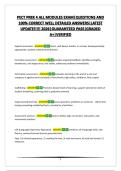
100% CORRECT WELL DETAILED ANSWERS|LATEST
Explicit instruction - ANSWER Direct, skill-based, holistic, in context, developmentally
appropriate, student centered and directed
Formative assessment - ANSWER provides ongoing feedback, identifies strengths,
weaknesses, and target areas, low stakes, addresses problems immediately
Summative assessment - ANSWER evaluates learning at the end of a unit and
compares it against some standard or benchmark, high stakes, (midterm, final, paper)
Scaffolding - ANSWER Promotes deeper level of learning, support tailored to needs of
student (modeling, coaching) that is gradually removed
Inquiry-based learning - ANSWER poses questions, problems or scenarios - rather than
simply presenting established facts; assisted by a facilitator
Assessment anchors - ANSWER tools to better align curriculum, instruction, and
assessment practices
LEA (Language Experience Approach) - ANSWER combines all 4 language skills, aids
fluency, centered around learner generated text.
Step 1) A shared experience, 2) creating the text, 3) read and revise, 4) read and reread, 5)
extension
1
, Receptive language - ANSWER the ability to understand or comprehend language
heard or read
Expressive language - ANSWER being able to put thoughts into words and sentences
that make sense and are grammatically accurate
Family systems theory - ANSWER (Dr. Murray Bowen) individuals cannot be
understood in isolation from one another, but rather as a part of their family, which is an
emotional unit
Constructivist Approach - ANSWER the learner is an active participant in building
understanding and knowledge. Use hands-on exploration with concrete materials. Realistic
and relevant learning situations. Uses scaffolding
Alphabetic principle - ANSWER the understanding that the letters used in writing
represent the component sounds in spoken words
Informal assessment - ANSWER Sometimes referred to as criterion referenced
measures. Performance is not being evaluated against established standards or rubrics, not
data driven. Content and performance driven. (anecdotal notes, teacher observations,
running records, rubric scores, etc.) Used to inform instruction.
Formal assessment - ANSWER Assess overall achievement, compare student
performance with others at their grade or rangeHave data which support the conclusions
made from the test (standardized measures). Use statistics. Data is mathematically
computed and summarized. Scores are percentiles, stanines, or standard scores.
Diphthong - ANSWER a sound made by combining two vowels, specifically when it
starts as one vowel sound and goes to another (oy in oil). Refers to two adjacent vowel
sounds occurring within the same syllable.
2
Explicit instruction - ANSWER Direct, skill-based, holistic, in context, developmentally
appropriate, student centered and directed
Formative assessment - ANSWER provides ongoing feedback, identifies strengths,
weaknesses, and target areas, low stakes, addresses problems immediately
Summative assessment - ANSWER evaluates learning at the end of a unit and
compares it against some standard or benchmark, high stakes, (midterm, final, paper)
Scaffolding - ANSWER Promotes deeper level of learning, support tailored to needs of
student (modeling, coaching) that is gradually removed
Inquiry-based learning - ANSWER poses questions, problems or scenarios - rather than
simply presenting established facts; assisted by a facilitator
Assessment anchors - ANSWER tools to better align curriculum, instruction, and
assessment practices
LEA (Language Experience Approach) - ANSWER combines all 4 language skills, aids
fluency, centered around learner generated text.
Step 1) A shared experience, 2) creating the text, 3) read and revise, 4) read and reread, 5)
extension
1
, Receptive language - ANSWER the ability to understand or comprehend language
heard or read
Expressive language - ANSWER being able to put thoughts into words and sentences
that make sense and are grammatically accurate
Family systems theory - ANSWER (Dr. Murray Bowen) individuals cannot be
understood in isolation from one another, but rather as a part of their family, which is an
emotional unit
Constructivist Approach - ANSWER the learner is an active participant in building
understanding and knowledge. Use hands-on exploration with concrete materials. Realistic
and relevant learning situations. Uses scaffolding
Alphabetic principle - ANSWER the understanding that the letters used in writing
represent the component sounds in spoken words
Informal assessment - ANSWER Sometimes referred to as criterion referenced
measures. Performance is not being evaluated against established standards or rubrics, not
data driven. Content and performance driven. (anecdotal notes, teacher observations,
running records, rubric scores, etc.) Used to inform instruction.
Formal assessment - ANSWER Assess overall achievement, compare student
performance with others at their grade or rangeHave data which support the conclusions
made from the test (standardized measures). Use statistics. Data is mathematically
computed and summarized. Scores are percentiles, stanines, or standard scores.
Diphthong - ANSWER a sound made by combining two vowels, specifically when it
starts as one vowel sound and goes to another (oy in oil). Refers to two adjacent vowel
sounds occurring within the same syllable.
2

