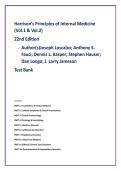
Harrison's Principles of Internal Medicine
(Vol.1 & Vol.2)
22nd Edition
• Author(s)Joseph Loscalzo; Anthony S.
Fauci; Dennis L. Kasper; Stephen Hauser;
Dan Longo; J. Larry Jameson
Test Bank
Covered
PART 1: Foundations of Clinical Medicine
PART 2: Cardinal Symptoms & Clinical Presentations
PART 3: Clinical Pharmacology
PART 4: Oncology & Hematology
PART 5: Infectious Diseases
PART 6: Cardiovascular Disorders
PART 7: Respiratory Disorders
PART 8: Critical Care Medicine
PART 9: Kidney & Urinary Tract Disorders
PART 10: Gastrointestinal & Hepatobiliary Disorders
,PART 11: Immune-Mediated & Rheumatologic Disorders
PART 12: Endocrinology & Metabolism
PART 13: Neurologic & Psychiatric Disorders
PART 14: Toxicology & Environmental Injury
PART 15: Environmental & Occupational Medicine
PART 16: Genetics, Precision & Systems Medicine
PART 17–20: Special & Emerging Topics
A 68-year-old man hospitalized with community-acquired
pneumonia becomes hypotensive and confused. According to
principles in “The Practice of Medicine,” which immediate
nursing action has the highest priority?
A. Administer scheduled oral antibiotics.
B. Obtain a complete medical history.
C. Assess airway, breathing, and circulation and call for rapid
response.
D. Document the episode in the chart.
Answer: C
Rationale: In acute deterioration, ABC assessment and
activating rapid response take priority to prevent arrest;
documentation and history follow stabilization.
For a primary-care screening strategy discussed in
“Promoting Good Health,” which approach best balances
population benefit and harms for an asymptomatic 55-year-old?
,A. Universal MRI screening.
B. Age- and risk-based screening using validated tests (e.g.,
colorectal screening at guideline ages).
C. No screening unless symptoms develop.
D. Annual full-body CT for all adults over 50.
Answer: B
Rationale: Evidence-based, age/risk-targeted screening
maximizes benefit and minimizes harms (false positives,
overdiagnosis); indiscriminate imaging is not recommended.
A parent refuses routine childhood immunizations citing
safety concerns. According to “Vaccine Opposition and
Hesitancy,” the most effective initial nursing strategy is to:
A. Dismiss the parent from the practice.
B. Provide a nonjudgmental, fact-based discussion addressing
concerns and ask permission to share information.
C. Insist vaccines be given immediately without discussion.
D. Ignore concerns and document refusal only.
Answer: B
Rationale: Empathic, evidence-based dialog that explores
concerns and builds trust is more effective than confrontation
or dismissal in addressing hesitancy.
When applying concepts from “Decision-Making in Clinical
Medicine,” which reasoning process is most appropriate when a
patient’s presentation is atypical and data are limited?
A. Rely exclusively on pattern recognition.
B. Use analytic (hypothesis-driven) reasoning and deliberate
, data collection.
C. Ignore new data and follow usual pathways.
D. Decide based on team hierarchy rather than evidence.
Answer: B
Rationale: Atypical cases require analytic, hypothesis-driven
reasoning and targeted data gathering to reduce diagnostic
error.
A nurse suspects confirmation bias is affecting diagnostic
decisions on a ward. Per “Decision-Making in Clinical Medicine,”
the best corrective step is to:
A. Continue without comment to avoid conflict.
B. Present disconfirming data and encourage alternative
hypotheses.
C. Replace the clinician making decisions.
D. Wait for the attending to notice.
Answer: B
Rationale: Introducing disconfirming evidence and soliciting
alternative explanations reduces cognitive bias and improves
diagnostic accuracy.
Regarding “Precision Medicine and Clinical Care,” which
nursing implication is most accurate when genetic testing
identifies a pharmacogenomic variant affecting drug
metabolism?
A. Ignore the result; give standard dosing.
B. Document the result, educate the patient about implications,
and collaborate with prescriber to adjust therapy as indicated.
(Vol.1 & Vol.2)
22nd Edition
• Author(s)Joseph Loscalzo; Anthony S.
Fauci; Dennis L. Kasper; Stephen Hauser;
Dan Longo; J. Larry Jameson
Test Bank
Covered
PART 1: Foundations of Clinical Medicine
PART 2: Cardinal Symptoms & Clinical Presentations
PART 3: Clinical Pharmacology
PART 4: Oncology & Hematology
PART 5: Infectious Diseases
PART 6: Cardiovascular Disorders
PART 7: Respiratory Disorders
PART 8: Critical Care Medicine
PART 9: Kidney & Urinary Tract Disorders
PART 10: Gastrointestinal & Hepatobiliary Disorders
,PART 11: Immune-Mediated & Rheumatologic Disorders
PART 12: Endocrinology & Metabolism
PART 13: Neurologic & Psychiatric Disorders
PART 14: Toxicology & Environmental Injury
PART 15: Environmental & Occupational Medicine
PART 16: Genetics, Precision & Systems Medicine
PART 17–20: Special & Emerging Topics
A 68-year-old man hospitalized with community-acquired
pneumonia becomes hypotensive and confused. According to
principles in “The Practice of Medicine,” which immediate
nursing action has the highest priority?
A. Administer scheduled oral antibiotics.
B. Obtain a complete medical history.
C. Assess airway, breathing, and circulation and call for rapid
response.
D. Document the episode in the chart.
Answer: C
Rationale: In acute deterioration, ABC assessment and
activating rapid response take priority to prevent arrest;
documentation and history follow stabilization.
For a primary-care screening strategy discussed in
“Promoting Good Health,” which approach best balances
population benefit and harms for an asymptomatic 55-year-old?
,A. Universal MRI screening.
B. Age- and risk-based screening using validated tests (e.g.,
colorectal screening at guideline ages).
C. No screening unless symptoms develop.
D. Annual full-body CT for all adults over 50.
Answer: B
Rationale: Evidence-based, age/risk-targeted screening
maximizes benefit and minimizes harms (false positives,
overdiagnosis); indiscriminate imaging is not recommended.
A parent refuses routine childhood immunizations citing
safety concerns. According to “Vaccine Opposition and
Hesitancy,” the most effective initial nursing strategy is to:
A. Dismiss the parent from the practice.
B. Provide a nonjudgmental, fact-based discussion addressing
concerns and ask permission to share information.
C. Insist vaccines be given immediately without discussion.
D. Ignore concerns and document refusal only.
Answer: B
Rationale: Empathic, evidence-based dialog that explores
concerns and builds trust is more effective than confrontation
or dismissal in addressing hesitancy.
When applying concepts from “Decision-Making in Clinical
Medicine,” which reasoning process is most appropriate when a
patient’s presentation is atypical and data are limited?
A. Rely exclusively on pattern recognition.
B. Use analytic (hypothesis-driven) reasoning and deliberate
, data collection.
C. Ignore new data and follow usual pathways.
D. Decide based on team hierarchy rather than evidence.
Answer: B
Rationale: Atypical cases require analytic, hypothesis-driven
reasoning and targeted data gathering to reduce diagnostic
error.
A nurse suspects confirmation bias is affecting diagnostic
decisions on a ward. Per “Decision-Making in Clinical Medicine,”
the best corrective step is to:
A. Continue without comment to avoid conflict.
B. Present disconfirming data and encourage alternative
hypotheses.
C. Replace the clinician making decisions.
D. Wait for the attending to notice.
Answer: B
Rationale: Introducing disconfirming evidence and soliciting
alternative explanations reduces cognitive bias and improves
diagnostic accuracy.
Regarding “Precision Medicine and Clinical Care,” which
nursing implication is most accurate when genetic testing
identifies a pharmacogenomic variant affecting drug
metabolism?
A. Ignore the result; give standard dosing.
B. Document the result, educate the patient about implications,
and collaborate with prescriber to adjust therapy as indicated.