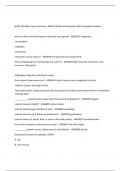
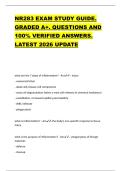
CNOR Prep with all Correct & 100% Verified Answers |
Actual Complete Exam |Already Graded A+
nursing process ✔Correct Answer-Assessment
Diagnosis
Planning
Implementation
Evaluation
Spaulding Classification ✔Correct Answer-I. Critical (exposed to sterile areas of the body; must be
sterile)
II. Semi-Critical (touches mucous membranes; recommended sterile or high level disinfected)
III. Non Critical (touch the skin; can be cleaned or disinfected; less than high level disinfection)
Workflow progression ✔Correct Answer-vendor/back table/open tray/canceled case ->
decontamination -> preparation & packaging -> sterilization -> clean distribution/storage
Testing for steam sterilizer (gravity displacement/prevacuum) ✔Correct Answer-Geobacillus
Stearothermophilus
Testing for prevacuum sterilizer ✔Correct Answer-Bowie-Dick
Testing for ethylene oxide sterilizer ✔Correct Answer-Bacillus atropheus
Testing for plasma sterilizer ✔Correct Answer-Geobacillus Stearothermophilus
Testing for ozone sterilizer ✔Correct Answer-Geobacillus Stearothermophilus
Testing for paracetic acid sterilizer ✔Correct Answer-Geobacillus Stearothermophilus
Testing for dry heat sterilizer ✔Correct Answer-Bacillus atropheus
3 surgical areas ✔Correct Answer-I. Unrestricted
II. Semi-restricted
III. Restricted
Types of Anesthesia ✔Correct Answer-I. Local
II. Moderate Sedation
III. Monitored Anesthesia Care (MAC)
IV. Nerve Blocks
V. Neuraxial
VI. General Anesthesia
Herbal supplement(s) that can cause liver damage ✔Correct Answer-Echinacea, Kava
Herbal supplement(s) that can increase bleeding ✔Correct Answer-Ginger, Gingko, Garlic, Fever
Few, Saw Palmetto, Fish oil
, Herbal supplement(s) that can have cardiac effects (arrhythmias/BP) ✔Correct Answer-Goldenseal,
Milk Thistle, Licorice, Ginseng, Ephedra (increase BG)
Herbal supplement(s) that cause prolonged emergence from anesthesia ✔Correct Answer-Gingko,
St. John's wort, Valerian
Process of administering a Bier Block ✔Correct Answer-I. Inflate proximal cuff
II. Give block through IV
III. Inflate distal cuff
IV. Deflate proximal cuff
LAST stands for ✔Correct Answer-Local Anesthetic Systemic Toxicity
Patients at highest risk for LAST are ✔Correct Answer-advanced age, cardiac issues (especially low
EF), liver disease, low albumin levels, metabolic/respiratory acidosis, meds that inhibit Na+ channels
Initial s/s of LAST ✔Correct Answer-metallic taste, numb tongue/lips, ringing in ears, light
headedness, agitation
Treatment/Reversal for LAST ✔Correct Answer-20% lipid emulsion
Max dose of 1% lidocaine ✔Correct Answer-5mg/kg per day
Max dose 1% lidocaine with epi ✔Correct Answer-7mg/kg per day
Stages of anesthesia ✔Correct Answer-I. Analgesia
II. Delirium
III. Surgical anesthesia (optimal for surgeon)
IV. Medullary/Respiratory paralysis (Overdose!)
ASA 1 ✔Correct Answer-Normal healthy patient
ASA 2 ✔Correct Answer-A patient with mild systemic disease
ASA 3 ✔Correct Answer-A patient with severe systemic disease
ASA 4 ✔Correct Answer-A patient with severe systemic disease that is a constant threat to life
ASA 5 ✔Correct Answer-A moribund patient who is not expected to survive without the operation
ASA 6 ✔Correct Answer-A declared brain-dead patient whose organs are being removed for donor
purposes
Narcotics ✔Correct Answer-hydromorphone (dilaudid); meperidine (demerol); sublimaze
(fentanyl); morphine
Reversal agent for narcotics ✔Correct Answer-Narcan (naloxone)
Benzodiazepines ✔Correct Answer-midazolam (versed); diazepam (valium)
Reversal agent for benzodiazepines ✔Correct Answer-Flumazenil (Romazicon)
Actual Complete Exam |Already Graded A+
nursing process ✔Correct Answer-Assessment
Diagnosis
Planning
Implementation
Evaluation
Spaulding Classification ✔Correct Answer-I. Critical (exposed to sterile areas of the body; must be
sterile)
II. Semi-Critical (touches mucous membranes; recommended sterile or high level disinfected)
III. Non Critical (touch the skin; can be cleaned or disinfected; less than high level disinfection)
Workflow progression ✔Correct Answer-vendor/back table/open tray/canceled case ->
decontamination -> preparation & packaging -> sterilization -> clean distribution/storage
Testing for steam sterilizer (gravity displacement/prevacuum) ✔Correct Answer-Geobacillus
Stearothermophilus
Testing for prevacuum sterilizer ✔Correct Answer-Bowie-Dick
Testing for ethylene oxide sterilizer ✔Correct Answer-Bacillus atropheus
Testing for plasma sterilizer ✔Correct Answer-Geobacillus Stearothermophilus
Testing for ozone sterilizer ✔Correct Answer-Geobacillus Stearothermophilus
Testing for paracetic acid sterilizer ✔Correct Answer-Geobacillus Stearothermophilus
Testing for dry heat sterilizer ✔Correct Answer-Bacillus atropheus
3 surgical areas ✔Correct Answer-I. Unrestricted
II. Semi-restricted
III. Restricted
Types of Anesthesia ✔Correct Answer-I. Local
II. Moderate Sedation
III. Monitored Anesthesia Care (MAC)
IV. Nerve Blocks
V. Neuraxial
VI. General Anesthesia
Herbal supplement(s) that can cause liver damage ✔Correct Answer-Echinacea, Kava
Herbal supplement(s) that can increase bleeding ✔Correct Answer-Ginger, Gingko, Garlic, Fever
Few, Saw Palmetto, Fish oil
, Herbal supplement(s) that can have cardiac effects (arrhythmias/BP) ✔Correct Answer-Goldenseal,
Milk Thistle, Licorice, Ginseng, Ephedra (increase BG)
Herbal supplement(s) that cause prolonged emergence from anesthesia ✔Correct Answer-Gingko,
St. John's wort, Valerian
Process of administering a Bier Block ✔Correct Answer-I. Inflate proximal cuff
II. Give block through IV
III. Inflate distal cuff
IV. Deflate proximal cuff
LAST stands for ✔Correct Answer-Local Anesthetic Systemic Toxicity
Patients at highest risk for LAST are ✔Correct Answer-advanced age, cardiac issues (especially low
EF), liver disease, low albumin levels, metabolic/respiratory acidosis, meds that inhibit Na+ channels
Initial s/s of LAST ✔Correct Answer-metallic taste, numb tongue/lips, ringing in ears, light
headedness, agitation
Treatment/Reversal for LAST ✔Correct Answer-20% lipid emulsion
Max dose of 1% lidocaine ✔Correct Answer-5mg/kg per day
Max dose 1% lidocaine with epi ✔Correct Answer-7mg/kg per day
Stages of anesthesia ✔Correct Answer-I. Analgesia
II. Delirium
III. Surgical anesthesia (optimal for surgeon)
IV. Medullary/Respiratory paralysis (Overdose!)
ASA 1 ✔Correct Answer-Normal healthy patient
ASA 2 ✔Correct Answer-A patient with mild systemic disease
ASA 3 ✔Correct Answer-A patient with severe systemic disease
ASA 4 ✔Correct Answer-A patient with severe systemic disease that is a constant threat to life
ASA 5 ✔Correct Answer-A moribund patient who is not expected to survive without the operation
ASA 6 ✔Correct Answer-A declared brain-dead patient whose organs are being removed for donor
purposes
Narcotics ✔Correct Answer-hydromorphone (dilaudid); meperidine (demerol); sublimaze
(fentanyl); morphine
Reversal agent for narcotics ✔Correct Answer-Narcan (naloxone)
Benzodiazepines ✔Correct Answer-midazolam (versed); diazepam (valium)
Reversal agent for benzodiazepines ✔Correct Answer-Flumazenil (Romazicon)