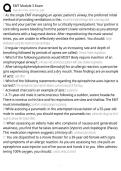
EMT Module 3 Exam
Study online at https://quizlet.com/_ip4ij9
1. As the single EMT managing an apneic patient's airway, the preferred initial
method of providing ventilations is the:: mouth-to-mask technique with a one-way valve
2. You and your partner are caring for a critically injured patient. Your partner is
controlling severe bleeding from the patient's lower extremities as you attempt
ventilations with a bag-mask device. After respositioning the mask several
times, you are unable to effectively ventilate the patient. You should:: begin
ventilations using the mouth-to-mask technique
3. Irregular respirations characterized by an increasing rate and depth of
breathing followed by periods of apnea are called:: Cheyne-Stokes respirations
4. Which if the following patients would MOST likely require insertion of an
oropharyngeal airway?: a 40-year-old unconscious patient with slow, shallow respirations
5. After taking diphendydramine (Benadryl) for an allergic reaction, a person be-
gins experiencing drowsiness and a dry mouth. These findings are an example
of a(n):: side effect
6. Which of the following statements regarding the epinephrine auto-injector is
correct?: The epinephrine auto-injector delivers a preset amount of the drug
7. Activated charcoal is an example of a(n):: suspension
8. A 71-year-old male is semiconscious following a sudden, severe headache.
There is vomitus on his face and his respirations are slow and shallow. The EMT
must immediately:: perform oropharyngeal suctioning
9. While assisting a paramedic in the attempted resuscitation of a 55-year-old
male in cardiac arrest, you should expect the paramedic to:: administer drugs via the IV
route to achieve the fastest effect
10. When assessing an elderly male who complains of nausea and generalized
weakness, you find that he takes simvastatin (Vytorin) and clopidogrel (Plavix).
This medication regimen suggests a history of:: cardiovascular disease
11. You are dispatched to a movie theater for a 39-year-old female with signs
and symptoms of an allergic reaction. As you are assessing her, she pulls an
epinephrine auto-injector out of her purse and hands it to you. After adminis-
tering 100% oxygen, you should:: contact medical control
1/6
, EMT Module 3 Exam
Study online at https://quizlet.com/_ip4ij9
12. In which of the following patients would the head tilt-chin life maneuver be
the MOST appropriate method of opening the airway?: a 37-year-old female who is found
unconscious in her bed
13. You are dispatched to a state park for a young female experiencing an al-
lergic reaction. Your assessment reveals that her breathing is severely labored
and her blood pressure is very low. You carry epinephrine auto-injectors on
your ambulance and have been trained and approved by your medical director
to administer them. As your partner gives the patient high-flow oxygen, you
attempt to contact medical control but do not have a signal from your cell
phone. You should:: Administer epinephrine to the patient, begin immediate transport, and attempt to
contact medical control en route to the hospital
14. Despite your attempts to coach a conscious young female's respirations,
she continues to hyperventilate with a marked reduction in tidal volume. You
should:: explain to her that you will assist her ventilations
15. Inhalation occurs when the:: diaphragm and intercostal muscles contract and cause a decrease in
intrathoracic pressure.
16. You are ventilating a patient with a stoma; however, air is escaping from the
mouth and nose. To prevent this, you should:: seal the mouth and nose
17. The __________ of a medication usually dictates the route by which it will be
administered: form
18. You are ventilating an apneic woman with a bag-mask device. She has
dentures, which are tight-fitting. Adequate chest rise is present with each
ventilation, and the patient's oxygen saturation reads 96%. When you reassess
the patency of her airway, you note that her dentures are now loose, although
your ventilations are still producing adequate chest rise. You should:: remove her
dentures, resume ventilations, and assess for adequate chest rise
19. A 62-year-old male presents with crushing chest pain, which he describes
as being the same kind of pain that he had with a previous heart attack.
He has prescribed nitroglycerin but states that he has not taken any. After
administering 100% oxygen and contacting medical control, you should:: assist
him with his nitroglycerin unless his systolic blood pressure is less that 100 mm Hg
2/6
Study online at https://quizlet.com/_ip4ij9
1. As the single EMT managing an apneic patient's airway, the preferred initial
method of providing ventilations is the:: mouth-to-mask technique with a one-way valve
2. You and your partner are caring for a critically injured patient. Your partner is
controlling severe bleeding from the patient's lower extremities as you attempt
ventilations with a bag-mask device. After respositioning the mask several
times, you are unable to effectively ventilate the patient. You should:: begin
ventilations using the mouth-to-mask technique
3. Irregular respirations characterized by an increasing rate and depth of
breathing followed by periods of apnea are called:: Cheyne-Stokes respirations
4. Which if the following patients would MOST likely require insertion of an
oropharyngeal airway?: a 40-year-old unconscious patient with slow, shallow respirations
5. After taking diphendydramine (Benadryl) for an allergic reaction, a person be-
gins experiencing drowsiness and a dry mouth. These findings are an example
of a(n):: side effect
6. Which of the following statements regarding the epinephrine auto-injector is
correct?: The epinephrine auto-injector delivers a preset amount of the drug
7. Activated charcoal is an example of a(n):: suspension
8. A 71-year-old male is semiconscious following a sudden, severe headache.
There is vomitus on his face and his respirations are slow and shallow. The EMT
must immediately:: perform oropharyngeal suctioning
9. While assisting a paramedic in the attempted resuscitation of a 55-year-old
male in cardiac arrest, you should expect the paramedic to:: administer drugs via the IV
route to achieve the fastest effect
10. When assessing an elderly male who complains of nausea and generalized
weakness, you find that he takes simvastatin (Vytorin) and clopidogrel (Plavix).
This medication regimen suggests a history of:: cardiovascular disease
11. You are dispatched to a movie theater for a 39-year-old female with signs
and symptoms of an allergic reaction. As you are assessing her, she pulls an
epinephrine auto-injector out of her purse and hands it to you. After adminis-
tering 100% oxygen, you should:: contact medical control
1/6
, EMT Module 3 Exam
Study online at https://quizlet.com/_ip4ij9
12. In which of the following patients would the head tilt-chin life maneuver be
the MOST appropriate method of opening the airway?: a 37-year-old female who is found
unconscious in her bed
13. You are dispatched to a state park for a young female experiencing an al-
lergic reaction. Your assessment reveals that her breathing is severely labored
and her blood pressure is very low. You carry epinephrine auto-injectors on
your ambulance and have been trained and approved by your medical director
to administer them. As your partner gives the patient high-flow oxygen, you
attempt to contact medical control but do not have a signal from your cell
phone. You should:: Administer epinephrine to the patient, begin immediate transport, and attempt to
contact medical control en route to the hospital
14. Despite your attempts to coach a conscious young female's respirations,
she continues to hyperventilate with a marked reduction in tidal volume. You
should:: explain to her that you will assist her ventilations
15. Inhalation occurs when the:: diaphragm and intercostal muscles contract and cause a decrease in
intrathoracic pressure.
16. You are ventilating a patient with a stoma; however, air is escaping from the
mouth and nose. To prevent this, you should:: seal the mouth and nose
17. The __________ of a medication usually dictates the route by which it will be
administered: form
18. You are ventilating an apneic woman with a bag-mask device. She has
dentures, which are tight-fitting. Adequate chest rise is present with each
ventilation, and the patient's oxygen saturation reads 96%. When you reassess
the patency of her airway, you note that her dentures are now loose, although
your ventilations are still producing adequate chest rise. You should:: remove her
dentures, resume ventilations, and assess for adequate chest rise
19. A 62-year-old male presents with crushing chest pain, which he describes
as being the same kind of pain that he had with a previous heart attack.
He has prescribed nitroglycerin but states that he has not taken any. After
administering 100% oxygen and contacting medical control, you should:: assist
him with his nitroglycerin unless his systolic blood pressure is less that 100 mm Hg
2/6