
CPACE Performance
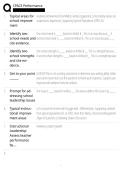
1. Typical areas for Academic Achievement (ELA/Math), Family Engagement, School safety/culture (ie.
school improve- suspensions, expulsions), Supporting Special Populations (SPED, EL)
ment
2. Identify two One school need is _____ based on Artifact #_. This is an issue because__. A
school needs and second school need is ____ based on Artifact #_. This is an issue because____.
cite evidence.
3. Identify two One school strength is _____ based on Artifact # __. This is a strength because _.
school strengths A second school strength is ____ based on Artifact #__. This is a strength because
and cite evi- _.
dence.
4. Get to your point QUICKLY! This is not a writing assessment to determine your writing ability. Make
______. your point crystal clear. Use the questions to frame your responses. Support your
response with evidence from the artifacts.
5. Prompt for ad- One issue is ____ based on artifact___. One way to address this issue is by _____.
dressing school
leadership issues
6. Typical instruc- Let's assume the teacher will struggle with.. Differentiation, Supporting students
tional improve- from special populations (EL or SPED, more than likely), Classroom Management
ment areas ,Rigor of Questions ,Facilitating Student Discussion
7. Instructional Reviewing student growth.
Leadership:
Assess teacher
performance
by....
8.
, CPACE Performance
Blooms Taxono-
my: Level of ques-
tioning
9. Addressing Use Mentors to Promote Good Attendance, Promote an Attendance Culture When
chronic Connecting With Guardians, Manage Behavior Effectively, Address the Underlying
absenteeism Factors, When Possible, Use a Multi-Tiered System of Supports, Reward Positive
Behavior
10. Addressing high Implement the restorative justice framework, increase engagement with educa-
suspension/ex- tional partners/stakeholders, address the school culture/climate, determine any
pulsion rates overrepresentation of student populations and address the need, implement a
system of Positive Behavioral Intervention and Supports (PBIS), determine staff
need for continued PD in classroom management and behavior de-escalation
strategies
11. Creating a Pro- 1. focused on teacher and student needs
fessional Devel- 2. Mentorship and peer coaching
opment Plan
12. SMART Goals Specific = What will be accomplished
Measurable = How success will be quantified
Achievable = Not unrealistic
Relevant = How it fits with overall mission
Time-bound = Intermittent checkpoints
13. Characteristics of 1. Clear and shared focus
High Performing 2. High standards & expectations
Schools 3. Effective school leadership
4. High levels of collaboration & communication
5. curriculum, instruction, and assessment aligned with standards
6. Frequent monitoring of learning & teaching (MTSS)
7. Focused professional development

