
WGU - INTRO TO IT - D322 - FULL STUDY GUIDE
SECTIONS 2-8 QUESTIONS & DETAILED COMPLETE
SOLUTIONS PASSED ALREADY GRADED A+
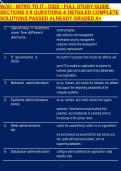
1. Specifically, IT functions
communication
cover five different
data collection and management
domains:
information security management
consumer relationship management
process improvement
2. IT governance is the system of processes that ensures the effective and
efficient
use of IT to enable an organization to achieve its
business goals and to add value to key stakeholders
in an organization.
3. Network administrators set up, maintain, and monitor the hardware and software
that support the networking components of the
computer systems.
4. Systems administrators set up, maintain, and monitor devices that support
business
operations. These devices include anything from
projectors and smartboards in a training room to
the devices in the server room.
5. Web administrators control the outward-facing content on an organization's
web-
site and intranets and ensure that the sites function and
inte- grate with back-end systems, such as
supporting databases.
6. Database administrators configure and troubleshoot an organization's data
reposito- ries.
,WGU - INTRO TO IT - D322 - FULL STUDY GUIDE
SECTIONS 2-8 QUESTIONS & DETAILED COMPLETE
SOLUTIONS PASSED ALREADY GRADED A+
7. Cybersecurity analysts monitor the behaviors of the system components for
anom-
alies and malicious attacks. They also put measures in
place to deter, detect, and mitigate internal and
external threats.
8. Technical support specialists provide end-user training and help users resolve
issues ac-
cessing resources and systems.
,WGU - INTRO TO IT - D322 - FULL STUDY GUIDE
SECTIONS 2-8 QUESTIONS & DETAILED COMPLETE
SOLUTIONS PASSED ALREADY GRADED A+
9. Outsourcing uses the resources and skills of a developed
workforce from an external organization.
10. Insourcing assigns a project to employees within the
organization. In- sourcing generally requires the
development of new opera- tions and processes,
making it an expensive option.
11. The project management initiation, planning, execution, and closure.
life cycle is represented
differently in various
models, but projects
generally include four
phases:
12. Project initiation broadly defines the project. It usually begins with a
business
case, followed by a feasibility study. During the
feasibility study, research assesses whether the
business case will lead to a reasonable, feasible
solution. Project stakeholders pro- vide input in the
analysis of the business case, resulting in a project
charter, or project initiation document, that outlines the
business needs, the stakeholders, and the business
case.
13. Project planning (1 of 2) includes developing a road map that everyone follows. This
phase starts with setting the project goals,
commonly using the SMART or CLEAR frameworks,
both of which are described below.
,WGU - INTRO TO IT - D322 - FULL STUDY GUIDE
SECTIONS 2-8 QUESTIONS & DETAILED COMPLETE
SOLUTIONS PASSED ALREADY GRADED A+
Specific: Set a specific goal that answers the questions
who, what, where, when, which, and why.
Measurable: Create criteria that can be used to measure
the success of the goal.
Attainable: Ensure the goal is attainable given the
resources. Realistic: Assess the willingness to work
toward the goal.
Timely: The goal should be achievable within the
available timeframe.
SECTIONS 2-8 QUESTIONS & DETAILED COMPLETE
SOLUTIONS PASSED ALREADY GRADED A+
1. Specifically, IT functions
communication
cover five different
data collection and management
domains:
information security management
consumer relationship management
process improvement
2. IT governance is the system of processes that ensures the effective and
efficient
use of IT to enable an organization to achieve its
business goals and to add value to key stakeholders
in an organization.
3. Network administrators set up, maintain, and monitor the hardware and software
that support the networking components of the
computer systems.
4. Systems administrators set up, maintain, and monitor devices that support
business
operations. These devices include anything from
projectors and smartboards in a training room to
the devices in the server room.
5. Web administrators control the outward-facing content on an organization's
web-
site and intranets and ensure that the sites function and
inte- grate with back-end systems, such as
supporting databases.
6. Database administrators configure and troubleshoot an organization's data
reposito- ries.
,WGU - INTRO TO IT - D322 - FULL STUDY GUIDE
SECTIONS 2-8 QUESTIONS & DETAILED COMPLETE
SOLUTIONS PASSED ALREADY GRADED A+
7. Cybersecurity analysts monitor the behaviors of the system components for
anom-
alies and malicious attacks. They also put measures in
place to deter, detect, and mitigate internal and
external threats.
8. Technical support specialists provide end-user training and help users resolve
issues ac-
cessing resources and systems.
,WGU - INTRO TO IT - D322 - FULL STUDY GUIDE
SECTIONS 2-8 QUESTIONS & DETAILED COMPLETE
SOLUTIONS PASSED ALREADY GRADED A+
9. Outsourcing uses the resources and skills of a developed
workforce from an external organization.
10. Insourcing assigns a project to employees within the
organization. In- sourcing generally requires the
development of new opera- tions and processes,
making it an expensive option.
11. The project management initiation, planning, execution, and closure.
life cycle is represented
differently in various
models, but projects
generally include four
phases:
12. Project initiation broadly defines the project. It usually begins with a
business
case, followed by a feasibility study. During the
feasibility study, research assesses whether the
business case will lead to a reasonable, feasible
solution. Project stakeholders pro- vide input in the
analysis of the business case, resulting in a project
charter, or project initiation document, that outlines the
business needs, the stakeholders, and the business
case.
13. Project planning (1 of 2) includes developing a road map that everyone follows. This
phase starts with setting the project goals,
commonly using the SMART or CLEAR frameworks,
both of which are described below.
,WGU - INTRO TO IT - D322 - FULL STUDY GUIDE
SECTIONS 2-8 QUESTIONS & DETAILED COMPLETE
SOLUTIONS PASSED ALREADY GRADED A+
Specific: Set a specific goal that answers the questions
who, what, where, when, which, and why.
Measurable: Create criteria that can be used to measure
the success of the goal.
Attainable: Ensure the goal is attainable given the
resources. Realistic: Assess the willingness to work
toward the goal.
Timely: The goal should be achievable within the
available timeframe.

