CLEP COLLEGE COMPOSITION
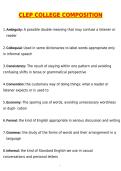
1.Ambiguity: A possible double meaning that may confuse a listener or
reader
2.Colloquial: Used in some dictionaries to label words appropriate only
in informal speech
3.Consistency: The result of staying within one pattern and avoiding
confusing shifts in tense or grammatical perspective
4.Convention: the customary way of doing things; what a reader or
listener expects or is used to
5.Economy: The sparing use of words, avoiding unnecessary wordiness
or dupli- cation
6.Formal: the kind of English appropriate in serious discussion and writing
7.Grammar: the study of the forms of words and their arrangement in a
language
8.Informal: the kind of Standard English we use in casual
conversations and personal letters
1/
8
, 9.Non-standard: the everyday language of those with little formal
education; inap- propriate in school, business, or writing
10.Redundancy: unintentional repetition, needless duplication
11.Slang: extremely informal language; often used in a disrespectful
manner
12.Standard: the language of our institutions- of school, church,
business, and government
13.Word: parts of speech
14.Phrase: group of related words acting together as one part of
speech; not containing both a subject and verb
15.Clause: group of related words containing a subject and a verb
16.Sentence: group of words containing a subject and a verb and
expressing a complete thought
17.Paragraph: group of sentences organized around a central or main idea
18.Verb: a word that expresses action or helps to make a statement
2/
8
1.Ambiguity: A possible double meaning that may confuse a listener or
reader
2.Colloquial: Used in some dictionaries to label words appropriate only
in informal speech
3.Consistency: The result of staying within one pattern and avoiding
confusing shifts in tense or grammatical perspective
4.Convention: the customary way of doing things; what a reader or
listener expects or is used to
5.Economy: The sparing use of words, avoiding unnecessary wordiness
or dupli- cation
6.Formal: the kind of English appropriate in serious discussion and writing
7.Grammar: the study of the forms of words and their arrangement in a
language
8.Informal: the kind of Standard English we use in casual
conversations and personal letters
1/
8
, 9.Non-standard: the everyday language of those with little formal
education; inap- propriate in school, business, or writing
10.Redundancy: unintentional repetition, needless duplication
11.Slang: extremely informal language; often used in a disrespectful
manner
12.Standard: the language of our institutions- of school, church,
business, and government
13.Word: parts of speech
14.Phrase: group of related words acting together as one part of
speech; not containing both a subject and verb
15.Clause: group of related words containing a subject and a verb
16.Sentence: group of words containing a subject and a verb and
expressing a complete thought
17.Paragraph: group of sentences organized around a central or main idea
18.Verb: a word that expresses action or helps to make a statement
2/
8