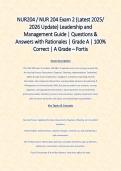
NUR204 / NUR 204 Exam 2 (Latest 2025/
2026 Update) Leadership and
Management Guide | Questions &
Answers with Rationales | Grade A | 100%
Correct | A Grade – Fortis
Exam Description
This NUR 204 Exam 2 Contains 140 Q&A. It typically covers core nursing concepts like
the Nursing Process (Assessment, Diagnosis, Planning, Implementation, Evaluation),
Safety & Legal Issues (malpractice, negligence, mandatory reporting), Fluid &
Electrolytes, Skin Integrity & Wound Care, and potentially elements of Leadership &
Management or Communication Skills, focusing on patient care scenarios, nursing
diagnoses, and appropriate interventions. Expect questions on wound healing
(primary/secondary intention), pressure ulcer prevention, cognitive impairment, basic
skills (incentive spirometry, NG tubes), and ethical/legal responsibilities.
Key Topics & Concepts
Nursing Process: Applying the steps (Assessment, Diagnosis, Planning, etc.) to patient
situations.
Patient Safety: Fall prevention, cognitive changes, restraint use, and maintaining a
safe environment.
Skin & Wound Care: Wound types (primary, secondary intention), signs of infection,
dehiscence, evisceration, and pressure ulcer prevention.
Fluid & Electrolytes & Acid-Base Balance: How these affect the body.
, Cognitive & Neurological Issues: Expressive aphasia, confusion, MMSE, and related
interventions.
Basic Nursing Skills: NG tube placement verification, incentive spirometry use.
Legal & Ethical: Malpractice, negligence, mandatory reporting, and professional
responsibility (e.g., MORAL model).
Leadership & Delegation: What can and cannot be delegated, managing staff issues.
Quiz_________________?
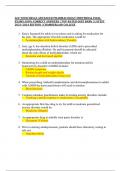
1. Which action should be taken when attempting to decrease
falls in the hospital setting?
a. Lower the height of the bed and the bottom two side rails
before leaving the room.
b. Ask patients on first encounter to use the bathroom and every 4
hours thereafter.
c. Instruct patients to use the call light only if they think they need
help getting out of bed.
d. Encourage patients to not take any prescribed medicine that
could cause drowsiness or light headedness. -
Answer☑️
Answer: a
Keeping the bed in the lowest position and lowering the bottom
side rails decreases the chance of a fall. Hourly rounding for
toileting is recommended to improve patient safety. Patients
,should always use a call light to get up even if they do not think
they need it. Patients should take prescribed medications but may
need assistance with ambulation.
Quiz_________________?
2. The nurse demonstrates proper use of a fire extinguisher by
taking which action first?
a. Sweep from side to side
b. Pull the pin
c. Squeeze the handles together
d. Aim and approach the fire -
Answer☑️
Answer: b
The pin must be pulled to break the seal and activate the fire
extinguisher. When using a fire extinguisher, remembering the
PASS acronym (i.e., pull, aim, squeeze, and sweep) ensures
proper technique.
Quiz_________________?
A nurse is assessing a patient in restraints. The nurse observes
correct use of restraints by checking which of the following?
, a. Restraint is tied in a secure knot.
b. Restraint is secured to the bedrail.
c. Restraint allows for 3 to 4 fingers width between restraint and
patient's wrist.
d. Restraint is secured to the bedframe. -
Answer☑️
Answer: d
Restraints should be secured to a part of the bed that moves with
the patient. The bedframe allows for a secure area to attach. The
restraint should always be tied in a quick release knot that can be
easily untied in an emergency. The recommendation is for two
finger widths of space between the restraint and the patient's
extremity.
Quiz_________________?
4. What actions should be taken when caring for an 80-year-old
postoperative patient with a history of Parkinson's disease?
a. Ensure that all four side rails are elevated.
b. Instruct family that they cannot leave the room.
c. Place wrists in soft restraints to protect invasive lines.
d. Include hourly rounding in the plan of care. -
Answer☑️
2026 Update) Leadership and
Management Guide | Questions &
Answers with Rationales | Grade A | 100%
Correct | A Grade – Fortis
Exam Description
This NUR 204 Exam 2 Contains 140 Q&A. It typically covers core nursing concepts like
the Nursing Process (Assessment, Diagnosis, Planning, Implementation, Evaluation),
Safety & Legal Issues (malpractice, negligence, mandatory reporting), Fluid &
Electrolytes, Skin Integrity & Wound Care, and potentially elements of Leadership &
Management or Communication Skills, focusing on patient care scenarios, nursing
diagnoses, and appropriate interventions. Expect questions on wound healing
(primary/secondary intention), pressure ulcer prevention, cognitive impairment, basic
skills (incentive spirometry, NG tubes), and ethical/legal responsibilities.
Key Topics & Concepts
Nursing Process: Applying the steps (Assessment, Diagnosis, Planning, etc.) to patient
situations.
Patient Safety: Fall prevention, cognitive changes, restraint use, and maintaining a
safe environment.
Skin & Wound Care: Wound types (primary, secondary intention), signs of infection,
dehiscence, evisceration, and pressure ulcer prevention.
Fluid & Electrolytes & Acid-Base Balance: How these affect the body.
, Cognitive & Neurological Issues: Expressive aphasia, confusion, MMSE, and related
interventions.
Basic Nursing Skills: NG tube placement verification, incentive spirometry use.
Legal & Ethical: Malpractice, negligence, mandatory reporting, and professional
responsibility (e.g., MORAL model).
Leadership & Delegation: What can and cannot be delegated, managing staff issues.
Quiz_________________?
1. Which action should be taken when attempting to decrease
falls in the hospital setting?
a. Lower the height of the bed and the bottom two side rails
before leaving the room.
b. Ask patients on first encounter to use the bathroom and every 4
hours thereafter.
c. Instruct patients to use the call light only if they think they need
help getting out of bed.
d. Encourage patients to not take any prescribed medicine that
could cause drowsiness or light headedness. -
Answer☑️
Answer: a
Keeping the bed in the lowest position and lowering the bottom
side rails decreases the chance of a fall. Hourly rounding for
toileting is recommended to improve patient safety. Patients
,should always use a call light to get up even if they do not think
they need it. Patients should take prescribed medications but may
need assistance with ambulation.
Quiz_________________?
2. The nurse demonstrates proper use of a fire extinguisher by
taking which action first?
a. Sweep from side to side
b. Pull the pin
c. Squeeze the handles together
d. Aim and approach the fire -
Answer☑️
Answer: b
The pin must be pulled to break the seal and activate the fire
extinguisher. When using a fire extinguisher, remembering the
PASS acronym (i.e., pull, aim, squeeze, and sweep) ensures
proper technique.
Quiz_________________?
A nurse is assessing a patient in restraints. The nurse observes
correct use of restraints by checking which of the following?
, a. Restraint is tied in a secure knot.
b. Restraint is secured to the bedrail.
c. Restraint allows for 3 to 4 fingers width between restraint and
patient's wrist.
d. Restraint is secured to the bedframe. -
Answer☑️
Answer: d
Restraints should be secured to a part of the bed that moves with
the patient. The bedframe allows for a secure area to attach. The
restraint should always be tied in a quick release knot that can be
easily untied in an emergency. The recommendation is for two
finger widths of space between the restraint and the patient's
extremity.
Quiz_________________?
4. What actions should be taken when caring for an 80-year-old
postoperative patient with a history of Parkinson's disease?
a. Ensure that all four side rails are elevated.
b. Instruct family that they cannot leave the room.
c. Place wrists in soft restraints to protect invasive lines.
d. Include hourly rounding in the plan of care. -
Answer☑️