HENKE'S MED-MATH
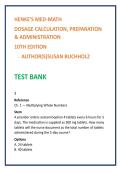
DOSAGE CALCULATION, PREPARATION
& ADMINISTRATION
10TH EDITION
• AUTHOR(S)SUSAN BUCHHOLZ
TEST BANK
1⃣
Reference
Ch. 1 — Multiplying Whole Numbers
Stem
An adult patient is prescribed amoxicillin 250 mg to be given as
4 tablets per dose every 8 hours for 24 hours. Each tablet
contains 250 mg. How many milligrams will the patient receive
in 24 hours?
A. 1,000 mg
B. 3,000 mg
,C. 4,000 mg
D. 750 mg
Correct answer: B. 3,000 mg
Rationales
Correct (B): One dose = 4 tablets × 250 mg = 1,000 mg. Doses
per 24 hours = 24 ÷ 8 = 3. Total = 1,000 mg × 3 = 3,000 mg. This
follows straightforward multiplication and repeated dosing.
A: 1,000 mg is the mg per single dose (4 tablets × 250 mg) —
error: did not account for 3 doses/day. May underdose patient.
C: 4,000 mg implies multiplying 1,000 mg by 4 doses — error:
incorrect number of doses in 24 hours. Could lead to overdose.
D: 750 mg is arithmetic nonsense for these quantities; likely
result of mismultiplying tablets and mg.
Teaching point: Multiply dose per administration by number of
administrations in period.
Citation: Buchholz, S. (2024). Henke’s Med-Math: Dosage
Calculation, Preparation & Administration (10th ed.). Ch. 1.
2️⃣
Reference
Ch. 1 — Dividing Whole Numbers
Stem
A nurse is to give a patient 750 mL of oral rehydration fluid in
,three equal portions over the day. What volume (mL) should be
given per portion to the adult patient?
A. 125 mL
B. 250 mL
C. 375 mL
D. 500 mL
Correct answer: B. 250 mL
Rationales
Correct (B): 750 mL ÷ 3 portions = 250 mL per portion. Division
of whole numbers gives exact per-portion volume.
A: 125 mL is 750 ÷ 6 — error: wrong divisor. May underdeliver
fluid.
C: 375 mL is 750 ÷ 2 — error: assumed two portions. Could
overload in a single administration.
D: 500 mL is 2/3 of the total — error from incorrect fractioning.
Teaching point: Divide total volume by number of equal
portions for per-dose volume.
Citation: Buchholz, S. (2024). Henke’s Med-Math: Dosage
Calculation, Preparation & Administration (10th ed.). Ch. 1.
3️⃣
Reference
Ch. 1 — Fractions
, Stem
A patient was instructed to drink 750 mL of water in 2 hours but
drank only 450 mL. What fraction of the ordered fluid remains
to be consumed?
A. 2/5
B. 1/2
C. 3/5
D. 2/3
Correct answer: A. 2/5
Rationales
Correct (A): Remaining = 750 − 450 = 300 mL. Fraction
remaining = 300/750 = divide numerator and denominator by
150 → 2/5.
B: 1/2 would be 375/750 — error: miscalculated remaining.
C: 3/5 equals 450/750 which represents amount already
consumed, not remaining.
D: 2/3 = 500/750 — incorrect reduction.
Teaching point: Subtract consumed amount, then reduce the
resulting fraction to lowest terms.
Citation: Buchholz, S. (2024). Henke’s Med-Math: Dosage
Calculation, Preparation & Administration (10th ed.). Ch. 1.
4️⃣
DOSAGE CALCULATION, PREPARATION
& ADMINISTRATION
10TH EDITION
• AUTHOR(S)SUSAN BUCHHOLZ
TEST BANK
1⃣
Reference
Ch. 1 — Multiplying Whole Numbers
Stem
An adult patient is prescribed amoxicillin 250 mg to be given as
4 tablets per dose every 8 hours for 24 hours. Each tablet
contains 250 mg. How many milligrams will the patient receive
in 24 hours?
A. 1,000 mg
B. 3,000 mg
,C. 4,000 mg
D. 750 mg
Correct answer: B. 3,000 mg
Rationales
Correct (B): One dose = 4 tablets × 250 mg = 1,000 mg. Doses
per 24 hours = 24 ÷ 8 = 3. Total = 1,000 mg × 3 = 3,000 mg. This
follows straightforward multiplication and repeated dosing.
A: 1,000 mg is the mg per single dose (4 tablets × 250 mg) —
error: did not account for 3 doses/day. May underdose patient.
C: 4,000 mg implies multiplying 1,000 mg by 4 doses — error:
incorrect number of doses in 24 hours. Could lead to overdose.
D: 750 mg is arithmetic nonsense for these quantities; likely
result of mismultiplying tablets and mg.
Teaching point: Multiply dose per administration by number of
administrations in period.
Citation: Buchholz, S. (2024). Henke’s Med-Math: Dosage
Calculation, Preparation & Administration (10th ed.). Ch. 1.
2️⃣
Reference
Ch. 1 — Dividing Whole Numbers
Stem
A nurse is to give a patient 750 mL of oral rehydration fluid in
,three equal portions over the day. What volume (mL) should be
given per portion to the adult patient?
A. 125 mL
B. 250 mL
C. 375 mL
D. 500 mL
Correct answer: B. 250 mL
Rationales
Correct (B): 750 mL ÷ 3 portions = 250 mL per portion. Division
of whole numbers gives exact per-portion volume.
A: 125 mL is 750 ÷ 6 — error: wrong divisor. May underdeliver
fluid.
C: 375 mL is 750 ÷ 2 — error: assumed two portions. Could
overload in a single administration.
D: 500 mL is 2/3 of the total — error from incorrect fractioning.
Teaching point: Divide total volume by number of equal
portions for per-dose volume.
Citation: Buchholz, S. (2024). Henke’s Med-Math: Dosage
Calculation, Preparation & Administration (10th ed.). Ch. 1.
3️⃣
Reference
Ch. 1 — Fractions
, Stem
A patient was instructed to drink 750 mL of water in 2 hours but
drank only 450 mL. What fraction of the ordered fluid remains
to be consumed?
A. 2/5
B. 1/2
C. 3/5
D. 2/3
Correct answer: A. 2/5
Rationales
Correct (A): Remaining = 750 − 450 = 300 mL. Fraction
remaining = 300/750 = divide numerator and denominator by
150 → 2/5.
B: 1/2 would be 375/750 — error: miscalculated remaining.
C: 3/5 equals 450/750 which represents amount already
consumed, not remaining.
D: 2/3 = 500/750 — incorrect reduction.
Teaching point: Subtract consumed amount, then reduce the
resulting fraction to lowest terms.
Citation: Buchholz, S. (2024). Henke’s Med-Math: Dosage
Calculation, Preparation & Administration (10th ed.). Ch. 1.
4️⃣