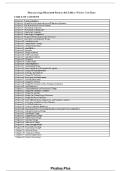
, CHAPTER LIST
Chapter 1: Food Choices: Nutrients and Nourishment
Chapter 2: Nutrition Guidelines and Assessment
Spotlight on Dietary Supplements and Functional Foods
Chapter 3: Digestion and Absorption
Chapter 4: Carbohydrates
Chapter 5: Lipids
Chapter 6: Proteins and Amino Acids
Chapter 7: Alcohol
Chapter 8: Metabolism
Chapter 9: Energy Balance and Weight Management: Finding Your
Equilibrium
Chapter 10: Fat-Soluble Vitamins
Chapter 11: Water-Soluble Vitamins
Chapter 12: Water and Major Minerals
Chapter 13: Trace Minerals
Chapter 14: Sports Nutrition: Eating for Peak Performance
Chapter 15: Diet and Health
Chapter 16: Life Cycle: Maternal and Infant Nutrition
Chapter 17: Life Cycle: From Childhood to Adulthood
Chapter 18: Food Safety and Technology: Microbial Threats and Genetic
Engineering
Chapter 19: World View of Nutrition: The Faces of Global Malnutrition
,Chapter 1
Food Choices—Nutrients and Nourishment
Question 1
A 35-year-old patient reports taking a “superfood” supplement advertised to prevent
heart disease and cancer. Which principle of evidence-based nutrition is most
appropriate when evaluating this claim?
A. Anecdotal success stories are sufficient evidence
B. Correlation between intake and health outcome proves causation
C. Claims must be supported by peer-reviewed, reproducible research
D. Traditional use over time confirms scientific validity
Answer: C
Rationale:
Evidence-based nutrition relies on systematic research, particularly peer-reviewed
studies that are reproducible and controlled. Anecdotes, correlations, and tradition do
not establish causation or scientific validity. This question directly reflects Chapter 1’s
emphasis on critical evaluation of nutrition claims.
Key words: evidence-based nutrition, peer-reviewed research, causation, health claims
Question 2
Which statement best describes a nutrient-dense food?
A. A food providing high energy with minimal micronutrients
B. A food supplying substantial vitamins and minerals relative to its energy content
C. A food containing all essential nutrients in one serving
D. A food fortified with synthetic vitamins regardless of caloric value
Answer: B
,Rationale:
Nutrient density refers to the amount of essential nutrients per calorie. Foods high in
vitamins, minerals, and fiber relative to energy intake are nutrient-dense. Chapter 1
emphasizes food quality rather than caloric quantity alone.
Key words: nutrient density, food quality, micronutrients, energy intake
Question 3
A college student avoids dairy due to cultural preferences. Which nutrient is MOST at
risk of inadequate intake if no appropriate substitutions are made?
A. Iron
B. Vitamin C
C. Calcium
D. Vitamin B12
Answer: C
Rationale:
Dairy products are major dietary sources of calcium. Cultural food patterns strongly
influence nutrient intake, and Chapter 1 highlights how cultural choices can affect
nutritional adequacy if alternatives are not selected.
Key words: cultural food choices, calcium, dietary patterns, nutrient adequacy
Question 4
Which scenario BEST illustrates the interaction between diet and chronic disease risk?
A. Choosing organic foods to reduce pesticide exposure
B. Replacing refined grains with whole grains to lower cardiovascular risk
C. Eating frequent small meals to enhance metabolism
D. Consuming supplements to compensate for skipped meals
Answer: B
,Rationale:
Whole grains reduce cardiovascular disease risk due to fiber, phytochemicals, and
improved lipid profiles. This reflects Chapter 1’s emphasis on diet–disease
relationships supported by evidence.
Key words: chronic disease prevention, whole grains, cardiovascular health, dietary
patterns
Question 5
Which factor MOST strongly explains why individuals of similar socioeconomic status
may make different food choices?
A. Nutrient bioavailability
B. Genetic predisposition
C. Psychological and social influences
D. Basal metabolic rate
Answer: C
Rationale:
Chapter 1 emphasizes that food choices are shaped not only by economics but also by
psychological factors, social norms, beliefs, and attitudes, which can differ widely
even within similar income groups.
Key words: food choice determinants, psychology, social influences, behavior
Question 6
A patient believes that “natural” foods are always safer than conventional foods. This
belief represents which barrier to informed nutrition decision-making?
A. Limited food availability
B. Misinformation and cognitive bias
C. Economic constraint
D. Lack of nutrient labeling
,Answer: B
Rationale:
Assuming “natural” equals safe reflects misinformation and cognitive bias, a major
obstacle to evidence-based choices discussed in Chapter 1.
Key words: misinformation, cognitive bias, nutrition myths, decision-making
Question 7
Which nutrient classification provides energy to the body?
A. Vitamins
B. Minerals
C. Water
D. Macronutrients
Answer: D
Rationale:
Macronutrients—carbohydrates, proteins, and fats—supply energy (kilocalories).
Micronutrients and water do not provide energy but support physiological processes.
Key words: macronutrients, energy, kilocalories, nutrient classification
Question 8
Which statement BEST differentiates nutrition science from popular nutrition trends?
A. Nutrition science relies on media influence
B. Trends prioritize cultural acceptance
C. Nutrition science is grounded in systematic research
D. Trends require regulatory approval
Answer: C
Rationale:
Nutrition science depends on controlled research and scientific methodology,
,whereas popular trends often lack rigorous evidence. Chapter 1 stresses scientific
literacy.
Key words: nutrition science, research methodology, trends, scientific evidence
Question 9
A community experiences high rates of obesity despite adequate food availability.
Which factor most likely contributes to this outcome?
A. Micronutrient deficiencies
B. Obesogenic environment
C. Genetic homogeneity
D. Inadequate protein intake
Answer: B
Rationale:
An obesogenic environment—characterized by easy access to energy-dense foods and
sedentary lifestyles—plays a major role in obesity, aligning with Chapter 1’s discussion
of environmental influences.
Key words: obesogenic environment, obesity, food environment, lifestyle
Question 10
Which action reflects informed nutrition decision-making?
A. Choosing foods based solely on taste
B. Relying on celebrity endorsements
C. Evaluating food choices using scientific evidence
D. Avoiding all processed foods
Answer: C
Rationale:
Informed decision-making requires applying scientific evidence, not emotions, trends,
or oversimplified rules.
, Key words: informed decision-making, scientific evaluation, nutrition literacy
Question 11
Which nutrient function is MOST directly related to growth and tissue repair?
A. Energy provision
B. Regulation of fluid balance
C. Structural and functional roles
D. Antioxidant activity
Answer: C
Rationale:
Proteins and some minerals serve structural and functional roles critical for growth,
maintenance, and repair—key concepts introduced in Chapter 1.
Key words: nutrient function, tissue repair, structure, growth
Question 12
A student compares two snack foods with equal calories but different nutrient profiles.
This comparison emphasizes which nutrition concept?
A. Energy balance
B. Nutrient density
C. Bioavailability
D. Dietary diversity
Answer: B
Rationale:
Comparing nutrients per calorie illustrates nutrient density, a foundational Chapter 1
concept tied to food quality.
Key words: nutrient density, food quality, calorie comparison
Chapter 1: Food Choices: Nutrients and Nourishment
Chapter 2: Nutrition Guidelines and Assessment
Spotlight on Dietary Supplements and Functional Foods
Chapter 3: Digestion and Absorption
Chapter 4: Carbohydrates
Chapter 5: Lipids
Chapter 6: Proteins and Amino Acids
Chapter 7: Alcohol
Chapter 8: Metabolism
Chapter 9: Energy Balance and Weight Management: Finding Your
Equilibrium
Chapter 10: Fat-Soluble Vitamins
Chapter 11: Water-Soluble Vitamins
Chapter 12: Water and Major Minerals
Chapter 13: Trace Minerals
Chapter 14: Sports Nutrition: Eating for Peak Performance
Chapter 15: Diet and Health
Chapter 16: Life Cycle: Maternal and Infant Nutrition
Chapter 17: Life Cycle: From Childhood to Adulthood
Chapter 18: Food Safety and Technology: Microbial Threats and Genetic
Engineering
Chapter 19: World View of Nutrition: The Faces of Global Malnutrition
,Chapter 1
Food Choices—Nutrients and Nourishment
Question 1
A 35-year-old patient reports taking a “superfood” supplement advertised to prevent
heart disease and cancer. Which principle of evidence-based nutrition is most
appropriate when evaluating this claim?
A. Anecdotal success stories are sufficient evidence
B. Correlation between intake and health outcome proves causation
C. Claims must be supported by peer-reviewed, reproducible research
D. Traditional use over time confirms scientific validity
Answer: C
Rationale:
Evidence-based nutrition relies on systematic research, particularly peer-reviewed
studies that are reproducible and controlled. Anecdotes, correlations, and tradition do
not establish causation or scientific validity. This question directly reflects Chapter 1’s
emphasis on critical evaluation of nutrition claims.
Key words: evidence-based nutrition, peer-reviewed research, causation, health claims
Question 2
Which statement best describes a nutrient-dense food?
A. A food providing high energy with minimal micronutrients
B. A food supplying substantial vitamins and minerals relative to its energy content
C. A food containing all essential nutrients in one serving
D. A food fortified with synthetic vitamins regardless of caloric value
Answer: B
,Rationale:
Nutrient density refers to the amount of essential nutrients per calorie. Foods high in
vitamins, minerals, and fiber relative to energy intake are nutrient-dense. Chapter 1
emphasizes food quality rather than caloric quantity alone.
Key words: nutrient density, food quality, micronutrients, energy intake
Question 3
A college student avoids dairy due to cultural preferences. Which nutrient is MOST at
risk of inadequate intake if no appropriate substitutions are made?
A. Iron
B. Vitamin C
C. Calcium
D. Vitamin B12
Answer: C
Rationale:
Dairy products are major dietary sources of calcium. Cultural food patterns strongly
influence nutrient intake, and Chapter 1 highlights how cultural choices can affect
nutritional adequacy if alternatives are not selected.
Key words: cultural food choices, calcium, dietary patterns, nutrient adequacy
Question 4
Which scenario BEST illustrates the interaction between diet and chronic disease risk?
A. Choosing organic foods to reduce pesticide exposure
B. Replacing refined grains with whole grains to lower cardiovascular risk
C. Eating frequent small meals to enhance metabolism
D. Consuming supplements to compensate for skipped meals
Answer: B
,Rationale:
Whole grains reduce cardiovascular disease risk due to fiber, phytochemicals, and
improved lipid profiles. This reflects Chapter 1’s emphasis on diet–disease
relationships supported by evidence.
Key words: chronic disease prevention, whole grains, cardiovascular health, dietary
patterns
Question 5
Which factor MOST strongly explains why individuals of similar socioeconomic status
may make different food choices?
A. Nutrient bioavailability
B. Genetic predisposition
C. Psychological and social influences
D. Basal metabolic rate
Answer: C
Rationale:
Chapter 1 emphasizes that food choices are shaped not only by economics but also by
psychological factors, social norms, beliefs, and attitudes, which can differ widely
even within similar income groups.
Key words: food choice determinants, psychology, social influences, behavior
Question 6
A patient believes that “natural” foods are always safer than conventional foods. This
belief represents which barrier to informed nutrition decision-making?
A. Limited food availability
B. Misinformation and cognitive bias
C. Economic constraint
D. Lack of nutrient labeling
,Answer: B
Rationale:
Assuming “natural” equals safe reflects misinformation and cognitive bias, a major
obstacle to evidence-based choices discussed in Chapter 1.
Key words: misinformation, cognitive bias, nutrition myths, decision-making
Question 7
Which nutrient classification provides energy to the body?
A. Vitamins
B. Minerals
C. Water
D. Macronutrients
Answer: D
Rationale:
Macronutrients—carbohydrates, proteins, and fats—supply energy (kilocalories).
Micronutrients and water do not provide energy but support physiological processes.
Key words: macronutrients, energy, kilocalories, nutrient classification
Question 8
Which statement BEST differentiates nutrition science from popular nutrition trends?
A. Nutrition science relies on media influence
B. Trends prioritize cultural acceptance
C. Nutrition science is grounded in systematic research
D. Trends require regulatory approval
Answer: C
Rationale:
Nutrition science depends on controlled research and scientific methodology,
,whereas popular trends often lack rigorous evidence. Chapter 1 stresses scientific
literacy.
Key words: nutrition science, research methodology, trends, scientific evidence
Question 9
A community experiences high rates of obesity despite adequate food availability.
Which factor most likely contributes to this outcome?
A. Micronutrient deficiencies
B. Obesogenic environment
C. Genetic homogeneity
D. Inadequate protein intake
Answer: B
Rationale:
An obesogenic environment—characterized by easy access to energy-dense foods and
sedentary lifestyles—plays a major role in obesity, aligning with Chapter 1’s discussion
of environmental influences.
Key words: obesogenic environment, obesity, food environment, lifestyle
Question 10
Which action reflects informed nutrition decision-making?
A. Choosing foods based solely on taste
B. Relying on celebrity endorsements
C. Evaluating food choices using scientific evidence
D. Avoiding all processed foods
Answer: C
Rationale:
Informed decision-making requires applying scientific evidence, not emotions, trends,
or oversimplified rules.
, Key words: informed decision-making, scientific evaluation, nutrition literacy
Question 11
Which nutrient function is MOST directly related to growth and tissue repair?
A. Energy provision
B. Regulation of fluid balance
C. Structural and functional roles
D. Antioxidant activity
Answer: C
Rationale:
Proteins and some minerals serve structural and functional roles critical for growth,
maintenance, and repair—key concepts introduced in Chapter 1.
Key words: nutrient function, tissue repair, structure, growth
Question 12
A student compares two snack foods with equal calories but different nutrient profiles.
This comparison emphasizes which nutrition concept?
A. Energy balance
B. Nutrient density
C. Bioavailability
D. Dietary diversity
Answer: B
Rationale:
Comparing nutrients per calorie illustrates nutrient density, a foundational Chapter 1
concept tied to food quality.
Key words: nutrient density, food quality, calorie comparison