BIOLOGY STUDY PHOTOSYNTHESIS AND
CELLULAR RESPIRATION
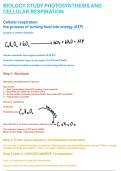
Cellular respiration:
the process of turning food into energy (ATP)
Equation of cellular respiration:
6602 6H20 ATP
Cotti Do 60 i
Aerobic respiration: uses oxygen/ produces 36-38 ATP
Anaerobic respiration: does not use oxygen/ 2-4 ATP and 2 NADH
The overall goal of cellular respiration is to create energy that we can use.
Step 1: Glycolysis
Glycolysis: breaking down of glucose
Key events:
1. Gets 2 phosphates from ATP, making a new molecule
2. New molecule splits into 2 smaller ones
3. As the smaller molecules get processed, they create ATP and NADH
4. Final product: pyruvate
Occurs in: Cytoplasm
Anaerobic
76s
Reactants used:
Cottied
Gets split into 2 3-carbon molecules called pyruvate
34403
This reaction releases: 2 ATP and 2 NADH
Moves to next stage: 2 pyruvate molecules
Step 2: Krebs Cycle (aerobic) / Fermentation (anaerobic)
The next step of cellular respiration is a decision. After glycolysis, the cells decides what to do next. If there is oxygen
available, the Krebs cycle begins. I f there is no oxygen available, fermentation begins.
Step 2 path A: (OXYGEN ABSENT) Fermentation
Type 1 of fermentation: Lactic Acid Fermentation
Occurs in organisms like: some bacteria and animal cells (like our muscles)
CELLULAR RESPIRATION
Cellular respiration:
the process of turning food into energy (ATP)
Equation of cellular respiration:
6602 6H20 ATP
Cotti Do 60 i
Aerobic respiration: uses oxygen/ produces 36-38 ATP
Anaerobic respiration: does not use oxygen/ 2-4 ATP and 2 NADH
The overall goal of cellular respiration is to create energy that we can use.
Step 1: Glycolysis
Glycolysis: breaking down of glucose
Key events:
1. Gets 2 phosphates from ATP, making a new molecule
2. New molecule splits into 2 smaller ones
3. As the smaller molecules get processed, they create ATP and NADH
4. Final product: pyruvate
Occurs in: Cytoplasm
Anaerobic
76s
Reactants used:
Cottied
Gets split into 2 3-carbon molecules called pyruvate
34403
This reaction releases: 2 ATP and 2 NADH
Moves to next stage: 2 pyruvate molecules
Step 2: Krebs Cycle (aerobic) / Fermentation (anaerobic)
The next step of cellular respiration is a decision. After glycolysis, the cells decides what to do next. If there is oxygen
available, the Krebs cycle begins. I f there is no oxygen available, fermentation begins.
Step 2 path A: (OXYGEN ABSENT) Fermentation
Type 1 of fermentation: Lactic Acid Fermentation
Occurs in organisms like: some bacteria and animal cells (like our muscles)