Through-bond J-coupling and 2D, 3D NMR
Learning objectives:
1. Recognise J coupling, connects nuclei that are linked together through bonds (up to 4 bonds)
2. Explain that the splitting pattern will tell us how many neighbouring nuclei are present
3. Describe the relationship between the backbone torsion angles in proteins and the 3Ja-NH coupling
4. illustrate how 2D NMR can be used to connect NMR peaks that are connected through bonds
5. Describe how amino acids in proteins have standard patterns of cross-peaks in 2D spectra
6. Report why a 2D 15N HSQC gives a “fingerprint” of a protein
7. Explain how 3D NMR experiments separate out crowded 2D NMR spectra
Information available from 1D 1H NMR spectra
1. Chemical shift
Gives information on the chemical environment of a particular H
2. Integration
Area under curve
Number of protons are equivalent to the peak
3. Multiplicity
Splitting= neighbouring H
N+1 peak rule
4. Coupling constant
Spin-spin (through-bond) J-coupling
Principle:
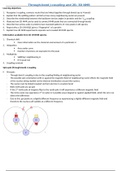
- Through-bond J-coupling is due to the coupling/linking of neighbouring nuclei
- The possible spin orientation (with or against the magnetic field) of neighbouring nuclei effects the magnetic field
of the nucleus being studied via the electron distribution around the nucleus.
- The nuclei must be linked/coupled via their electron in covalent bond
- Both north pole are up spin
- If the 2nd north pole of magnets flips to the south pole it will experience a different magnetic field
- The 2st H nuclei can experience 2nd H nuclei in 2 possible ways (aligned or against applied field), which the nmr can
detect the difference
- Due to this, get peaks at a slightly different frequency as experiencing a slightly different magnetic field and
therefore the nucleus will wobble at a different frequency
, Splitting patterns
Gives information about neighbouring H
The resonant frequencies increase depending on if the neighbouring nuclei.
This produces a splitting patters
In proton NMR a peak with singlet indicates no through-bond neighbours.
A doublet indicates 1 through bond neighbour
A triplet indicated 2 neighbours
A quartet three neighbour H
Appearance of some multiplet
The magnitude of the coupling give information and its called J coupling
Magnitude of J coupling measured in Hz rather than ppm so it’s a radio wave frequency
J-values are independent of the magnetic field strength
J coupling
Learning objectives:
1. Recognise J coupling, connects nuclei that are linked together through bonds (up to 4 bonds)
2. Explain that the splitting pattern will tell us how many neighbouring nuclei are present
3. Describe the relationship between the backbone torsion angles in proteins and the 3Ja-NH coupling
4. illustrate how 2D NMR can be used to connect NMR peaks that are connected through bonds
5. Describe how amino acids in proteins have standard patterns of cross-peaks in 2D spectra
6. Report why a 2D 15N HSQC gives a “fingerprint” of a protein
7. Explain how 3D NMR experiments separate out crowded 2D NMR spectra
Information available from 1D 1H NMR spectra
1. Chemical shift
Gives information on the chemical environment of a particular H
2. Integration
Area under curve
Number of protons are equivalent to the peak
3. Multiplicity
Splitting= neighbouring H
N+1 peak rule
4. Coupling constant
Spin-spin (through-bond) J-coupling
Principle:
- Through-bond J-coupling is due to the coupling/linking of neighbouring nuclei
- The possible spin orientation (with or against the magnetic field) of neighbouring nuclei effects the magnetic field
of the nucleus being studied via the electron distribution around the nucleus.
- The nuclei must be linked/coupled via their electron in covalent bond
- Both north pole are up spin
- If the 2nd north pole of magnets flips to the south pole it will experience a different magnetic field
- The 2st H nuclei can experience 2nd H nuclei in 2 possible ways (aligned or against applied field), which the nmr can
detect the difference
- Due to this, get peaks at a slightly different frequency as experiencing a slightly different magnetic field and
therefore the nucleus will wobble at a different frequency
, Splitting patterns
Gives information about neighbouring H
The resonant frequencies increase depending on if the neighbouring nuclei.
This produces a splitting patters
In proton NMR a peak with singlet indicates no through-bond neighbours.
A doublet indicates 1 through bond neighbour
A triplet indicated 2 neighbours
A quartet three neighbour H
Appearance of some multiplet
The magnitude of the coupling give information and its called J coupling
Magnitude of J coupling measured in Hz rather than ppm so it’s a radio wave frequency
J-values are independent of the magnetic field strength
J coupling