TEST BANK
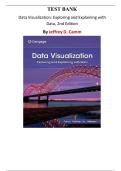
Data Visualization: Exploring and Explaining with
Data, 2nd Edition
By Jeffrey D. Camm
TU
TO
R
G
U
R
U
,TABLE OF CONTENT
Chapter 1. Introduction
Chapter 2. Selecting a Chart Type
Chapter 3. Data Visualization and Design
TU
Chapter 4. Purposeful Use of Color
TO
Chapter 5. Visualizing Variability
Chapter 6. Exploring Data Visually
R
Chapter 7. Explaining Visually to Influence with Data
G
U
Chapter 8. Data Dashboards
R
Chapter 9. Telling the Truth with Data Visualization
U
,Test Bank for
Data Visualization: Exploring and Explaining with Data by Jeffrey D. Camm | 2nd Edition
Chapter 1-9
Multiple Choice
1. The graphical representation of data and information using displays such as charts, graphs, and maps is known as data
.
a. visualization
b. mining
c. analytics
d. science
ANSWER: a
TU
2. The set of analytical tools that describe what has happened and includes techniques such as data queries, reports,
descriptive or summary statistics, and data visualization is .
a. descriptive analytics
b. predictive analytics
c. prescriptive analytics
TO
d. diagnostic analytics
ANSWER: a
3. What field of analytics consists of techniques that use mathematical models constructed from past data to predict future
events or better understand the relationships between variables?
a. Descriptive analytics
R
b. Predictive analytics
c. Prescriptive analytics
d. Restorative analytics
G
ANSWER: b
4. Mathematical or logical models that suggest a decision or course of action and include mathematical optimization
models, decision analysis, and heuristic or rule-based systems are used in the field of .
U
a. descriptive analytics
b. predictive analytics
c. prescriptive analytics
R
d. restorative analytics
ANSWER: c
U
5. The scientific process of transforming data into insights for making better decisions is .
a. analytics
b. visualization
c. surveying
d. sampling
ANSWER: a
6. Descriptive analytics is the set of analytical tools that describe .
a. what has happened
b. what may happen
, Test Bank for
Data Visualization: Exploring and Explaining with Data by Jeffrey D. Camm | 2nd Edition
Chapter 1-9
c. a course of action to take
d. future trends
ANSWER: a
7. Predictive analytics consists of techniques that use mathematical models constructed from past data to predict future
events or .
a. describe what has happened in the past
b. better understand the relationships between variables
c. determine a course of action for the future
TU
d. suggest a decision
ANSWER: b
8. Prescriptive analytics are mathematical or logical models that .
a. describe the past
b. predict the future
TO
c. suggest a decision or course of action
d. describe a relationship between two variables
ANSWER: c
9. Data for which numerical values are used to indicate magnitude, such as how many or how much, are referred to as:
a. quantitative
R
b. qualitative
c. categorical
d. ordinal
G
ANSWER: a
10. What type of data is that for which categories of like items are identified by labels or names?
U
a. Quantitative
b. Numerical
c. Categorical
R
d. Arithmetic
ANSWER: c
U
11. Which of the following arithmetic operations can be performed on categorical data?
a. Addition
b. Subtraction
c. Multiplication
d. None of these choices
ANSWER: d
12. If we collect data on the number of wins each team in the NFL had during the 2023–2024 season, we have
data.
a. cross-sectional
Data Visualization: Exploring and Explaining with
Data, 2nd Edition
By Jeffrey D. Camm
TU
TO
R
G
U
R
U
,TABLE OF CONTENT
Chapter 1. Introduction
Chapter 2. Selecting a Chart Type
Chapter 3. Data Visualization and Design
TU
Chapter 4. Purposeful Use of Color
TO
Chapter 5. Visualizing Variability
Chapter 6. Exploring Data Visually
R
Chapter 7. Explaining Visually to Influence with Data
G
U
Chapter 8. Data Dashboards
R
Chapter 9. Telling the Truth with Data Visualization
U
,Test Bank for
Data Visualization: Exploring and Explaining with Data by Jeffrey D. Camm | 2nd Edition
Chapter 1-9
Multiple Choice
1. The graphical representation of data and information using displays such as charts, graphs, and maps is known as data
.
a. visualization
b. mining
c. analytics
d. science
ANSWER: a
TU
2. The set of analytical tools that describe what has happened and includes techniques such as data queries, reports,
descriptive or summary statistics, and data visualization is .
a. descriptive analytics
b. predictive analytics
c. prescriptive analytics
TO
d. diagnostic analytics
ANSWER: a
3. What field of analytics consists of techniques that use mathematical models constructed from past data to predict future
events or better understand the relationships between variables?
a. Descriptive analytics
R
b. Predictive analytics
c. Prescriptive analytics
d. Restorative analytics
G
ANSWER: b
4. Mathematical or logical models that suggest a decision or course of action and include mathematical optimization
models, decision analysis, and heuristic or rule-based systems are used in the field of .
U
a. descriptive analytics
b. predictive analytics
c. prescriptive analytics
R
d. restorative analytics
ANSWER: c
U
5. The scientific process of transforming data into insights for making better decisions is .
a. analytics
b. visualization
c. surveying
d. sampling
ANSWER: a
6. Descriptive analytics is the set of analytical tools that describe .
a. what has happened
b. what may happen
, Test Bank for
Data Visualization: Exploring and Explaining with Data by Jeffrey D. Camm | 2nd Edition
Chapter 1-9
c. a course of action to take
d. future trends
ANSWER: a
7. Predictive analytics consists of techniques that use mathematical models constructed from past data to predict future
events or .
a. describe what has happened in the past
b. better understand the relationships between variables
c. determine a course of action for the future
TU
d. suggest a decision
ANSWER: b
8. Prescriptive analytics are mathematical or logical models that .
a. describe the past
b. predict the future
TO
c. suggest a decision or course of action
d. describe a relationship between two variables
ANSWER: c
9. Data for which numerical values are used to indicate magnitude, such as how many or how much, are referred to as:
a. quantitative
R
b. qualitative
c. categorical
d. ordinal
G
ANSWER: a
10. What type of data is that for which categories of like items are identified by labels or names?
U
a. Quantitative
b. Numerical
c. Categorical
R
d. Arithmetic
ANSWER: c
U
11. Which of the following arithmetic operations can be performed on categorical data?
a. Addition
b. Subtraction
c. Multiplication
d. None of these choices
ANSWER: d
12. If we collect data on the number of wins each team in the NFL had during the 2023–2024 season, we have
data.
a. cross-sectional