
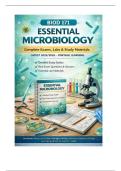
,Structured Microbiology Exam Questions and Answers
create the 100 questions and answers well structured and well used right tick to mark correct
answer BIOD 171 Essential Microbiology – Module Exams BIOD 171 Essential Microbiology
Module 1 Exam Questions & Answers (Latest 2025/2026)
BIOD 171 Essential Microbiology – Module 1 Exam
Disclaimer: This is a structured study guide intended for educational review. Always consult
your official course materials for definitive exam content.
Section 1: Introduction to Microbiology & Microscopy
1. What is the primary difference between prokaryotic and eukaryotic cells?
• A) Eukaryotes have a cell wall; prokaryotes do not.
• B) Prokaryotes have membrane-bound organelles; eukaryotes do not.
• [✓] C) Prokaryotes lack a membrane-bound nucleus; eukaryotes have one.
• D) Eukaryotes are always smaller than prokaryotes.
2. Who is credited with developing the first crude microscope and observing "animalcules"?
• A) Louis Pasteur
• B) Robert Koch
• [✓] C) Antonie van Leeuwenhoek
• D) Edward Jenner
3. Resolution in microscopy refers to:
• A) The ability to magnify an object.
• [✓] B) The ability to distinguish two adjacent points as separate.
• C) The use of oil to increase light scattering.
• D) The total magnification power of the lenses.
4. Immersion oil is used with the 100x objective lens to:
• A) Clean the lens.
, • B) Increase magnification.
• [✓] C) Reduce light refraction and increase resolution.
• D) Stain the specimen.
5. What is the total magnification when using the 40x objective lens on a standard compound
light microscope (10x oculars)?
• A) 40x
• [✓] B) 400x
• C) 4x
• D) 1000x
Section 2: Cell Structure & Taxonomy
6. Which structure is found in ALL prokaryotic cells?
• A) Nucleus
• B) Mitochondria
• [✓] C) Ribosomes
• D) Endoplasmic reticulum
7. The rigid outer structure providing shape and protection to bacterial cells is the:
• [✓] A) Cell wall
• B) Cell membrane
• C) Capsule
• D) Slime layer
8. The bacterial structure involved in protein synthesis is the:
• A) Nucleoid
• [✓] B) Ribosome
• C) Inclusion body
• D) Pilus
, 9. Flagella are primarily used for:
• A) DNA transfer
• B) Adhesion to surfaces
• [✓] C) Motility
• D) Protein synthesis
10. The scientific name of an organism includes its:
• [✓] A) Genus and species
• B) Family and order
• C) Domain and kingdom
• D) Class and phylum
Section 3: Staining Techniques
11. The purpose of heat-fixing a bacterial smear is to:
• A) Stain the cells.
• [✓] B) Adhere cells to the slide and kill the organism.
• C) Increase magnification.
• D) Dissolve the cell wall.
12. In a Gram stain, the primary stain is:
• A) Safranin
• B) Iodine
• C) Alcohol
• [✓] D) Crystal violet
13. Gram-negative bacteria appear ___ after completing the Gram stain procedure.
• A) Purple
• [✓] B) Pink/Red
• C) Colorless
create the 100 questions and answers well structured and well used right tick to mark correct
answer BIOD 171 Essential Microbiology – Module Exams BIOD 171 Essential Microbiology
Module 1 Exam Questions & Answers (Latest 2025/2026)
BIOD 171 Essential Microbiology – Module 1 Exam
Disclaimer: This is a structured study guide intended for educational review. Always consult
your official course materials for definitive exam content.
Section 1: Introduction to Microbiology & Microscopy
1. What is the primary difference between prokaryotic and eukaryotic cells?
• A) Eukaryotes have a cell wall; prokaryotes do not.
• B) Prokaryotes have membrane-bound organelles; eukaryotes do not.
• [✓] C) Prokaryotes lack a membrane-bound nucleus; eukaryotes have one.
• D) Eukaryotes are always smaller than prokaryotes.
2. Who is credited with developing the first crude microscope and observing "animalcules"?
• A) Louis Pasteur
• B) Robert Koch
• [✓] C) Antonie van Leeuwenhoek
• D) Edward Jenner
3. Resolution in microscopy refers to:
• A) The ability to magnify an object.
• [✓] B) The ability to distinguish two adjacent points as separate.
• C) The use of oil to increase light scattering.
• D) The total magnification power of the lenses.
4. Immersion oil is used with the 100x objective lens to:
• A) Clean the lens.
, • B) Increase magnification.
• [✓] C) Reduce light refraction and increase resolution.
• D) Stain the specimen.
5. What is the total magnification when using the 40x objective lens on a standard compound
light microscope (10x oculars)?
• A) 40x
• [✓] B) 400x
• C) 4x
• D) 1000x
Section 2: Cell Structure & Taxonomy
6. Which structure is found in ALL prokaryotic cells?
• A) Nucleus
• B) Mitochondria
• [✓] C) Ribosomes
• D) Endoplasmic reticulum
7. The rigid outer structure providing shape and protection to bacterial cells is the:
• [✓] A) Cell wall
• B) Cell membrane
• C) Capsule
• D) Slime layer
8. The bacterial structure involved in protein synthesis is the:
• A) Nucleoid
• [✓] B) Ribosome
• C) Inclusion body
• D) Pilus
, 9. Flagella are primarily used for:
• A) DNA transfer
• B) Adhesion to surfaces
• [✓] C) Motility
• D) Protein synthesis
10. The scientific name of an organism includes its:
• [✓] A) Genus and species
• B) Family and order
• C) Domain and kingdom
• D) Class and phylum
Section 3: Staining Techniques
11. The purpose of heat-fixing a bacterial smear is to:
• A) Stain the cells.
• [✓] B) Adhere cells to the slide and kill the organism.
• C) Increase magnification.
• D) Dissolve the cell wall.
12. In a Gram stain, the primary stain is:
• A) Safranin
• B) Iodine
• C) Alcohol
• [✓] D) Crystal violet
13. Gram-negative bacteria appear ___ after completing the Gram stain procedure.
• A) Purple
• [✓] B) Pink/Red
• C) Colorless

