

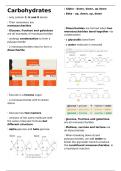
Carbohydrates : Alpha - down, down, up down
: Beta - up, down, up, down
: only contain C, H and O atoms
: Their monomers are
monosaccharides
: Disaccharides are formed when two
- Glucose, fructose and galactose monosaccharides bond together via
are all examples of monosaccharides condensation
- undergo condensation to form a - a glycosidic bond form
polysaccharide
- a water molecule is removed
- 2 monosaccharides react to form a
disaccharide
: Glucose is a hexose sugar
- a monosaccharide with 6 carbon
atoms
: Glucose has two isomers
- versions of the same molecule with
: glucose, fructose and galactose
the same molecular formula but
are all monosaccharides
different structure
: Maltose, sucrose and lactose are
: alpha-glucose and beta-glucose
all disaccharides
: When breaking down di and
polysaccharides, we add water to
break the glycosidic bond to produce
the constituent monosaccharides, in
a hydrolysis reaction.
, : first break the non-reducing sugars
down into monosaccharides
: get a fresh sample of the test
Benedicts test solution
: All sugars are classed as reducing or - add dilute hydrochloric acid and
non-reducing sugars heat in a water bath brought to the boil
: If non-reducing sugar is present, the
Reducing sugars ; HCl will hydrolyse it by breaking its
glycosidic bonds
: all monosaccharides
- forms its constituent
: a few disaccharides like maltose and monosaccharides
lactose
: add 2cm3 Benedict’s reagent to a
sample and heat it in a water bath : You then neutralise the acid using
sodium hydrogen carbonate solution
: bring the water bath to a boil
– acid must be neutralised because
benedict’s reagent will not work in
: If reducing sugars are present, a acidic conditions
coloured (brick-red) precipitate will
form
: Then carry out the Benedict’s test
: if no reducing sugars are present, again
the sample will stay blue and no
precipitate will form : if a precipitate forms, then a non-
reducing sugar was initially present in
the original sample
: The colour of the precipitate depends
on the concentration of the reducing
sugar
: only a semi-quantitative measure of
the concentration
Non-reducing sugars ; - brings inaccuracies since the colour
change is subjective to human
: If the result for reducing sugars is perception
negative, we may still have a non-
reducing sugar present
: Beta - up, down, up, down
: only contain C, H and O atoms
: Their monomers are
monosaccharides
: Disaccharides are formed when two
- Glucose, fructose and galactose monosaccharides bond together via
are all examples of monosaccharides condensation
- undergo condensation to form a - a glycosidic bond form
polysaccharide
- a water molecule is removed
- 2 monosaccharides react to form a
disaccharide
: Glucose is a hexose sugar
- a monosaccharide with 6 carbon
atoms
: Glucose has two isomers
- versions of the same molecule with
: glucose, fructose and galactose
the same molecular formula but
are all monosaccharides
different structure
: Maltose, sucrose and lactose are
: alpha-glucose and beta-glucose
all disaccharides
: When breaking down di and
polysaccharides, we add water to
break the glycosidic bond to produce
the constituent monosaccharides, in
a hydrolysis reaction.
, : first break the non-reducing sugars
down into monosaccharides
: get a fresh sample of the test
Benedicts test solution
: All sugars are classed as reducing or - add dilute hydrochloric acid and
non-reducing sugars heat in a water bath brought to the boil
: If non-reducing sugar is present, the
Reducing sugars ; HCl will hydrolyse it by breaking its
glycosidic bonds
: all monosaccharides
- forms its constituent
: a few disaccharides like maltose and monosaccharides
lactose
: add 2cm3 Benedict’s reagent to a
sample and heat it in a water bath : You then neutralise the acid using
sodium hydrogen carbonate solution
: bring the water bath to a boil
– acid must be neutralised because
benedict’s reagent will not work in
: If reducing sugars are present, a acidic conditions
coloured (brick-red) precipitate will
form
: Then carry out the Benedict’s test
: if no reducing sugars are present, again
the sample will stay blue and no
precipitate will form : if a precipitate forms, then a non-
reducing sugar was initially present in
the original sample
: The colour of the precipitate depends
on the concentration of the reducing
sugar
: only a semi-quantitative measure of
the concentration
Non-reducing sugars ; - brings inaccuracies since the colour
change is subjective to human
: If the result for reducing sugars is perception
negative, we may still have a non-
reducing sugar present

