Prescription Requirements and Guidelines
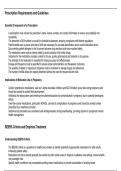
Essential Components of a Prescription
A prescription must include the prescriber’s name, license number, and contact information to ensure accountability and
traceability.
The prescriber’s DEA number is crucial for controlled substances, ensuring compliance with federal regulations.
Patient details such as name and date of birth are necessary for accurate identification and to avoid medication errors.
Documenting patient allergies is vital to prevent adverse drug reactions and ensure patient safety.
The medication name must be clearly stated to avoid confusion with similar drugs.
Indication for the medication provides context for its use, guiding pharmacists and patients on its purpose.
The strength of the medication is essential for dosing accuracy and effectiveness.
Dosage and frequency must be specified to ensure proper administration and therapeutic outcomes.
The quantity of tablets or capsules to dispense must be indicated to manage supply and adherence.
The number of refills allows for ongoing treatment without the need for frequent doctor visits.
Implications of Medication Use in Pregnancy
Certain hypertension medications, such as 5 alpha reductase inhibitors and ACE inhibitors, pose risks during pregnancy and
should be avoided to protect fetal development.
Antibiotics like tetracyclines and trimethoprim-sulfamethoxazole are contraindicated in pregnancy due to potential teratogenic
effects.
Over-the-counter medications, particularly NSAIDs, can lead to complications in pregnancy and should be avoided unless
prescribed by a healthcare provider.
Sertraline and paroxetine are considered safe antidepressants during breastfeeding, providing options for postpartum mental
health management.
BEERS Criteria and Empirical Treatment
Understanding BEERS Criteria
The BEERS criteria is a guideline for healthcare providers to identify potentially inappropriate medications for older adults,
enhancing patient safety.
Medications on the list should generally be avoided by older adults unless in hospice or palliative care settings, where benefits
may outweigh risks.
Specific health conditions may necessitate avoiding certain medications to prevent exacerbation of existing issues.
, The criteria highlight the importance of monitoring drug-drug interactions that can lead to harmful side effects in older patients.
Caution is advised when prescribing medications that may have adverse effects, particularly in patients with reduced kidney
function.
Empirical Treatment in Clinical Practice
Empirical treatment involves initiating therapy based on clinical judgment before laboratory results are available, particularly in
cases of suspected infections.
Broad-spectrum antibiotics are often used initially to cover a wide range of potential pathogens, ensuring timely intervention.
Once specific pathogens are identified through culture and sensitivity testing, treatment can be adjusted to more targeted
therapies, improving patient outcomes.
This approach is critical in managing infections effectively while minimizing the risk of complications.
Pharmacotherapeutic Monitoring and Patient Education
Monitoring in Tuberculosis Treatment
Regular monitoring of sputum smears and cultures is essential in tuberculosis therapy to confirm treatment efficacy and
ensure the patient is no longer infectious.
Liver function tests (AST, ALT, bilirubin) must be monitored monthly to detect potential hepatotoxicity from antitubercular drugs.
Platelet counts and screening for HIV and Hepatitis B and C are necessary for patients with risk factors to manage co-
morbidities effectively.
Diabetes screening is also recommended for patients with risk factors, as diabetes can complicate tuberculosis treatment.
Patient Education on Acyclovir
Patients should be informed that acyclovir reduces symptoms of viral infections but does not eliminate the virus, emphasizing
the importance of ongoing management.
Proper application techniques, such as using a finger cot or glove, are crucial to prevent viral transmission during topical
treatment.
Patients should be educated about potential side effects, including transient local burning or stinging, which do not necessarily
indicate an allergic reaction.
Clinical Assessment and History Taking
HPI Questions for Pediatric Patients
Essential Components of a Prescription
A prescription must include the prescriber’s name, license number, and contact information to ensure accountability and
traceability.
The prescriber’s DEA number is crucial for controlled substances, ensuring compliance with federal regulations.
Patient details such as name and date of birth are necessary for accurate identification and to avoid medication errors.
Documenting patient allergies is vital to prevent adverse drug reactions and ensure patient safety.
The medication name must be clearly stated to avoid confusion with similar drugs.
Indication for the medication provides context for its use, guiding pharmacists and patients on its purpose.
The strength of the medication is essential for dosing accuracy and effectiveness.
Dosage and frequency must be specified to ensure proper administration and therapeutic outcomes.
The quantity of tablets or capsules to dispense must be indicated to manage supply and adherence.
The number of refills allows for ongoing treatment without the need for frequent doctor visits.
Implications of Medication Use in Pregnancy
Certain hypertension medications, such as 5 alpha reductase inhibitors and ACE inhibitors, pose risks during pregnancy and
should be avoided to protect fetal development.
Antibiotics like tetracyclines and trimethoprim-sulfamethoxazole are contraindicated in pregnancy due to potential teratogenic
effects.
Over-the-counter medications, particularly NSAIDs, can lead to complications in pregnancy and should be avoided unless
prescribed by a healthcare provider.
Sertraline and paroxetine are considered safe antidepressants during breastfeeding, providing options for postpartum mental
health management.
BEERS Criteria and Empirical Treatment
Understanding BEERS Criteria
The BEERS criteria is a guideline for healthcare providers to identify potentially inappropriate medications for older adults,
enhancing patient safety.
Medications on the list should generally be avoided by older adults unless in hospice or palliative care settings, where benefits
may outweigh risks.
Specific health conditions may necessitate avoiding certain medications to prevent exacerbation of existing issues.
, The criteria highlight the importance of monitoring drug-drug interactions that can lead to harmful side effects in older patients.
Caution is advised when prescribing medications that may have adverse effects, particularly in patients with reduced kidney
function.
Empirical Treatment in Clinical Practice
Empirical treatment involves initiating therapy based on clinical judgment before laboratory results are available, particularly in
cases of suspected infections.
Broad-spectrum antibiotics are often used initially to cover a wide range of potential pathogens, ensuring timely intervention.
Once specific pathogens are identified through culture and sensitivity testing, treatment can be adjusted to more targeted
therapies, improving patient outcomes.
This approach is critical in managing infections effectively while minimizing the risk of complications.
Pharmacotherapeutic Monitoring and Patient Education
Monitoring in Tuberculosis Treatment
Regular monitoring of sputum smears and cultures is essential in tuberculosis therapy to confirm treatment efficacy and
ensure the patient is no longer infectious.
Liver function tests (AST, ALT, bilirubin) must be monitored monthly to detect potential hepatotoxicity from antitubercular drugs.
Platelet counts and screening for HIV and Hepatitis B and C are necessary for patients with risk factors to manage co-
morbidities effectively.
Diabetes screening is also recommended for patients with risk factors, as diabetes can complicate tuberculosis treatment.
Patient Education on Acyclovir
Patients should be informed that acyclovir reduces symptoms of viral infections but does not eliminate the virus, emphasizing
the importance of ongoing management.
Proper application techniques, such as using a finger cot or glove, are crucial to prevent viral transmission during topical
treatment.
Patients should be educated about potential side effects, including transient local burning or stinging, which do not necessarily
indicate an allergic reaction.
Clinical Assessment and History Taking
HPI Questions for Pediatric Patients