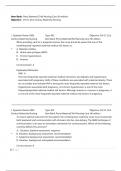
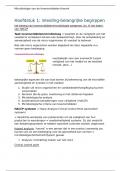
What are the parameters for giving verapamil?
Give this one a try later!
monitor BP and HR and hold drug if SBP< 90 and HR <100, can give with a
beta blocker if reflex tachycardia present,
If patient is non compliant with their medications for hypertension what should we
do?
Give this one a try later!
, Identify why the patient is not taking their medication and to potentially
switch their method of medication, offer non pharmacological ways to
manage their condition such as diet, no smoking and exercise
Explain what the DASH diet is
Give this one a try later!
used in patients with hypertension to reduce sodium intake and lowers
cholesterol. It can also increase potassium and calcium levels
What are important medication interactions with use of loop diuretics?
Give this one a try later!
Digoxin: increases the toxicity by causing increase Na levels and low K
levels
Lithium: since sodium is lost, it has a risk for increased levels of the drug in
the body.
NSAIDs: decreases diuretic activity, causes less reabsorption in the kidneys
and decreased blood flow for excretion.
Antihypertensive: have an additive effect to drop the blood pressure even
more with patients to use a diuretic.
K sparing diuretics: causes the patient to hold onto more potassium, which
can cause deadly dysrhythmias
Ototoxic medications: will be an additive as this medication has a side
effect that is ototoxicity.
What arrhythmias does adenosine treat?
, Give this one a try later!
Converts PSVT to sinus- will need to give fast IVP- has a 10-sec half-life.
Secondary Hypertension
Give this one a try later!
has identifiable cause and can treat directly, potentially curing patients.
What are the side effects of osmotic diuretics?
Give this one a try later!
pulmonary edema,HF, rebound increased ICP, metabolic acidosis,
electrolyte imbalances
What are diuretics normally used to treat?
Give this one a try later!
fluid volume overload, hypertension, heart failure, renal and liver failure,
lowers peripheral edema and pulmonary edema
Primary Hypertension
Give this one a try later!
monitor BP and HR and hold drug if SBP< 90 and HR <100, can give with a
beta blocker if reflex tachycardia present,
If patient is non compliant with their medications for hypertension what should we
do?
Give this one a try later!
, Identify why the patient is not taking their medication and to potentially
switch their method of medication, offer non pharmacological ways to
manage their condition such as diet, no smoking and exercise
Explain what the DASH diet is
Give this one a try later!
used in patients with hypertension to reduce sodium intake and lowers
cholesterol. It can also increase potassium and calcium levels
What are important medication interactions with use of loop diuretics?
Give this one a try later!
Digoxin: increases the toxicity by causing increase Na levels and low K
levels
Lithium: since sodium is lost, it has a risk for increased levels of the drug in
the body.
NSAIDs: decreases diuretic activity, causes less reabsorption in the kidneys
and decreased blood flow for excretion.
Antihypertensive: have an additive effect to drop the blood pressure even
more with patients to use a diuretic.
K sparing diuretics: causes the patient to hold onto more potassium, which
can cause deadly dysrhythmias
Ototoxic medications: will be an additive as this medication has a side
effect that is ototoxicity.
What arrhythmias does adenosine treat?
, Give this one a try later!
Converts PSVT to sinus- will need to give fast IVP- has a 10-sec half-life.
Secondary Hypertension
Give this one a try later!
has identifiable cause and can treat directly, potentially curing patients.
What are the side effects of osmotic diuretics?
Give this one a try later!
pulmonary edema,HF, rebound increased ICP, metabolic acidosis,
electrolyte imbalances
What are diuretics normally used to treat?
Give this one a try later!
fluid volume overload, hypertension, heart failure, renal and liver failure,
lowers peripheral edema and pulmonary edema
Primary Hypertension