NUR 1400 Fluid, Electrolytes, and Acid-Base Imbalances Practice Questions with Rationales.
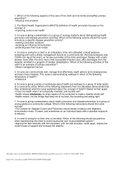
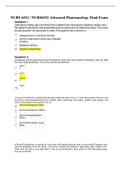
NUR 1400 Fluid, Electrolytes, and Acid-Base Imbalances Practice Questions with Rationales. Targeted ATI Fluid, Electrolyte, and Acid-Base 1. A nurse is assessing a client who has dehydration. Which of the following assessments is the priority? a. Skin turgor i. The nurse should assess skin turgor to monitor the client's hydration status. Poor skin turgor is a manifestation of dehydration. However, another assessment is the nurse's priority. b. Urine output i. The nurse should assess urine output to monitor the client's hydration status. Decreased urine output is a manifestation of dehydration. However, another assessment is the nurse's priority. c. Weight i. The nurse should weigh the client because weight loss is a manifestation of dehydration. Decreased weight is the best indication of the client's fluid status. However, another assessment is the nurse's priority. d. Mental status i. The greatest risk to this client is injury from a fall due to a decline in their mental status. Therefore, assessing the client's mental status is the nurse's priority. 2. A nurse is reviewing the laboratory report of a client who has fluid volume excess. Which of the following laboratory values should the nurse expect? a. Hgb 20 g/dL i. The nurse should identify that a client who has dehydration can have a Hgb level that is above the expected reference range of 12 to 16 g/dL for females or 14 to 18 g/dL for males. Fluid volume excess can cause hemodilution and a decreased hemoglobin level. b. Hct 34% i. The nurse should identify that a client who has fluid volume excess can have a Hct level that is below the expected reference range of 37% to 47% for females or 42% to 52% for males. Fluid volume excess can cause hemodilution and a decreased hematocrit level. c. BUN 25 mg/dL i. The nurse should identify that a client who has dehydration can have a BUN that is above the expected reference range of 10 to 20 mg/dL. Fluid volume excess can cause a decrease in BUN. d. Urine specific gravity 1.050 i. The nurse should identify that a client who has dehydration can have a urine specific gravity that is above the expected reference range of 1.010 to 1.025. Fluid volume excess can cause a decrease in urine specific gravity. 3. A nurse is assessing a client who is receiving hydrochlorothiazide and notes that the client is confused and lethargic. Which of the following laboratory values should the nurse report to the provider? a. Sodium 128 mEq/L i. This level is below the expected reference range of 136 to 145 mEq/L and is the likely cause of the client's altered mental status. The nurse should report this finding to the provider and monitor the client for weakened respiratory effort. b. Potassium 4.8 mEq/L i. This finding is within the expected reference range. However, the nurse should continue to monitor for hypokalemia while the client is taking hydrochlorothiazide. c. Calcium 9.1 mg/dL i. This finding is within the expected reference range. However, the nurse should continue to monitor for hypercalcemia while the client is taking hydrochlorothiazide. d. Magnesium 2.0 mEq/L i. This finding is within the expected reference range. However, the nurse should continue to monitor for hypomagnesemia while the client is taking hydrochlorothiazide. 4. A nurse is providing dietary teaching to a client who has kidney disease. Which of the following food choices should the nurse include in the teaching as containing the lowest amount of magnesium? a. One large, hard-boiled egg i. One large, hard-boiled egg contains 5 mg of magnesium. Therefore, the nurse should recommend this food as containing the lowest amount of magnesium. b. 1 cup bran cereal i. One cup of bran cereal contains 112 mg of magnesium. Therefore, the nurse should include a different food as containing the lowest amount of magnesium. c. ½ cup almonds i. One-half cup of almonds contains 193 mg of magnesium. Therefore, the nurse should include a different food as containing the lowest amount of magnesium. d. 1 cup cooked spinach i. One cup of cooked spinach contains 157 mg of magnesium. Therefore, the nurse should include a different food as containing the lowest amount of magnesium. 5. A nurse is assessing a client who has a serum calcium level of 8.1 mg/dL. Which of the following findings is the priority for the nurse to assess? a. Deep-tendon reflexes i. The nurse should assess the client's deep-tendon reflexes because this total serum calcium level is below the expected reference range of 9 to 10.5 mg/dL, and hypocalcemia can cause neuromuscular changes. However, there is another assessment the nurse should make first. b. Cardiac rhythm i. When using the airway, breathing, circulation approach to client care, the nurse should first assess the client's cardiac rhythm because this total serum calcium level is below the expected reference range. Hypocalcemia can cause ECG changes, bradycardia, or tachycardia. c. Peripheral sensation i. The nurse should assess the client's peripheral sensation to check for paresthesia because this total serum calcium level is below the expected reference range, and hypocalcemia can cause neuromuscular changes. However, there is another assessment the nurse should make first. d. Bowel sounds i. The nurse should assess the client's bowel sounds to check for hypermotility because this total serum calcium level is below the expected reference range, and hypocalcemia can cause increased peristalsis. However, there is another assessment the nurse should make first. 6. A nurse is caring for a client who has a sodium level of 155 mEq/L. Which of the following IV fluids should the nurse anticipate the provider to prescribe? a. Dextrose 5% in 0.9% sodium chloride i. A sodium level of 155 mEq/L is an indication of hypernatremia. Dextrose 5% in 0.9% sodium chloride is a hypertonic solution. The nurse should anticipate a prescription for a hypotonic solution. b. Dextrose 5% in lactated Ringer’s i. A sodium level of 155 mEq/L is an indication of hypernatremia. Lactated Ringer's contains sodium and other electrolytes and is not indicated for hypernatremia. c. 3% sodium chloride i. A sodium level of 155 mEq/L is an indication of hypernatremia, and 3% sodium chloride is a hypertonic solution. The nurse should anticipate a prescription for a hypotonic solution. d. 0.45% sodium chloride i. A sodium level of 155 mEq/L is an indication of hypernatremia. The nurse should anticipate a prescription for a hypotonic solution. The 0.45% sodium chloride is a hypotonic solution used to provide free water and treat cellular dehydration, which promotes waste elimination by the kidneys. 7. A nurse is assessing a client who has hypomagnesemia. Which of the following findings should the nurse expect? a. Hyperactive deep-tendon reflexes i. Hyperactive deep-tendon reflexes are an expected finding for a client who has hypomagnesemia. Other expected findings include muscle cramps, numbness, and tingling. b. Increased bowel sounds i. Decreased bowel sounds are an expected finding for a client who has hypomagnesemia. c. Drowsiness i. Insomnia is an expected finding for a client who has hypomagnesemia. d. Decreased blood pressure i. Increased blood pressure is an expected finding for a client who has hypomagnesemia. 8. A nurse is assessing a client who has a phosphorous level of 2.4 mg/dL. Which of the following findings should the nurse expect? a. Hepatic failure i. This phosphorus level is below the expected reference range of 3 to 4.5 mg/dL. The nurse should assess a client who has hypophosphatemia for manifestations of kidney failure, not hepatic failure. b. Abdominal pain i. This phosphorus level is below the expected reference range. Hypophosphatemia causes weakness of skeletal muscles and rhabdomyolysis, which is acute muscle breakdown. It does not cause abdominal pain. c. Slow peripheral pulses i. This phosphorus level is below the expected reference range. The nurse should expect the client to have slow peripheral pulses. The nurse might also find that the client's pulses are difficult to find and easy to block. d. Increase in cardiac output i. This phosphorus level is below the expected reference range. The nurse should expect a decrease in cardiac output. 9. A nurse is caring for a client who is experiencing respiratory distress as a result of pulmonary edema. Which of the following actions should the nurse take first? a. Assist with intubation i. The nurse should be prepared to assist the provider with intubation and mechanical ventilation if less invasive measures are ineffective. However, there is another action the nurse should take first. b. Initiate high flow oxygen therapy i. When using the airway, breathing, circulation approach to client care, the nurse should first administer high-flow oxygen therapy by face mask at 5 to 6 L/min to keep the client's oxygen saturation above 90%. c. Administer a rapid-acting diuretic i. The nurse should administer a rapid-acting diuretic IV bolus to the client to relieve pulmonary congestion. However, there is another action the nurse should take first. d. Provide cardiac monitoring i. The nurse should provide cardiac monitoring because premature ventricular contractions and dysrhythmias are manifestations of pulmonary edema. However, there is another action the nurse should take first. 10. A nurse is planning care for a client who has a potassium level of 3.0 mEq/L. The nurse should plan to monitor the client for which of the following findings? a. Hyperactive deep-tendon reflexes i. The nurse should plan to monitor the client for hyporeflexia. Manifestations of hypokalemia include weak hand grip strength and weak deep-tendon reflexes. b. Orthostatic hypotension i. The nurse should plan to monitor the client for orthostatic hypotension, which places them at risk for falls. Orthostatic hypotension is a manifestation of hypokalemia. c. Rapid, deep respirations i. The nurse should plan to monitor the client for respiratory distress. Weakening of the respiratory muscles and shallow respirations are manifestations of hypokalemia. d. Strong, bounding pulse i. The nurse should plan to monitor the client for a weak and thready pulse. A weak, thready pulse is a manifestation of hypokalemia. 11. A nurse is providing teaching to a client who is at risk for developing respiratory acidosis following surgery. Which of the following statements by the client indicates an understanding of the teaching? a. “I should conserve energy by limiting my physical activity.” i. The nurse should encourage the client to ambulate and change positions frequently to prevent postoperative complications. b. “I will wait until my pai is at least 6 out of 10 before I use the PCA.” i. The nurse should encourage the client to use the PCA when feeling acute pain to prevent the pain from worsening. c. “I will limit my daily fluid intake to two to three glasses.” i. Dehydration can cause metabolic acidosis. The nurse should encourage the client to take in approximately 2,200 mL of fluid daily. This includes fluid intake of six to eight glasses containing 240 mL each, as well as liquids obtained from eating solid foods. Limiting fluid intake to two to three 8 oz glasses would not meet the client's total daily intake needs. d. “I will use the incentive spirometer every hour.” i. Respiratory depression and limited chest expansion are both causes of respiratory acidosis. Using an incentive spirometer will promote adequate chest expansion. 12. A nurse is assessing a client who is using PCA following a thoracotomy. The client is short of breath, appears restless, and has a respiratory rate of 28/min. The client's ABG results are pH 7.52, PoO2 89 mm hg, and HCO3- 24 mEq/L. Which of the following actions should the nurse take? a. Instruct the client to cough forcefully i. Coughing forcefully will not treat the underlying cause of the ABG results. b. Assist the client with ambulation i. Ambulation can exacerbate the client's respiratory distress and is not appropriate at this time. c. Provide calming interventions i. The client's respiratory rate is above the expected reference range of 12 to 20/min. The nurse should instruct the client to breathe slowly. Calming the client should decrease the respiratory rate, which will cause the client's carbon dioxide levels to increase to expected levels of 35 to 45 mm Hg and lower the pH to expected levels of 7.35 to 7.45. d. Discontinue the PCA i. Discontinuing the PCA will not treat the underlying cause of the ABG results and could exacerbate the client's respiratory distress. 13. A nurse is reviewing the medical record of a client who had diabetes mellitus and is receiving regular insulin by continuous IV infusion to treat diabetic ketoacidosis. Which of the following findings should the nurse report to the provider? a. Urine output 30 mL/hr i. The expected reference range for urinary output is between 1,500 to 2,000 mL daily. A urinary output of less than 30 mL/hr, known as oliguria, can indicate dehydration, impaired renal blood flow, or renal failure. However, a urine output of 30 mL/hr does not need to be reported to the provider. b. Blood glucose 180 mg/dL i. A blood glucose level of 200 mg/dL or less is an indication that the client's diabetic ketoacidosis is resolving and is within the expect reference range for a casual glucose level. Therefore, the nurse does not need to report this finding to the provider. c. Serum potassium 3.0 mEq/L i. This serum potassium level is below the expected reference range. Hypokalemia is a serious complication that can occur when a client who has diabetic ketoacidosis is receiving insulin to treat the condition. The nurse should report this finding to the provider. d. BUN 18 mg/dL i. A BUN of 18 mg/dL is within the expected reference range. A BUN of 30 mg/dL or greater can occur due to dehydration for a client who has diabetic ketoacidosis. 14. A nurse is providing teaching for a client who has venous insufficiency of the lower extremities. Which of the following statements by the client indicates an understanding of the teaching? a. “If my stockings feel tight, I’ll just roll them down for a while.” i. The client should not roll the stockings down, because the rolled part can become a constricting band around the leg which can impede circulation. b. “I’ll put on my elastic stockings at the first sign of swelling.” i. The client should don graduated compression stockings upon awakening and remove them at bedtime. Wearing the stockings throughout the day prevents swelling of the extremities and improves circulation. c. “When I sit down to watch television, I’ll be sure to put my feet up.” i. Venous insufficiency makes it difficult for blood flow to return to the heart. Elevating the feet will increase venous return. The client should elevate their feet for at least 20 min several times per day. d. “It’s okay to cross my legs as long as it’s for less than an hour.” i. The client should not cross their legs. Doing so can further impair circulation of the lower extremities. 15. A nurse is providing dietary teaching to a client who has heart failure and is receiving furosemide. Which of the following foods should the nurse recommend as containing the greatest amount of potassium? a. ½ cup chopped celery i. One-half cup of chopped celery contains 132 g of potassium. Therefore, there is another food the nurse should recommend as containing the greatest amount of potassium. b. 1 cup plain yogurt i. One cup of plain yogurt contains 380 g of potassium. Therefore, the nurse should recommend this food as containing the greatest amount of potassium. c. One slice whole grain bread i. One slice of whole grain bread contains 60 g of potassium. Therefore, there is another food the nurse should recommend as containing the greatest amount of potassium. d. ½ cup cooked tofu i. One-half cup of cooked tofu contains 164 g of potassium. Therefore, there is another food the nurse should recommend as containing the greatest amount of potassium. 16. A nurse is assessing a client who has respiratory acidosis. Which of the following findings should the nurse expect? a. Confusion i. A client who has respiratory acidosis will experience confusion from a lack of cerebral perfusion. If acidosis is not reversed, the client's level of consciousness will decrease, and coma can occur. b. Peripheral edema i. Peripheral edema is not a manifestation of respiratory acidosis. c. Facial flushing and warmth i. Facial flushing and warmth are manifestations of metabolic acidosis. Pale, cyanotic, dry skin is a manifestation of respiratory acidosis, as ineffective breathing causes a lack of perfusion to the tissues. d. Hyperreflexia i. Hyporeflexia, not hyperreflexia, is a manifestation of respiratory acidosis. As acidosis increases, hyperkalemia can occur, causing muscle weakness, flaccid paralysis, and hyporeflexia. 17. A nurse is admitting a client who takes 40 mg furosemide daily for heart failure and has experienced 3 days of vomiting. The nurse suspects hypokalemia. Which of the following medications should the nurse prepare to administer? a. Sodium polystyrene sulfonate 30 g/day i. Sodium polystyrene sulfonate is an electrolyte cation exchange medication that is given to treat hyperkalemia, not hypokalemia. b. 0.9% sodium chloride with 10 mEq/L of potassium chloride at 100 mL/hr i. This IV solution will provide adequate fluid and potassium replacement to offset the losses from vomiting. The typical amount of potassium chloride to administer IV is 5 to 10 mEq/hr, not to exceed 20 mEq/hr. The dilution should be 1 mEq of potassium chloride to 10 mL of 0.9% sodium chloride. c. Bumetanide 8 mg/day i. High-ceiling loop diuretics such as bumetanide are given to treat hyperkalemia, not hypokalemia. d. 100 mL of dextrose 10% in water with 10 units of insulin i. Dextrose 10% in water with 10 units of insulin is an IV solution given to treat hyperkalemia, not hypokalemia. 18. A nurse is admitting a client who has status asthmaticus. The client's ABG results are pH 7.32, PaO2 74 mmhg, PaC02 56 mm hg, and HCO3- 26 mEq/L. The nurse should interpret these laboratory values as which of the following imbalances. a. Respiratory acidosis i. Status asthmaticus causes inadequate gas exchange, resulting in a low pH and PaO2, an elevated PaCO2, and an HCO3- within the expected reference range. These laboratory values indicate respiratory acidosis. b. Respiratory alkalosis i. The pH level is elevated above 7.45 in both respiratory and metabolic alkalosis. c. Metabolic acidosis i. With metabolic acidosis, the pH is less than 7.35 but the PaCO2 is either within or below the expected reference range, and the HCO3- is decreased. d. Metabolic alkalosis i. The pH level is elevated above 7.5 in both respiratory and metabolic alkalosis. 19. A nurse is teaching nutritional strategies to a client who has a low serum calcium level and an allergy to milk. Which of the following statements by the client indicates an understanding of the teaching? a. “I will eat more cheese because I can’t drink milk.” i. Cheese is a dairy product. If the client is allergic to milk, they will also be allergic to cheese. b. “I need to avoid foods with vitamin D because I am allergic to milk.” i. Vitamin D is necessary for calcium absorption and is unlikely to trigger an allergic reaction in a client who has a dairy allergy. c. “I will stop taking my calcium supplements if they irritate my stomach.” i. The nurse should recommend that the client prevent gastric upset by taking the calcium supplements with food. d. “I will add broccoli and kale to my diet.” i. The nurse should recommend that the client consume broccoli and kale, which are good sources of calcium, as alternatives to dairy products. 20. A nurse is caring for a client who reports difficulty breathing and tingling in both hands. His respiratory rate is 36/min and he appears very restless. Which of the following values should the nurse anticipate to be outside the expected reference range if the client is experiencing respiratory alkalosis? a. PaO2 i. The nurse should anticipate that a client who has respiratory alkalosis will have a PaO2 level within the expected reference range of 80 to 100 mm Hg. b. PaCO2 i. The nurse should anticipate that a client who has respiratory alkalosis will have a decreased PaCO2 level due to hyperventilation. c. Sodium i. The nurse should anticipate that a client who has respiratory alkalosis will have a sodium level within the expected reference range. d. Bicarbonate i. The nurse should anticipate that a client who has respiratory alkalosis will have a bicarbonate level within the expected reference range. The bicarbonate level is increased in metabolic alkalosis. 21. A nurse is caring for a client who had dehydration and is receiving IV fluids. Which assessing for complications, the nurse should recognize which of the following manifestations as a sign of fluid overload? a. Increased urine specific gravity i. The nurse should anticipate that a client who has respiratory alkalosis will have a bicarbonate level within the expected reference range. The bicarbonate level is increased in metabolic alkalosis. b. Hypoactive bowel sounds i. The nurse should recognize that increased gastrointestinal motility is a manifestation of fluid volume overload. c. Bounding peripheral pulses i. The nurse should recognize that increased vascular volume results in full, bounding peripheral pulses. d. Decreased respiratory rate i. The nurse should recognize that an increased respiratory rate is a manifestation of fluid volume overload. 22. A nurse is planning care for a client who has experienced excessive fluid loss. Which of the following interventions should the nurse include in the plan of care? (SATA) a. Administer IV fluids to the client evenly over 24 hr i. A client who has excessive fluid loss is typically prescribed IV replacement fluids. Administering IV fluids rapidly over a short period of time places the client at risk for fluid volume overload. b. Provide the client with a salt substitute i. There is no reason to limit the client's sodium intake. A client who has hypernatremia might require dietary sodium restriction. However, this client might require electrolyte replacement, depending on the cause of fluid loss. c. Assess the client for pitting edema i. This action is appropriate for a client who has fluid volume overload. d. Encourage the client to rise slowly when standing up i. This action can prevent injury from falls caused by orthostatic hypotension. e. Weigh the client every 8 hr i. Weighing the client every 8 hr will provide information regarding fluid balance. 23. A nurse is caring for a client who requires nasogastric suctioning. Which of the following set of laboratory results indicates that the client has metabolic alkalosis? a. pH 7.51, PaO2 94 mm Hg, PaCO2 36 mm Hg, HCO3- 31 mEq/L i. An elevated pH and HCO3- with a PaCO2 that is either elevated or within the expected reference range indicates metabolic alkalosis. b. pH 7.48, PaO2 89 mm Hg, PaCO2 30 mm Hg, HCO3- 26 mEq/L i. With metabolic alkalosis, the pH is above 7.45 and HCO3- is elevated, not within the expected reference range. The PaCO2 is either elevated or within the expected reference range. c. pH 7.31, PaO2 77 mm Hg, PaCO2 52 mm Hg, HCO3- 23 mEq/L i. With respiratory alkalosis and metabolic alkalosis, the pH is elevated above 7.45. d. pH 7.26, PaO2 84 mm Hg, PaCO2 38 mm Hg, HCO3- 20 mEq/L i. With respiratory alkalosis and metabolic alkalosis, the pH is elevated above 7.45. 24. A nurse is assessing a client who has hyperkalemia. Which of the following findings should the nurse expect? a. Decreased muscle strength i. The nurse should expect the client to experience muscle weakness, fatigue, paresthesia, and nausea. b. Decreased gastric motility i. The nurse should expect the client to experience increased gastric motility, including abdominal cramps and diarrhea. c. Increased heart rate i. The nurse should expect the client to experience bradycardia. d. Increased blood pressure i. The nurse should expect the client to experience hypotension. 25. A nurse is caring for a client who requires continuous cardiac monitoring. The nurse identifies a prolonged PR interval and a widened QRS complex. Which of the following laboratory values supports this finding? a. Sodium 152 mEq/L
Written for
- Institution
-
Stanbridge College
- Course
-
NUR 1400
Document information
- Uploaded on
- January 15, 2024
- Number of pages
- 34
- Written in
- 2023/2024
- Type
- Exam (elaborations)
- Contains
- Questions & answers
Subjects
-
nur 1400 fluid electrolytes and acid base imba