100% satisfaction guarantee Immediately available after payment Both online and in PDF No strings attached 4.6 TrustPilot
logo-home
Summary

Summary Maximize Your Performance with [Retailing,Dunne,4e] Study Guide

Rating
-
Sold
-
Pages
624
Uploaded on
30-07-2023
Written in
2022/2023

Take Control of Your Academic Journey with [Retailing,Dunne,4e] Solutions Manual! Don't let challenging exercises hold you back from achieving your goals. Our Solutions Manual for [Retailing,Dunne,4e] provides a roadmap to success. By following the step-by-step solutions, you'll not only master the material but also develop problem-solving skills that will benefit you throughout your academic and professional life. Empower yourself with the tools to conquer any obstacle.

Show more Read less

Content preview

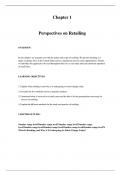
Chapter 1


Perspectives on Retailing


OVERVIEW:


In this chapter, we acquaint you with the nature and scope of retailing. We present retailing as a
major economic force in the United States and as a significant area for career opportunities. Finally,
we introduce the approach to be used throughout this text as you study and learn about the operation
of retail firms.


LEARNING OBJECTIVES:


1. Explain what retailing is and why is it undergoing so much change today.

2. Describe the five methods used to categorize retailers.

3. Understand what is involved in a retail career and be able to list the prerequisites necessary for
success in retailing.

4. Explain the different methods for the study and practice of retailing.


CHAPTER OUTLINE:


Number range level0Number range level1Number range level2Number range
level3Number range level4Number range level5Number range level6Number range level7I.
What Is Retailing, and Why Is It Undergoing So Much Change Today?

,Retailing consists of the final activities and steps needed to either place a product in the hands of
the consumer or to provide a service to the consumer. It is the last step in a supply chain which
can be performed by any firm that sells a product or provides a service to the final consumer.


A. Number range level1The Nature of Change in Retailing


Retailing includes every living individual as a customer and accounts for 20 percent of the
worldwide labor force, and consumer spending represents nearly a third of America’s total
economy. As the largest single industry in most nations, retailing, or spending by consumers, is
necessary for businesses to “grow and hire again.” Today, retailing is undergoing many exciting
changes. Every retailer must consider how a change in any facet of the external environment
could impact its current and future retail plans, as well as the entire retail sector within which it
competes.


B. E-tailing


Embedded in the word retail is one of the most important trends in the retail industry, and that is
e-tailing. Contrary to the fears of many retailers a decade ago, the Internet hasn’t destroyed
bricks-and-mortar retailers—retailers that operate out of a physical and geographic based
building or store.


Focusing solely on online sales diminishes or overlooks where the Internet’s truly making an
impact on retailing: consumer expectations and behavior. Today, customers, especially the
younger ones, are accustomed not only to the speed and convenience of purchasing online but
also to the control it gives them. E-tailing, after all, enables consumers to shop when they like
and from where they like. In addition, it provides access to vast amounts of information, ranging
from a product’s attributes to who has the lowest price. No real-world store can match that.


The fastest growing form of e-tailing or e-commerce is beginning to be known as m-tailing or
m-commerce—where shoppers use their smartphones to purchase not only traditional
merchandise and services, but also virtual service providers, which are commonly referred to as
apps. Apps are digital services that can be downloaded to one’s phone or tablet. Services
provided range from those designed to:

• Enable the playing of an electronic game

, • View a magazine such as Time or Newsweek

• Locating a restaurant

• Getting medical advice

eBay is witnessing its mobile app downloaded between a half million and a million times a
week.


M-tailing, which is only a small fraction of e-tailing—less than 2 percent—is projected by the
authors to be over 25 percent of e-tailing by 2020. The trend toward m-tailing is particularly
good for retailers that sell mobile phones such as Radio Shack, Verizon, AT&T, and Sprint.


With the growth of Web 2.0, the Internet has become much more interactive and social in
nature. This has important implications for retailers.


To combat e-tailing, bricks-and-mortar retailers must give their customers more control over the
shopping experience, even if it means bringing web-style technology into the store in an attempt
to replicate the best things about online shopping, but in a more personal way. Retailers should
not fight this trend because the customer is already bringing the web into the store. For instance,
young shoppers with smartphones send photos of a potential purchase to their friends and then
friends text message back, which allows the young shopper to get input on the potential
purchase. These savvy shoppers also use their phones to scan Universal Product Code (UPC)
bars to immediately see if the price is competitive with other retailers in the area or online.
Consequently, the retailer needs to get on and grow with the web technology trend. In-store
kiosks, for example, are particularly useful to show the final product before a special,
customized order is placed. They allow a shopper to see the finished product before purchasing
and provide an online experience in the store. Other retailers have set up their own websites,
while others have begun to use nontraditional methods to reach out to the consumer.


The most important thing for bricks-and-mortar retailers to grasp is the shift in power between
retailers and consumers. Traditionally, the retailers’ control over pricing information provided
them the upper hand in most transactions. Today, the information dissemination capabilities of
the Internet have made consumers better informed. This has increased their power when
transacting and negotiating with retailers. Some bricks-and-mortar retailers may have to
discontinue some product categories as consumers engage in an activity called channel surfing.
Channel surfing occurs when the customer gets needed information (such as proper size or how
to assemble a product) in the stores and then orders it online for a lower price and to avoid
paying state sales tax.

, Retailers must keep experimenting with various strategies, both in-store and online, because the
next generation of technology will change the consumers’ expectation of what they demand
from their retailers.


C.Number range level2 Price Competition


Some people claim that America’s fixation with low prices began after World War II when fair-
trade laws, which allowed the manufacturer to set a price that no retailer was allowed to sell
below, were abolished, paving the way for America’s first discounter, E. J. Korvette. Actually,
this revolution more than likely began with the birth of Walmart in Rogers, Arkansas, in 1962.
What Sam Walton did that forever changed the face of retailing was to realize, before
everybody else, that most of any product’s cost gets added after the item is produced. As a
result, Walton began enlisting suppliers to help him reduce these costs and increase the
efficiency of the product’s movement from production to placement on store shelves. Simply
put, Walmart became the world’s largest retailer by relentlessly cutting unnecessary costs,
improving operating efficiency, and demanding that its suppliers do the same. A popular
measure of operating efficiency is operating costs as a percentage of sales.


Exhibit 1.1 shows how discount or low-price retailing allows retailers to improve their operating
efficiency and thus enables them to continue to lower prices. This occurs because when
operating a store, many costs are fixed, such as rent and occupancy. Thus, as sales rise, the rent
and occupancy costs as a percentage of sales decline.


D. Demographic Shifts


Other significant changes in retailing over the past decade have resulted from changing
demographic factors, such as:

• The fluctuating birth rate

• The growing importance of the 70 million Generation Y consumers (those born between
1978 and 1994)

• The move of Generation X (those born between 1965 and 1977) into now middle age

• The beginning movement of baby boomer generation (those born between 1946
and1964) into retirement

Document information

Summarized whole book?
Yes
Uploaded on
July 30, 2023
Number of pages
624
Written in
2022/2023
Type
SUMMARY

Get to know the seller

Seller avatar
Reputation scores are based on the amount of documents a seller has sold for a fee and the reviews they have received for those documents. There are three levels: Bronze, Silver and Gold. The better the reputation, the more your can rely on the quality of the sellers work.
PracticeExams my own
View profile
Follow You need to be logged in order to follow users or courses
Sold
326
Member since
2 year
Number of followers
194
Documents
3266
Last sold
1 day ago
ExamPrepZone

4.1

42 reviews

5
26
4
4
3
7
2
2
1
3

Trending documents

Recently viewed by you

Why students choose Stuvia

Created by fellow students, verified by reviews

Quality you can trust: written by students who passed their tests and reviewed by others who've used these notes.

Didn't get what you expected? Choose another document

No worries! You can instantly pick a different document that better fits what you're looking for.

Pay as you like, start learning right away

No subscription, no commitments. Pay the way you're used to via credit card and download your PDF document instantly.

Student with book image

“Bought, downloaded, and aced it. It really can be that simple.”

Alisha Student

Frequently asked questions