100% satisfaction guarantee Immediately available after payment Both online and in PDF No strings attached 4.6 TrustPilot
logo-home
Other

Criminal Law - Principles

Rating
-
Sold
-
Pages
6
Uploaded on
12-11-2022
Written in
2023/2024

Comprehensive notes on Criminal Law in the UK, on the principles.

Institution
Course

Content preview

CRIMINAL LAW
REVISION NOTES


1. PURPOSES OF CRIMINAL LAW:

SOCIAL CONTROL:

 Criminal law functions as society’s method of social control: it sets
boundaries both to our behaviour and to the power of the state to
coerce and punish us.

 Criminal law ensures that human-beings treat each other as human-
beings, rather than as objects.

THE AMERICAN PENAL CODE:

 The American Model Penal Code provides us with a statement of the
proper purposes of criminal law:

A. To forbid and prevent conduct that unjustifiably and inexcusably
inflicts/ threatens substantial harm to individuals/ public interests.

B. To subject people whose conduct indicates that they are disposed to
commit crimes to public control.

C. To safeguard conduct that is without fault from being condemned as
criminal.

D. To give fair warning of the nature of offensive conduct.

E. To differentiate between serious and minor offences on reasonable
grounds.

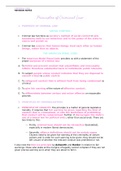
2. PRINCIPLES OF CRIMINALISATION:

 PRINCIPLE OF LEGALITY: this principle is a matter of general legislative
morality. It requires that fair warning be given regarding the kind of
conduct that is criminalised, or else the lawfulness of prohibiting
that conduct will be compromised. Further, it discourages the state’s
use of criminal law for political ends, rather than social ends. There are
two limbs to this:

 Firstly, criminal laws should not be retroactive (backdated),
especially in modern liberal democracies.

 Secondly, offence definitions should not be unduly vague.
Citizens need to be given fair warning of the criminality of certain
actions and in order for such warning to be given, they should not be
left unsure of whether the relevant conduct was prohibited or not.

! Also note the thin-ice principle by Ashworth and Horder in relation to fair
warnings: those who skate at the margins of legality cannot complain if they are not
given precise warning as to when they are about to fall in.

, CRIMINAL LAW
REVISION NOTES

 PRINCIPLE OF RESPONSIBILITY: unless the relevant conduct consists of a
moral fault, a person should not be blamed and suffer punishment, however
serious the consequences of their conduct.

 PRINCIPLE OF URGENCY/ MINIMAL CRIMINALISATION: criminal
consequences of conduct that consists of a moral fault should only be
attended to if there are substantial interferences with/ threats to public
interest.

 PRINCIPLE OF PROPORTIONALITY: the severity of a sentence should vary
according to the seriousness of an offence.

 PRINCIPLE OF FAIR LABELLING: the moral distinctions between different
kinds f conduct should be reflected by the creation of different offences.

3. IMPORTANCE OF PUBLIC AND PRIVATE INTERESTS:

PUBLIC INTERESTS:

 Preventing physical injury (through crimes of violence, such as murder and
arson).

 Proscribing personal immorality deemed injurious to society’s well-
being (through criminalising incest, drug possession, bestiality,
sadomasochism, etc.).

 Preventing the moral corruption of the youth (through crimes such as
unlawful sexual intercourse).

 Maintaining the integrity of the state and the administration of
justice (through crimes such as perverting the course of justice, tax evasion,
etc.).

 Maintaining public order and security (through offences such as public
drunkenness, riot, etc.).

PRIVATE INTERESTS:
Remaining free from:

 Undesired physical interference (through crimes such as rape and
assault).

 Offence (through crimes such as indecent exposure, indecency in public,
etc.).

 Undesired interference with property (through crimes such as theft and
robbery).


4. PRINCIPLES/ IDEAS INFORMING DECISIONS TO CRIMINALISE:

1. AUTONOMY:

 Human action is seen as the product of free, rational choices on the part of
the individual (HJ Paton). Therefore, humans are their own autonomous

Written for

Institution
Study
Unknown
Course

Document information

Uploaded on
November 12, 2022
Number of pages
6
Written in
2023/2024
Type
OTHER
Person
Unknown

Subjects

$11.58
Get access to the full document:

100% satisfaction guarantee
Immediately available after payment
Both online and in PDF
No strings attached


Also available in package deal

Get to know the seller

Seller avatar
Reputation scores are based on the amount of documents a seller has sold for a fee and the reviews they have received for those documents. There are three levels: Bronze, Silver and Gold. The better the reputation, the more your can rely on the quality of the sellers work.
sirjacktan Kings College London
Follow You need to be logged in order to follow users or courses
Sold
11
Member since
3 year
Number of followers
7
Documents
51
Last sold
1 year ago
Comprehensive Law Notes

Selling Comprehensive Law Notes for Undergraduate Students in the UK.

5.0

3 reviews

5
3
4
0
3
0
2
0
1
0

Trending documents

Recently viewed by you

Why students choose Stuvia

Created by fellow students, verified by reviews

Quality you can trust: written by students who passed their tests and reviewed by others who've used these notes.

Didn't get what you expected? Choose another document

No worries! You can instantly pick a different document that better fits what you're looking for.

Pay as you like, start learning right away

No subscription, no commitments. Pay the way you're used to via credit card and download your PDF document instantly.

Student with book image

“Bought, downloaded, and aced it. It really can be that simple.”

Alisha Student

Frequently asked questions