100% satisfaction guarantee Immediately available after payment Both online and in PDF No strings attached 4.6 TrustPilot
logo-home
Exam (elaborations)

Study Guide for PN 161 Practical Nursing III Final Exam

Rating
-
Sold
-
Pages
19
Grade
A+
Uploaded on
17-04-2022
Written in
2022/2023

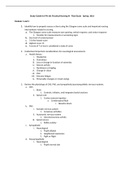
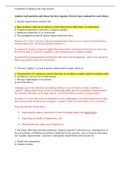
Study Guide for PN 161 Practical Nursing III Final Exam Study Guide for PN 161 Practical Nursing III Final Exam Spring 2016 Module 1 and 2 1. Identify how to properly assess a client using the Glasgow coma scale and important nursing interventions related to scoring. a. The Glasgow coma scale measures eye opening, verbal response, and motor response i. Monitor for improvements or worsening signs b. See level of consciousness! c. 3 is the lowest score d. Highest score 15 e. A score of 7 or less is considered a state of coma 2. Understand important considerations for neurological assessments. a. Health history i. Headaches ii. Clumsiness iii. Loss or change in function of extremity iv. Seizure activity v. Numbness or tingling vi. Change in vision vii. Pain viii. Extreme fatigue ix. Personality changes or mood swings 3. Review the physiology of CNS, PNS, and sympathetic/parasympathetic nervous systems. a. CNS i. Brain 1. Controls, initiates, and integrates body functions ii. Spinal cord 1. Carries sensory impulses a. Cerebrospinal fluid i. Absorbs shock b. PNS i. Somatic nervous system 1. Conscious activities ii. Autonomic nervous system 1. Unconsciousness activity iii. Spinal nerves 1. Reflex activity c. Sympathetic i. Neurological 1. Pupils dilated 2. Heightened awareness 3. Fight or flight d. Parasympathetic i. Neurological 1. Pupils normal size 2. Rest and digest 4. Identify important observations to include when assessing a pt.’s. mental status. a. Appearance b. Behavior c. Posture d. Mood e. Gestures f. Movements and facial expressions 5. Safety factors in Parkinson’s patients. a. Ambulation with assistance b. Provide an elevated toilet seat 6. S/S of encephalitis, meningitis and review nursing actions when caring for patients with them. a. Encephalitis i. Inflammation of brain ii. Fever, headache, nuchal rigidity, photophobia, irritability, lethargy, nausea/vomiting b. Meningitis i. Inflammation of meninges ii. Fever, headache, nuchal rigidity, photophobia, irritability, lethargy, and nausea/vomiting c. Nursing care i. Monitor for changes in neurological status ii. Quiet environment decreases external stimulation iii. Observe for seizure activity and protect from injury iv. Comfort measures offered 7. Post-op care of patient following back surgery. a. Monitor neurological status and vital signs b. Encourage client to cough, deep breathe, use incentive spirometer hourly, and move legs as allowed c. Provide adequate fluids to prevent renal stasis and constipation 8. List the S/S of herniated disks. a. Pain b. Motor changes c. Sensory changes d. Alterations in reflexes 9. S/S and exacerbations of them in MS patients. a. S/S of MS i. Vary according to the areas of demyelination ii. Vary from hour to hour or day to day iii. May be sensory, motor, or other disturbances 1. Visual disturbances 2. Numbness 3. Paresthesia 4. Pain 5. Decreased sense of temperature 6. Decreased muscle strength 7. Spasticity 8. Paralysis 9. Bowel and bladder incontinence or retention b. Exacerbations i. Periods of exacerbation and remission also make diagnosis difficult ii. Are frequently precipitated by periods of emotional or physical stress 1. Infections 2. Pregnancy 3. Trauma 4. Fatigue 10. Review the care of a client with seizures. a. If client is in bed: i. Be sure the side rails are up ii. Put padding (blankets) on the side rails to prevent injury b. If client is out of bed: i. Carefully ease the client to the floor ii. Move nearby objects so the client will not be injured iii. Place a soft item beneath the client’s head c. Never leave the client alone d. Don NOT restrain the client e. Do not attempt to put anything in the client’s mouth f. Loosen any restrictive clothing around the client’s neck g. Turn the client’s head to the side h. Monitor seizure activity carefully, noting exact time that the seizure began and ended i. After the seizure i. Call the client by name and ask her to perform a simple command ii. Test the client’s memory by asking her to remember two words iii. Ask the client whether an aura was experienced before the seizure iv. Check the oral cavity—especially the tongue—for injury v. Offer comfort and reassurance, because the client may be frightened and embarrassed vi. Document the length of the seizure and everything observed vii. Keep the client in a side-lying position if the client remains lethargic j. Monitor for toxic signs of anticonvulsant medications k. Importance for compliance with prescribed medication schedule l. Encourage client to have anticonvulsant medication blood level checked regularly

Show more Read less


Whoops! We can’t load your doc right now. Try again or contact support.

Document information

Uploaded on
April 17, 2022
Number of pages
19
Written in
2022/2023
Type
Exam (elaborations)
Contains
Questions & answers

Subjects

Get to know the seller

Seller avatar
Reputation scores are based on the amount of documents a seller has sold for a fee and the reviews they have received for those documents. There are three levels: Bronze, Silver and Gold. The better the reputation, the more your can rely on the quality of the sellers work.
Madefamiliar Chamberlain College Of Nursing
View profile
Follow You need to be logged in order to follow users or courses
Sold
1293
Member since
4 year
Number of followers
917
Documents
3310
Last sold
3 days ago
GET YOUR VERIFIED STUDY DOCUMENT

Welcome to my World. On this page you will find Well elaborated study documents, bundles and flashcards offered. I wish you great and easy learning through your course. Kindly message me if you need any assistance in your studies and I will help you. “Thank you in advance for your purchase! THE DOCUMENTS WILL BE OF MUCH HELP IN YOUR STUDIES, kindly write a review and refer other learners so that they can also benefit from my study materials." MAKING EXAMS QUESTIONS FAMILIAR TO YOU#I’m not telling you it’s going to be easy. I’m telling you it’s going to be worth it! GOOD LUCK

Read more Read less
4.4

200 reviews

5
148
4
19
3
16
2
3
1
14

Trending documents

Recently viewed by you

Why students choose Stuvia

Created by fellow students, verified by reviews

Quality you can trust: written by students who passed their tests and reviewed by others who've used these notes.

Didn't get what you expected? Choose another document

No worries! You can instantly pick a different document that better fits what you're looking for.

Pay as you like, start learning right away

No subscription, no commitments. Pay the way you're used to via credit card and download your PDF document instantly.

Student with book image

“Bought, downloaded, and aced it. It really can be that simple.”

Alisha Student

Frequently asked questions