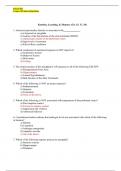
Psych 202 Exam 4 Practice Questions
Emotion, Learning, & Memory (Ch. 15, 17, 18) 1. Antisocial personality disorder is associated with . a) a hyperactive amygdala b) lesions of the bed nucleus of the stria terminalis (BNST) c) reduced grey matter in the prefrontal cortex d) high levels of serotonin e) Kluver-Bucy syndrome 2. Which component of emotional response is NOT objective? a) Autonomic arousal b) Behavior/Action c) Motivation d) Feeling 3. The central nucleus of the amygdala (CAN) projects to all of the following EXCEPT: a) Periaqueductal Grey Area b) Hippocampus c) Lateral Hypothalamus d) Bed Nucleus of the Stria Terminalis 4. Which of the following is NOT an innate response? a) Embarrassment b) Surprise c) Frustration d) None of the above. 5. Which of the following is NOT associated with impairment of the prefrontal cortex? a) Poor impulse control b) Excessive impulse control c) Aggression and violence d) Antisocial behavior 6. Correlational studies indicate that androgen levels are associated with which of the following in humans? a) Puberty b) Castration c) Androgen antagonists d) Anabolic steroids e) All of the above. 7. Which of the following regions projects to amygdala? a) Sensory cortices b) Hippocampus c) Thalamus d) All of the above. 8. Which theory of emotion is most recent? a) James-Lange b) Schacter c) Cannon-Bard d) Kluver-Bucy 9. Which of the following is a characteristic of Kluver-Bucy Syndrome? a) Decreased anxiety b) Tame behaviors c) Increased stress response d) All of the above. e) A&B only 10. What does prenatal androgen exposure do to neural circuits that control aggression? a) Creates them b) Organizes them c) Inhibits them d) All of the above e) None of the above. 11. Perceiving a stimulus first, and then experiencing feelings based on the autonomic response is an example of the theory. a) James-Lange b) Cannon-Bard c) Schacter d) None of the above. 12. Which theory, related to feelings, was first supported by the evidence that higher damage to the spinal cord results in milder emotions? a) James-Lange b) Cannon-Bard c) Schacter d) Masters & Johnson 13. What are the three components of emotional (objective) response? a) Motivation, autonomic arousal, stimulus b) Motivation, autonomic arousal, behavioral/action c) Behavioral/action, stimulus, reaction d) Behavioral/action, cognition, autonomic arousal 14. Which theory of feelings claims that feelings arise at the same time and independent of the physiological response to a stimulus? a) James-Lange b) Cannon-Bard c) Schacter d) They all claim this. 15. The central nucleus of the amygdala (CNA) is most important for which of the following? a) Aggression b) Release of stress hormones c) Fear conditioning d) Impulse control 16. What are the results of the Kluver-Bucy syndrome in animals? a) Tameness b) Fewer stress hormones c) Decreased anxiety d) Less stress-induced illness e) All of the above. 17. In operant conditioning, one learns to respond to which of the following? a) Unconditioned stimulus (US) b) Conditioned stimulus (CS) c) Discriminative stimulus (DS) d) Unconditioned response (UR) 18. Which of the following is NOT a component of the emotional (objective) response? a) Autonomic arousal b) Behavior/action c) Parasympathetic response d) Motivation 19. CaMK enzymes are involved with: a) synaptogenesis b) the release of nitric oxide c) rehearsal of episodic memories d) the addition of new AMPA receptors e) All of the above. 20. Spatial memory is most reliant on which region of the brain? a) Nucleus Accumbens b) Hippocampus c) Amygdala d) Basal Ganglia e) Prefrontal cortex 21. The influx of which ion can ultimately cause increased glutamate release from the pre-synaptic membrane? a) Na+ b) Ca+ c) K+ d) Cl-
Geschreven voor
Documentinformatie
- Geüpload op
- 16 januari 2024
- Aantal pagina's
- 9
- Geschreven in
- 2023/2024
- Type
- Tentamen (uitwerkingen)
- Bevat
- Vragen en antwoorden
Onderwerpen
-
emotion learning memory ch 15 17 18