
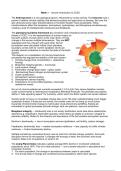
Week 1 - lecture introduction to CCEC
The Anthropocene is a new geological epoch, in uenced by human activity. The holocene was a
period of relative climatic stability that allowed societies and agriculture to develop. But over the
last centuries some major transformations in the Earth System have accelerated. These
transformations a ect the biosphere, atmosphere, hydrosphere, and lithosphere simultaneously,
creating a web of interdependent pressures and feedbacks.
The planetary boundries framework (by rockstrom and richardson) serves as the common
thread of CCEC. It is the representation of human impact on
the earth system. Human action is the main driver of most
change in this across multiple dimsnesions. They are NOT
separated and they interact with each other. Not all
boundaries were calculated initially. Each planetary
boundary comes with its ‘control variables’ which are
actually relevant indicators to monitor the state of the Earth
System.
This diagram is a visualisation of nine key biophysical
processes that regulate the stability of the eart system:
1. Climate change (Co2 concentration + radioactive
forcing)
2. Biosphere integrity (genetic + functional)
3. Land-system change
4. Freshwater change (blue water + green water)
5. Biochemical ows (nitrogen and phosphorus cycles)
6. Ocean acidi cation
7. Atmospheric aerosol loading
8. Stratospheric aerosol loading
9. Introduction of novel entities (plastics, chemicals,
radioactive waste)
Six out of nine boundaries are currently exceeded (1,2,3,4,5,9). Only ozone depletion remains
under control thanks to international cooperation (Montreal Protocol). The planetary boundaries
de ne a “safe operating space” for humanity, within which the Earth system can remain resilient.
Society tends to focus on immediate crisises (like covid-19) while underestimating much bigger
systematic threats. If those are not solved, the smaller ones will not bring so much (crisis
tsunamis). Environmental change is multi-scalar: local phenomena (wild res, oods) are
embedded in global processes (climate change, land use patterns, resource extraction).
Biosphere integrity — biodiversity loss is not evenly distributed: some taxa show catastrophic
declines (e.g. amphibians, freshwater species), while others are stable or unknown. Integral to
planetary stability. Refers to the diversity and abundance of life that sustains ecosystem services.
Decline in biodiversity → loss of ecosystem services (pollination, soil fertility, carbon storage).
Feedbacks: biodiversity loss → weaker ecosystem resilience → less capacity to bu er climate
extremes → further biodiversity decline.
Multiple sometimes overlooked drivers: sea ice loss from climate change, pollution, food web
disruption Arrival of new species: it changes the ecology of seas, the economic and social
impacts. Raise a lot of questions on what to do
The Living Planet Index indicates a global average 69% decline in monitored vertebrate
populations since 1970. This isn’t total extinction — but a severe reduction in abundance and
ecosystem function.
1. For each population, the change in abundance between years is calculated
2. The annual rates of change are combined across populations within each species.
fi fi fl ff fl fi fl ff
, 3. Then, changes are aggregated across all species, producing a global average trend (each
population contributes equally no matter its size)
4. The index is set to 1 in 1970 (or 100%) and annual changes are applied cumulatively Index
shows, in this case, decline over time always in regards to the year 1970
Disturbances of nitrogen and phospherus cycles
Globally, 120 millions of tons of N2 are converted to reactive forms for various uses but often
create pollution. But how to decrease their use without creating social tensions with the main
users. Conventional farmers around Europe who represent a large user of fertilizers are against
their reduction. Nutrient cycles (nitrogen and phosphorus loops) are crucial for food production
but destabilizing when overloaded. The case of phytoplankton blooms in the Baltic Sea
demonstrates how fertilizer runo creates eutrophication and “dead zones.” Excess nitrogen and
phosphorus fuel algal growth, leading to oxygen depletion and sh die-o s — a clear case of
ecological feedback failure. These dynamics can later be represented through Causal Loop
Diagrams (CLDs) as reinforcing loops leading to environmental degradation (a “Tragedy of the
Commons” archetype).
Land use and novel pollutants
Land use change is a driver of other boundaries, it links to biodiversity loss, nutrient cycles, and
carbon storage. Urbanization reduces fertile soil and increases vulnerability to oods. Novel
entities (plastics, PFAS, etc.) accumulate globally and alted biological and geological processes.
Environmental crises rarely have a single cause: they’re the product of multiple drivers (climate,
economy, governance, inequality) leading to compound consequences (malnutrition, migration,
con ict). One of the most powerful sections features the Madagascar food crisis (2021–2024).
World Food Programme reports shows how drought, insecurity, poor sanitation, and malnutrition
interact.
Unequivocal = clear and undeniable proof based on science.
Although climate change is quite accepted now, still people do not accept the role of human
activities as primary drivers of this. Nor the solutions that could be put in place about it.
There is a conceptual shift from weak to strong sustainability:
- Weak sustainability assumes natural and human capital are substitutable (if we degrade nature
but grow the economy, total “wealth” may still rise).
- Strong sustainability argues that some ecological functions are irreplaceable — e.g. stable
climate, biodiversity, fertile soil.
In the weak sustainability largely spread, all dimensions of sustainability are equal and
compensate each other. If you perform not well on the environment dimension, well you can often
compensate with more economy. But the real deal is as follow: economy needs the environment
and not the other way around that this the strong sustainability perspective: Nature STRIVES
without the economy or human society.
This leads into Raworth’s Doughnut Framework. The planetary
boundaries are merged with indicators represent social foundation: A
sustainable society with enough energy, good, water. Under this
framework we seek to not overshoot the ecological ceiling (i.e., the
planetary boundaries) while insuring the social foundation. The goal
of the Doughnut is to meet the needs of all within the means of living
planet.
• The inner ring de nes a social foundation (12 dimensions such as
food, health, education, equality, political voice).
• The outer ring de nes ecological ceilings (9 planetary boundaries).
The concurrent extent of social shortfall and ecological overshoot
re ects deep inequalities—of income and wealth, of exposure to risk,
of gender and race, and of political power. The Doughnut implies the
fl fl fifi ff fi ff fl
,need for a deep renewal of economic theory and policymaking so that the continued prioritisation
of GDP is replaced by an economic vision that seeks to social wellbeing as well rather than only
prioritizing economic wellbeing.
The framework can be applied to di erent system from global (previously) to country (here) and
local level (e.g., regions). They help decision making.
Petorca, Chile is known for water scarcity, especially due to avocado farming, where water is
overextracted. The phrase "Tragedy of the commons" means that when a shared resource (like
water) is used without regulation, individuals exploiI until it is depleted, harming everyone in the
long run. Fixes that fail = there aren't enough carbon sinks to o set every ton of CO2 produced
from our collective human activities. Both are system archetypes that demonstrate recurring
feedback failures.
Who bears the burden of mitigation and adaptation? The “polluter pays” vs. “right to develop”
principles raise ethical dilemmas.
6 broad transformations proposed by Sachs et al. (2019, Nature Sustainability) as pathways for
achieving the SDGs within planetary boundaries:
1. Education, Gender & Inequality
2. Health, Wellbeing &
3. Energy Decarbonization & Sustainable Industry
4. Sustainable Food, Land, Water & Oceans
5. Sustainable Cities & Communities
6. Digital Revolution for Sustainable Development
The DPSIR framework is a structured way to analyze environmental problems:
• Drivers: Human needs, economic growth, consumption.
• Pressures: Direct stresses (pollution, land use change, resource extraction).
• State: The condition of the environment (air, water, soil quality).
• Impacts: Consequences for ecosystems and human health.
• Responses: Policies, technology, social change.
The DPSIR framework is in a way a easy of describing systems. But this representation prevents
us from seeing interaction among drivers, pressures impacts and some interactions properties
that emerge in systems: feedback loops, archetypes that emerge and have a generic nature and
need to be properly identi ed to come up with appropriate solutions.
Most systems are socio-ecological systems, meaning: human systems → ecosystems → human
systems. These relationships can be depicted via a tool: a causal loop diagram which will be the
guiding tool of the course. Visual models showing feedbacks (e.g., irrigation → yields → income
fi ff ff
, → more irrigation → water depletion). These diagrams help identify leverage points — where
small interventions create large system changes. In this diagram, Human population when
growing increases activities which as major disturbance on ecosystems. These ecosystem when
they increases they deliver more services to humanity and these services are bene cial for the
development of the human population. This is a very simplistic view of the problem. A more
targeted and ne scale representation of some particular system is needed to understand all the
causes and all the consequences at stake when a human system changes.
The systems perspective:
Societies and ecosystems are interconnected and non-linear.
Actions produce feedback loops and tipping points.
Complex problems require interdisciplinary collaboration.
Week 1 - lecture on System Thinking (frameworks DPSIR & CLD’s)
The DPSIR framework as an example with the great smog of London.
1. What caused the smog? → demand for energy (driver)
2. Why did those practices exist? → burning coal from factories (pressure)
3. What were impacts? → High Co2 concentration and poor air (state) → reduced visibility / bad
health (impact)
4. what responses followed? → Clean air act (response)
Limitations of DPSIR:
- Static, snapshot-like structure: Neglect dynamics in the system
- Mono-directional and linearity: a linear or one-way cause-and-e ect relationship
- No-interdependency: separation in type of variables makes it harder to see interconnections
- Lack of feedback representation: they are not considered in details
- Rigidity in categories: limited focus on social and economic factors:
It is linear, static, and ignores feedbacks and interdependencies. Real systems are dynamic — the
same response (e.g., regulating emissions) can create new pressures (e.g., energy demand rising
elsewhere). That’s why we move from DPSIR to system thinking — to capture the dynamics.
The causal loop diagram is a map of feedback structures in a system. Variables are connected
by arrows showing causal in uence. The more emissions of sulfur will ultimately lead to less
emissions of sulfure. This chain contains feedbacks:
• Reinforcing (positive) loop (+): ampli es change
→ “The more temperature increases, the more ice melts, leading to less re ection (albedo) and
even higher temperature.”
• Balancing (negative) loop (–): counteracts change
→ “As CO₂ rises, concern about the environment grows, leading to mitigation e orts that
reduce emissions.”
Rules:
• An even number of “–” signs = reinforcing loop.
• An odd number = balancing loop.
A system is an interconnected set of elements coherently organised to achieve something.
Key characteristics of a system:
- elements: components of the system
- Interconnections: ows, relationships or feedback
- Purpose: what the system produces or maintains
System thinking is holistic and looks at relationships and feedbacks rather than isolated
variables.
fi fl fl fi ff fl ff fi
The Anthropocene is a new geological epoch, in uenced by human activity. The holocene was a
period of relative climatic stability that allowed societies and agriculture to develop. But over the
last centuries some major transformations in the Earth System have accelerated. These
transformations a ect the biosphere, atmosphere, hydrosphere, and lithosphere simultaneously,
creating a web of interdependent pressures and feedbacks.
The planetary boundries framework (by rockstrom and richardson) serves as the common
thread of CCEC. It is the representation of human impact on
the earth system. Human action is the main driver of most
change in this across multiple dimsnesions. They are NOT
separated and they interact with each other. Not all
boundaries were calculated initially. Each planetary
boundary comes with its ‘control variables’ which are
actually relevant indicators to monitor the state of the Earth
System.
This diagram is a visualisation of nine key biophysical
processes that regulate the stability of the eart system:
1. Climate change (Co2 concentration + radioactive
forcing)
2. Biosphere integrity (genetic + functional)
3. Land-system change
4. Freshwater change (blue water + green water)
5. Biochemical ows (nitrogen and phosphorus cycles)
6. Ocean acidi cation
7. Atmospheric aerosol loading
8. Stratospheric aerosol loading
9. Introduction of novel entities (plastics, chemicals,
radioactive waste)
Six out of nine boundaries are currently exceeded (1,2,3,4,5,9). Only ozone depletion remains
under control thanks to international cooperation (Montreal Protocol). The planetary boundaries
de ne a “safe operating space” for humanity, within which the Earth system can remain resilient.
Society tends to focus on immediate crisises (like covid-19) while underestimating much bigger
systematic threats. If those are not solved, the smaller ones will not bring so much (crisis
tsunamis). Environmental change is multi-scalar: local phenomena (wild res, oods) are
embedded in global processes (climate change, land use patterns, resource extraction).
Biosphere integrity — biodiversity loss is not evenly distributed: some taxa show catastrophic
declines (e.g. amphibians, freshwater species), while others are stable or unknown. Integral to
planetary stability. Refers to the diversity and abundance of life that sustains ecosystem services.
Decline in biodiversity → loss of ecosystem services (pollination, soil fertility, carbon storage).
Feedbacks: biodiversity loss → weaker ecosystem resilience → less capacity to bu er climate
extremes → further biodiversity decline.
Multiple sometimes overlooked drivers: sea ice loss from climate change, pollution, food web
disruption Arrival of new species: it changes the ecology of seas, the economic and social
impacts. Raise a lot of questions on what to do
The Living Planet Index indicates a global average 69% decline in monitored vertebrate
populations since 1970. This isn’t total extinction — but a severe reduction in abundance and
ecosystem function.
1. For each population, the change in abundance between years is calculated
2. The annual rates of change are combined across populations within each species.
fi fi fl ff fl fi fl ff
, 3. Then, changes are aggregated across all species, producing a global average trend (each
population contributes equally no matter its size)
4. The index is set to 1 in 1970 (or 100%) and annual changes are applied cumulatively Index
shows, in this case, decline over time always in regards to the year 1970
Disturbances of nitrogen and phospherus cycles
Globally, 120 millions of tons of N2 are converted to reactive forms for various uses but often
create pollution. But how to decrease their use without creating social tensions with the main
users. Conventional farmers around Europe who represent a large user of fertilizers are against
their reduction. Nutrient cycles (nitrogen and phosphorus loops) are crucial for food production
but destabilizing when overloaded. The case of phytoplankton blooms in the Baltic Sea
demonstrates how fertilizer runo creates eutrophication and “dead zones.” Excess nitrogen and
phosphorus fuel algal growth, leading to oxygen depletion and sh die-o s — a clear case of
ecological feedback failure. These dynamics can later be represented through Causal Loop
Diagrams (CLDs) as reinforcing loops leading to environmental degradation (a “Tragedy of the
Commons” archetype).
Land use and novel pollutants
Land use change is a driver of other boundaries, it links to biodiversity loss, nutrient cycles, and
carbon storage. Urbanization reduces fertile soil and increases vulnerability to oods. Novel
entities (plastics, PFAS, etc.) accumulate globally and alted biological and geological processes.
Environmental crises rarely have a single cause: they’re the product of multiple drivers (climate,
economy, governance, inequality) leading to compound consequences (malnutrition, migration,
con ict). One of the most powerful sections features the Madagascar food crisis (2021–2024).
World Food Programme reports shows how drought, insecurity, poor sanitation, and malnutrition
interact.
Unequivocal = clear and undeniable proof based on science.
Although climate change is quite accepted now, still people do not accept the role of human
activities as primary drivers of this. Nor the solutions that could be put in place about it.
There is a conceptual shift from weak to strong sustainability:
- Weak sustainability assumes natural and human capital are substitutable (if we degrade nature
but grow the economy, total “wealth” may still rise).
- Strong sustainability argues that some ecological functions are irreplaceable — e.g. stable
climate, biodiversity, fertile soil.
In the weak sustainability largely spread, all dimensions of sustainability are equal and
compensate each other. If you perform not well on the environment dimension, well you can often
compensate with more economy. But the real deal is as follow: economy needs the environment
and not the other way around that this the strong sustainability perspective: Nature STRIVES
without the economy or human society.
This leads into Raworth’s Doughnut Framework. The planetary
boundaries are merged with indicators represent social foundation: A
sustainable society with enough energy, good, water. Under this
framework we seek to not overshoot the ecological ceiling (i.e., the
planetary boundaries) while insuring the social foundation. The goal
of the Doughnut is to meet the needs of all within the means of living
planet.
• The inner ring de nes a social foundation (12 dimensions such as
food, health, education, equality, political voice).
• The outer ring de nes ecological ceilings (9 planetary boundaries).
The concurrent extent of social shortfall and ecological overshoot
re ects deep inequalities—of income and wealth, of exposure to risk,
of gender and race, and of political power. The Doughnut implies the
fl fl fifi ff fi ff fl
,need for a deep renewal of economic theory and policymaking so that the continued prioritisation
of GDP is replaced by an economic vision that seeks to social wellbeing as well rather than only
prioritizing economic wellbeing.
The framework can be applied to di erent system from global (previously) to country (here) and
local level (e.g., regions). They help decision making.
Petorca, Chile is known for water scarcity, especially due to avocado farming, where water is
overextracted. The phrase "Tragedy of the commons" means that when a shared resource (like
water) is used without regulation, individuals exploiI until it is depleted, harming everyone in the
long run. Fixes that fail = there aren't enough carbon sinks to o set every ton of CO2 produced
from our collective human activities. Both are system archetypes that demonstrate recurring
feedback failures.
Who bears the burden of mitigation and adaptation? The “polluter pays” vs. “right to develop”
principles raise ethical dilemmas.
6 broad transformations proposed by Sachs et al. (2019, Nature Sustainability) as pathways for
achieving the SDGs within planetary boundaries:
1. Education, Gender & Inequality
2. Health, Wellbeing &
3. Energy Decarbonization & Sustainable Industry
4. Sustainable Food, Land, Water & Oceans
5. Sustainable Cities & Communities
6. Digital Revolution for Sustainable Development
The DPSIR framework is a structured way to analyze environmental problems:
• Drivers: Human needs, economic growth, consumption.
• Pressures: Direct stresses (pollution, land use change, resource extraction).
• State: The condition of the environment (air, water, soil quality).
• Impacts: Consequences for ecosystems and human health.
• Responses: Policies, technology, social change.
The DPSIR framework is in a way a easy of describing systems. But this representation prevents
us from seeing interaction among drivers, pressures impacts and some interactions properties
that emerge in systems: feedback loops, archetypes that emerge and have a generic nature and
need to be properly identi ed to come up with appropriate solutions.
Most systems are socio-ecological systems, meaning: human systems → ecosystems → human
systems. These relationships can be depicted via a tool: a causal loop diagram which will be the
guiding tool of the course. Visual models showing feedbacks (e.g., irrigation → yields → income
fi ff ff
, → more irrigation → water depletion). These diagrams help identify leverage points — where
small interventions create large system changes. In this diagram, Human population when
growing increases activities which as major disturbance on ecosystems. These ecosystem when
they increases they deliver more services to humanity and these services are bene cial for the
development of the human population. This is a very simplistic view of the problem. A more
targeted and ne scale representation of some particular system is needed to understand all the
causes and all the consequences at stake when a human system changes.
The systems perspective:
Societies and ecosystems are interconnected and non-linear.
Actions produce feedback loops and tipping points.
Complex problems require interdisciplinary collaboration.
Week 1 - lecture on System Thinking (frameworks DPSIR & CLD’s)
The DPSIR framework as an example with the great smog of London.
1. What caused the smog? → demand for energy (driver)
2. Why did those practices exist? → burning coal from factories (pressure)
3. What were impacts? → High Co2 concentration and poor air (state) → reduced visibility / bad
health (impact)
4. what responses followed? → Clean air act (response)
Limitations of DPSIR:
- Static, snapshot-like structure: Neglect dynamics in the system
- Mono-directional and linearity: a linear or one-way cause-and-e ect relationship
- No-interdependency: separation in type of variables makes it harder to see interconnections
- Lack of feedback representation: they are not considered in details
- Rigidity in categories: limited focus on social and economic factors:
It is linear, static, and ignores feedbacks and interdependencies. Real systems are dynamic — the
same response (e.g., regulating emissions) can create new pressures (e.g., energy demand rising
elsewhere). That’s why we move from DPSIR to system thinking — to capture the dynamics.
The causal loop diagram is a map of feedback structures in a system. Variables are connected
by arrows showing causal in uence. The more emissions of sulfur will ultimately lead to less
emissions of sulfure. This chain contains feedbacks:
• Reinforcing (positive) loop (+): ampli es change
→ “The more temperature increases, the more ice melts, leading to less re ection (albedo) and
even higher temperature.”
• Balancing (negative) loop (–): counteracts change
→ “As CO₂ rises, concern about the environment grows, leading to mitigation e orts that
reduce emissions.”
Rules:
• An even number of “–” signs = reinforcing loop.
• An odd number = balancing loop.
A system is an interconnected set of elements coherently organised to achieve something.
Key characteristics of a system:
- elements: components of the system
- Interconnections: ows, relationships or feedback
- Purpose: what the system produces or maintains
System thinking is holistic and looks at relationships and feedbacks rather than isolated
variables.
fi fl fl fi ff fl ff fi



