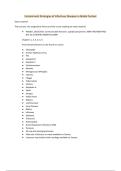
Containment Strategies of Infectious Diseases in Global Context
Exam material
The Lectures, the assignment theory and the course reading are exam material.
● Webber, 2019/2016. Communicable diseases: a global perspective. ISBN 9781780647425
DOI 10.1079/9781780647425.0000
Chapters 1, 2, 3, 4, 5, 6
And selected diseases can be found on canvas
● Chlamydia
● Human Papilloma Virus
● HIV
● Hepatitis B
● Hepatitis C
● Schistosomiasis
● Measles
● Menigococcol Menigitis
● Leprosy
● Chagas
● Tuberculosis
● Cholera
● Hepatites A
● Ebola
● Dengue
● Yellow Fever
● Malaria
● Leishmaniasis
● Lyme Disease
● Rabies
● Influenza
● Diphteria
● Trachoma
● Poliomyelitis
● Acute Respiratory Infections (ARI)
● Pertussis
● All new and emerging diseases
● Slide sets of lectures as made available on Canvas.
● Lecturers may make further readings available on Canvas.
,Week 1
Reading - Chapter 1
Communicable disease = illness that is transmitted from a person, animal or inanimate source to
another person either directly (with assistance of a host) or by a vector.
With endemic diseases children are more vulnerable
More diseases are found to be linked to infectious diseases e.g. hepatitis b linked to cancer and HPV
causing cancer
- Cervix cancer is the commonest cancer with a communicable cause
Coronary heart diseases are also linked to infective causes
Better hygiene might be helpful to prevent infectious diseases but it might have led to more allergies
and problems like DM type I and inflammatory bowel disorder → hypothesis is that our obsession
with cleanliness and using antibacterial products stops minor infections which are actually helping
the immune system.
1. The agent
Agent = can be an organism (virus, prion, bacteria, rickettsia, protozoa, helminth, fungus or
arthropod) or a physical or chemical agent (toxin or poison).
1.1. Multiplication
organisms need to multiply, find a means of transmission and survive
types of multiplication:
1) sexual; great scope for variety (natural selection based on individuals) → some individuals are
successful and some are unsuccessful in invading the host + both male and female are needed for
continuing existence | if treatment is successful at destroying one organism it will not necessarily
,also work against others of the same organism BUT for treatment and control you can address one of
the sexes to kill both
2) asexual; a succession of exact or almost exact replicas are produced (natural selection based on
batches or strains) → strain of the organism is either successful or unsuccessful in invading the host +
only one organism needed for continuing existence | for treatment and control if treatment is
successful at destroying organism then it will be successful against all the other individuals of that
strain - unless a mutation occurs
1.2. Survival
Survive by finding a suitable host within a certain time
Reservoir = storage place for agents of infection after adaptation of the parasite to the immune
reaction of the host → the reaction of the host diminishes and the adaptability of the parasite
increases
- from this reservoir the parasite can attack new hosts of the same or other species
- reservoirs can be human, animal, vectors or the inanimate environment (e.g. soil, water)
- intermediaries may be required before the final reservoir host is colonized → however if a
new mutation arises which increases reproduction this will be used against the host
The adaptability of the parasites may reduce immune responses (and thereby allergies) so it also has
some advantages for us
Infection with some virus elements early on in the development of our species has led to
evolutionary benefits as the development of the human placenta and our large brain
Persistence = special stages that resist destruction in an adverse environment, e.g. cysts of protozoa,
spores and eggs → destruction of persistent organisms requires the use of antiseptics (inhibit growth
instead of killing like antibiotics + can also be used for not bacteria) or sufficient heat for a prolonged
period
Latency = the production by the organisms of a developmental stage in the environment that is not
infective to a new host → allows the parasite to wait until suitable conditions before changing into
the infective form
1.3. Effect of the agent
Severity of illness = toxicity + virulence
- toxicity = infectious agents produce a toxic reaction due to the foreign proteins they consist
of or produce in their respiratory or reproductive processes
- virulence = how deadly the pathogen is and how easy transmitted
- Spanish flu vs. influenza
- Over time, pathogens often become less virulent in a population because killing the
host too quickly reduces their ability to spread
- In labs, scientists can deliberately reduce virulence by passing the organism through
many animals → creating a weakened strain that can be used in vaccines
, 1.4. Excreted load and infective dose
Number of organisms excreted can vary considerably according to the type of infection or the stage
of the disease
Infective dose = number of organisms required to overcome the defenses of the host and cause the
disease (either with or without symptoms)
- in most infections, once this number is surpassed, the severity of the disease is the same
whether a few or a large number of organisms are introduced, but in some cases the dose
does correlate with severity of the illness (e.g. in food contamination)
- difficult to measure an exact infective dose for individuals because variables like host
susceptibility prevent precision in the estimations
- worms generally have a low infective dose
- a low dose of organisms may produce no symptoms of disease but be sufficient to induce
immunity
- infections with a low infective dose can spread person-to-person → provision of a safe water
supply or sanitation will have little or no effect
- for infections with a high infective provision of a safe water supply or sanitation will have
effect
2. Transmission
Transmission basics
- Direct transmission → from person to person (touch, droplets, food/water, autoinfection)
- With intermediate hosts → parasites need to develop in another organism before it can
infect a new human. The intermediate host does not necessarily transmit directly by feeding.
- With vectors → infection is carried by an insect or arachnid from one host to another.
Transmits diseases directly by feeding or habits.
2.1. Direct
From person-to-person via contact, or via food and water (diarrhoeal diseases), droplet infection
(respiratory diseases), autoinfection (when humans contaminate themselves directly from their
external orifices)
2.2. Human reservoir with intermediate host
e.g. schistosomiasis parasite live in humans, but for transmission to another human the parasite
must undergo developmental stages in a snail intermediate host
2.3. Animals as intermediate host or reservoir
2.4. Vectors
Carries the infection from one host to another either as part of the transmission process (e.g.
mosquito also develops) or mechanically (only transmitting)
Exam material
The Lectures, the assignment theory and the course reading are exam material.
● Webber, 2019/2016. Communicable diseases: a global perspective. ISBN 9781780647425
DOI 10.1079/9781780647425.0000
Chapters 1, 2, 3, 4, 5, 6
And selected diseases can be found on canvas
● Chlamydia
● Human Papilloma Virus
● HIV
● Hepatitis B
● Hepatitis C
● Schistosomiasis
● Measles
● Menigococcol Menigitis
● Leprosy
● Chagas
● Tuberculosis
● Cholera
● Hepatites A
● Ebola
● Dengue
● Yellow Fever
● Malaria
● Leishmaniasis
● Lyme Disease
● Rabies
● Influenza
● Diphteria
● Trachoma
● Poliomyelitis
● Acute Respiratory Infections (ARI)
● Pertussis
● All new and emerging diseases
● Slide sets of lectures as made available on Canvas.
● Lecturers may make further readings available on Canvas.
,Week 1
Reading - Chapter 1
Communicable disease = illness that is transmitted from a person, animal or inanimate source to
another person either directly (with assistance of a host) or by a vector.
With endemic diseases children are more vulnerable
More diseases are found to be linked to infectious diseases e.g. hepatitis b linked to cancer and HPV
causing cancer
- Cervix cancer is the commonest cancer with a communicable cause
Coronary heart diseases are also linked to infective causes
Better hygiene might be helpful to prevent infectious diseases but it might have led to more allergies
and problems like DM type I and inflammatory bowel disorder → hypothesis is that our obsession
with cleanliness and using antibacterial products stops minor infections which are actually helping
the immune system.
1. The agent
Agent = can be an organism (virus, prion, bacteria, rickettsia, protozoa, helminth, fungus or
arthropod) or a physical or chemical agent (toxin or poison).
1.1. Multiplication
organisms need to multiply, find a means of transmission and survive
types of multiplication:
1) sexual; great scope for variety (natural selection based on individuals) → some individuals are
successful and some are unsuccessful in invading the host + both male and female are needed for
continuing existence | if treatment is successful at destroying one organism it will not necessarily
,also work against others of the same organism BUT for treatment and control you can address one of
the sexes to kill both
2) asexual; a succession of exact or almost exact replicas are produced (natural selection based on
batches or strains) → strain of the organism is either successful or unsuccessful in invading the host +
only one organism needed for continuing existence | for treatment and control if treatment is
successful at destroying organism then it will be successful against all the other individuals of that
strain - unless a mutation occurs
1.2. Survival
Survive by finding a suitable host within a certain time
Reservoir = storage place for agents of infection after adaptation of the parasite to the immune
reaction of the host → the reaction of the host diminishes and the adaptability of the parasite
increases
- from this reservoir the parasite can attack new hosts of the same or other species
- reservoirs can be human, animal, vectors or the inanimate environment (e.g. soil, water)
- intermediaries may be required before the final reservoir host is colonized → however if a
new mutation arises which increases reproduction this will be used against the host
The adaptability of the parasites may reduce immune responses (and thereby allergies) so it also has
some advantages for us
Infection with some virus elements early on in the development of our species has led to
evolutionary benefits as the development of the human placenta and our large brain
Persistence = special stages that resist destruction in an adverse environment, e.g. cysts of protozoa,
spores and eggs → destruction of persistent organisms requires the use of antiseptics (inhibit growth
instead of killing like antibiotics + can also be used for not bacteria) or sufficient heat for a prolonged
period
Latency = the production by the organisms of a developmental stage in the environment that is not
infective to a new host → allows the parasite to wait until suitable conditions before changing into
the infective form
1.3. Effect of the agent
Severity of illness = toxicity + virulence
- toxicity = infectious agents produce a toxic reaction due to the foreign proteins they consist
of or produce in their respiratory or reproductive processes
- virulence = how deadly the pathogen is and how easy transmitted
- Spanish flu vs. influenza
- Over time, pathogens often become less virulent in a population because killing the
host too quickly reduces their ability to spread
- In labs, scientists can deliberately reduce virulence by passing the organism through
many animals → creating a weakened strain that can be used in vaccines
, 1.4. Excreted load and infective dose
Number of organisms excreted can vary considerably according to the type of infection or the stage
of the disease
Infective dose = number of organisms required to overcome the defenses of the host and cause the
disease (either with or without symptoms)
- in most infections, once this number is surpassed, the severity of the disease is the same
whether a few or a large number of organisms are introduced, but in some cases the dose
does correlate with severity of the illness (e.g. in food contamination)
- difficult to measure an exact infective dose for individuals because variables like host
susceptibility prevent precision in the estimations
- worms generally have a low infective dose
- a low dose of organisms may produce no symptoms of disease but be sufficient to induce
immunity
- infections with a low infective dose can spread person-to-person → provision of a safe water
supply or sanitation will have little or no effect
- for infections with a high infective provision of a safe water supply or sanitation will have
effect
2. Transmission
Transmission basics
- Direct transmission → from person to person (touch, droplets, food/water, autoinfection)
- With intermediate hosts → parasites need to develop in another organism before it can
infect a new human. The intermediate host does not necessarily transmit directly by feeding.
- With vectors → infection is carried by an insect or arachnid from one host to another.
Transmits diseases directly by feeding or habits.
2.1. Direct
From person-to-person via contact, or via food and water (diarrhoeal diseases), droplet infection
(respiratory diseases), autoinfection (when humans contaminate themselves directly from their
external orifices)
2.2. Human reservoir with intermediate host
e.g. schistosomiasis parasite live in humans, but for transmission to another human the parasite
must undergo developmental stages in a snail intermediate host
2.3. Animals as intermediate host or reservoir
2.4. Vectors
Carries the infection from one host to another either as part of the transmission process (e.g.
mosquito also develops) or mechanically (only transmitting)