Management: an evidence based approach
Chapter 1
Management (as an activity) has five essential parts (Henri Fayola):
1. Policy making and planning (prévoir)
2. Organizing/designing organizational structure (organizer)
3. Giving instructions and assistance during the execution of tasks (commander)
4. Coordinating (coordonner)
5. Controlling and making adjustments, if necessary (controller)
Managing in the narrow sense: leading (giving orders), motivating people and checking
activities.
Managing in the broad sense: determination of the organization’s mission and course,
positioning and the maintenance of external contacts.
A logical series of steps
Communication: all managers have to be able to explain
their reasons, intentions and decisions to others in such
a way that they will be understood.
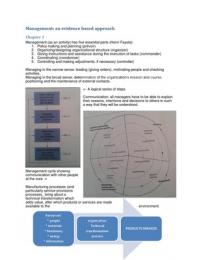
Management cycle showing
communication with other people
at the core
Manufacturing processes (and
particularly service-provisions
processes_ bring about a
technical transformation which
adds value, after which products or services are made
available to the environment.
Resources:
* people organizaiton:
* materials Technical
PRODUCTS SERVICES
* Machinery transformation
* energy process
* information
,The technical transformation (see arrow above) process can, for example, produce screws
or cars. These operations are managed by a managerial process in which decisions are
made about what products will be supplied, what services rendered, and how, by whom and
where the necessary activities will be undertaken.
Simple process model of an
organization.
More detailed process model of
an organization see below.
(page 47 book)
There are 3 types of processes:
1. Primary or main processes
a. Make a direct contribution to the
manufacturing of a product or the
provision of a service an
organization derives its existence from
this process (purchasing, production
and sales)
2. Secondary or supporting processes
a. Those activities required to maintain the primary processes or to facilitate
production. Tasks are not performed for own sake but to maintain the
effectiveness and continuity of the primary processes.
3. Managerial or regulatory and condition-setting processes.
a. Activities that determine goals for and give direction to the primary and
secondary processes. Set the conditions according to which value is added,
and they ensure that the organization is directed towards the attainment of
the organizational goals.
b. The activities with which an organization creates value can be divided into
primary, supporting and managerial categories, which are called the value
chain (Porter). See value chain below
The general
management activities
which form the content
of the managerial tasks
are:
1. Strategic policy
making and position
2. Design of a
suitable organizational
structure
3. Provision of
content and means of
performing the
organizational
processes, including the
, imposition of controls.
Henri Fayol represented management as a process. Fayol broke organizational government
up into five essential management functions as mentioned before: prévoir, organizer,
commander, coordonner and controller. These five categories can by clumped into three
core areas of managerial activity:
1. External tuning and adaptation
2. Structuring
3. Internal tuning and adaptation
These three management functions are closely related:
The primary and secondary
company processes are as
followed:
Marketing and sales
process
Purchasing process
Manufacturing
process or servicing process
Research and development process
Financial and information supply process
Personnel process
An organization can no longer function if there are no more processes to be performed.
Structuring, performing and controlling the organizational processes is therefore crucial. The
following is demanded for process control:
Mapping out the various functional or partial processes
Fine tuning of the processes trough the regulating or steering activities of
management
1. Formulating overall organizational objectives and goals
2. Deriving partial goals, norms and standards from the above in order to attain the
goals
3. Formulating and transmitting policy
4. Determining guidelines, procedures, instructions and assignments
5. Distributing tasks and assigning the authority to take the necessary actions
A cybernetic cycle always
involves the following processes:
Setting operational
standards
Giving an assignment or
signal for execution
Giving information to a
steering organ. The
managerial or operational
employee is always
informed about the actual
situation
Checking
Acting to adjust or
correct.
See this cybernetic cycle
, There are eight characteristics to successful management:
1. A bias towards action: preferring to undertake something actively instead of endlessly
studying and analyzing a concept
2. A customer-directed attitude: knowing the customer’s preference and serving that
preference
3. Autonomy and entrepreneurship: dividing the company up into smaller units and
encouraging an independent and competitive working attitude
4. Productivity through people: making employees aware of the fact that effort is
essential and that they profit from the company’s success
5. Hands-on and value driven: showing personal commitment and keeping in touch with
the essence of the company, stimulating a strong company culture
6. ‘Stick to the knitting’: stick to the activities that the company performs best
7. ‘Simple form and lean staff’: few administrative and managerial layers and few
people at the top
8. Simultaneous loose-tight properties: freedom from constraints taking care of the
central values of the company combined with respect for all employees who accept
these values
High performance characteristics: the management of innovation and creativity, the creation
of masterly high performance teams and high performance jobs, the efficient conversion of
strategies into action, fundamental and excellent leadership, rules for effective collaboration
and discipline, quality improvement in the relationship between staff and customers and
organizational management that makes use of the indicators that influence behavior and that
are incentives for excellent performance.
Criteria for effectiveness criteria:
Efficiency (the degree to which a set of goals is achieved while using up a minimum
of resources)
Satisfaction (the degree to which the need off the members of the organization are
satisfied)
Fulfillment of stakeholders needs (the degree to which the demands and needs of the
stakeholders form the external environment are met)
Self-preservation through flexibility and responsiveness (the degree to which an
organization can speedily adjust its short-term strategies, structure and operational
goals in reaction ot changing external circumstances
An organizational culture is formed by the prevailing ideas which are disseminated by a large
proportion of the members of the organization, members who carry disseminated by a large
proportion of the members of the organization, members who carry those ides with them in
terms of operative values, norms and convictions.
Values = the things that people consider to be important ad which determine human
behavior.
Convictions = are expressed by members of the organization, whether asked for or not.
They are the notions and views of reality which are shared by the members of the
organization. They can cause a certain type of behavior.
Organisational culture can be considered as the mutual understanding between the
members and the stakeholders of the organization.
Chapter 1
Management (as an activity) has five essential parts (Henri Fayola):
1. Policy making and planning (prévoir)
2. Organizing/designing organizational structure (organizer)
3. Giving instructions and assistance during the execution of tasks (commander)
4. Coordinating (coordonner)
5. Controlling and making adjustments, if necessary (controller)
Managing in the narrow sense: leading (giving orders), motivating people and checking
activities.
Managing in the broad sense: determination of the organization’s mission and course,
positioning and the maintenance of external contacts.
A logical series of steps
Communication: all managers have to be able to explain
their reasons, intentions and decisions to others in such
a way that they will be understood.
Management cycle showing
communication with other people
at the core
Manufacturing processes (and
particularly service-provisions
processes_ bring about a
technical transformation which
adds value, after which products or services are made
available to the environment.
Resources:
* people organizaiton:
* materials Technical
PRODUCTS SERVICES
* Machinery transformation
* energy process
* information
,The technical transformation (see arrow above) process can, for example, produce screws
or cars. These operations are managed by a managerial process in which decisions are
made about what products will be supplied, what services rendered, and how, by whom and
where the necessary activities will be undertaken.
Simple process model of an
organization.
More detailed process model of
an organization see below.
(page 47 book)
There are 3 types of processes:
1. Primary or main processes
a. Make a direct contribution to the
manufacturing of a product or the
provision of a service an
organization derives its existence from
this process (purchasing, production
and sales)
2. Secondary or supporting processes
a. Those activities required to maintain the primary processes or to facilitate
production. Tasks are not performed for own sake but to maintain the
effectiveness and continuity of the primary processes.
3. Managerial or regulatory and condition-setting processes.
a. Activities that determine goals for and give direction to the primary and
secondary processes. Set the conditions according to which value is added,
and they ensure that the organization is directed towards the attainment of
the organizational goals.
b. The activities with which an organization creates value can be divided into
primary, supporting and managerial categories, which are called the value
chain (Porter). See value chain below
The general
management activities
which form the content
of the managerial tasks
are:
1. Strategic policy
making and position
2. Design of a
suitable organizational
structure
3. Provision of
content and means of
performing the
organizational
processes, including the
, imposition of controls.
Henri Fayol represented management as a process. Fayol broke organizational government
up into five essential management functions as mentioned before: prévoir, organizer,
commander, coordonner and controller. These five categories can by clumped into three
core areas of managerial activity:
1. External tuning and adaptation
2. Structuring
3. Internal tuning and adaptation
These three management functions are closely related:
The primary and secondary
company processes are as
followed:
Marketing and sales
process
Purchasing process
Manufacturing
process or servicing process
Research and development process
Financial and information supply process
Personnel process
An organization can no longer function if there are no more processes to be performed.
Structuring, performing and controlling the organizational processes is therefore crucial. The
following is demanded for process control:
Mapping out the various functional or partial processes
Fine tuning of the processes trough the regulating or steering activities of
management
1. Formulating overall organizational objectives and goals
2. Deriving partial goals, norms and standards from the above in order to attain the
goals
3. Formulating and transmitting policy
4. Determining guidelines, procedures, instructions and assignments
5. Distributing tasks and assigning the authority to take the necessary actions
A cybernetic cycle always
involves the following processes:
Setting operational
standards
Giving an assignment or
signal for execution
Giving information to a
steering organ. The
managerial or operational
employee is always
informed about the actual
situation
Checking
Acting to adjust or
correct.
See this cybernetic cycle
, There are eight characteristics to successful management:
1. A bias towards action: preferring to undertake something actively instead of endlessly
studying and analyzing a concept
2. A customer-directed attitude: knowing the customer’s preference and serving that
preference
3. Autonomy and entrepreneurship: dividing the company up into smaller units and
encouraging an independent and competitive working attitude
4. Productivity through people: making employees aware of the fact that effort is
essential and that they profit from the company’s success
5. Hands-on and value driven: showing personal commitment and keeping in touch with
the essence of the company, stimulating a strong company culture
6. ‘Stick to the knitting’: stick to the activities that the company performs best
7. ‘Simple form and lean staff’: few administrative and managerial layers and few
people at the top
8. Simultaneous loose-tight properties: freedom from constraints taking care of the
central values of the company combined with respect for all employees who accept
these values
High performance characteristics: the management of innovation and creativity, the creation
of masterly high performance teams and high performance jobs, the efficient conversion of
strategies into action, fundamental and excellent leadership, rules for effective collaboration
and discipline, quality improvement in the relationship between staff and customers and
organizational management that makes use of the indicators that influence behavior and that
are incentives for excellent performance.
Criteria for effectiveness criteria:
Efficiency (the degree to which a set of goals is achieved while using up a minimum
of resources)
Satisfaction (the degree to which the need off the members of the organization are
satisfied)
Fulfillment of stakeholders needs (the degree to which the demands and needs of the
stakeholders form the external environment are met)
Self-preservation through flexibility and responsiveness (the degree to which an
organization can speedily adjust its short-term strategies, structure and operational
goals in reaction ot changing external circumstances
An organizational culture is formed by the prevailing ideas which are disseminated by a large
proportion of the members of the organization, members who carry disseminated by a large
proportion of the members of the organization, members who carry those ides with them in
terms of operative values, norms and convictions.
Values = the things that people consider to be important ad which determine human
behavior.
Convictions = are expressed by members of the organization, whether asked for or not.
They are the notions and views of reality which are shared by the members of the
organization. They can cause a certain type of behavior.
Organisational culture can be considered as the mutual understanding between the
members and the stakeholders of the organization.