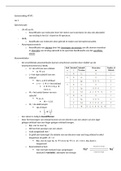
Summary Leadership: Mobilizing People (LMP)
LMP Lecture 1 l Introduction and theories of leadership
This lecture → an introduction to
leadership:
- Definition
- Effectiveness
- Influential theories
Correlation, mediation and moderation are the
most important statistics in this course.
Mediation → Facebook use is negatively
correlated to self esteem (via social
comparison).
Moderation → Abusive leaders are positively related to burn out employees, but interaction
frequency moderates the relationship.
Defining leadership:
‘Leadership is the process of influencing others to understand and agree about what needs to be
done and how to do it, and the process of facilitating individual and collective efforts to accomplish
shared objectives.’ (Yukl, 2013).
- What do leaders influence? → people, teamwork.
What leaders can influence:
- The choice of objectives and strategies to pursue.
- The motivation of members to achieve the objectives: a hierarchy keeps you motivated to
achieve more.
- The mutual trust and cooperation of members.
- The organization and coordination of work activities.
- The allocation of resources to activities and objectives.
- The development of members mills and confidence.
- The learning and sharing of new knowledge by members.
- The enlistment of support of cooperation of outsiders.
- The design of formal structure, programs, and systems.
- The shared beliefs and values of members.
Influential theories:
● The ‘Great Man’ theories → an important stream of research but also very
simplified.
○ Historians who examined the life of a respected leader for clues leading to that
person’s greatness.
○ Often focused on major life events and admirable traits (persistence, optimism,
intelligence).
● The trait approach:
, ○ Intelligence (IQ) & personality (big 5) → certain characteristics correlate
with good leadership (intelligence and leadership r = .21)
● The behavioral approach:
○ Ohio State University (in the early 1950s) → 2 styles of leadership: initiating
structure (task-oriented) and consideration (relation-oriented).
○ Initiating structure is related to individual and group performance.
○ Consideration is related to follower satisfaction, motivation and leadership
effectiveness.
One example of this is the ‘Managerial Grid’ (Blake & Mouton, 1964, 1982):
- Concern for people: emphasis on the needs of team members, their
interests, and areas of personal development when deciding how to
accomplish a task.
- Concern for production: emphasis on concrete objectives
organizational efficiency and high productivity when deciding how to
accomplish a task.
➔ Belongs to the style approach.
DeRue et al. (2011): integration
between style and trait
approach →
But will someone with the right traits /
behaviors always be an effective
leader?
- No, because: role of the
situation → there is more
to it than just having
certain traits and
characteristics.
The contingency approach:
● The Least Preferred Coworker
Contingency Model (Fiedler, 1967):
○ Task-oriented leadership preferred in highly (un)favorable situations.
○ Relation-oriented leadership preferred at moderate levels of situational favorability.
The situational approach:
The Hersey-Blanchard (1977) Model of Leadership (the leader adjusts the style to the situation):
- Job maturity: subordinate’s job-related ability, skills and knowledge.
- Psychological maturity: the self-confidence and self-respect of the subordinate.
- From task-oriented to relation-oriented.
➔ Difference between contingency and situational (both imply: it does not just depend
on the traits, but also the situation) → the contingency approach assumes that the
leadership style is fixed, in the situational approach the leadership depends on
the situation.
New approaches:
New approaches → LMX:
● Leader-member exchange (LMX) theory (Dansereau, Graen & Haga, 1975):
, ○ In-group members have high-quality relationships with their leader and high latitude
for negotiating their work roles; rare use of formal power or authority.
○ Out-group members have low-quality relationships with their leader and little latitude
for negotiating their work roles; the leader relies on formal power and authority.
➔ Positive attitudes, motivation and performance.
New approaches → transformational leadership:
● Transformational leadership is the interplay between leaders and followers in which
each raises the other to higher levels of ethics, morality, and motivation. The
leader transforms the followers by appealing to their nobler motives, such as
justice and peace. (Burns, 1978) → change-orientated.
Four components of transformational leadership (Bass, 1985):
1) Idealized influence (charisma): behavior that increases follower identification with the
leader, such as setting an example of courage and making self-sacrifices to benefit followers
(e.g. a football coach).
2) Inspirational motivation: communicating an appealing vision, and using symbols to focus
subordinate effort.
3) Intellectual stimulation: behavior that influences followers to view problems from a new
perspective and look for more creative solutions.
4) Individualized consideration: providing support, encouragement, and coaching to followers.
Passive management is negatively
correlated to leadership
effectiveness, but not always → there
are situations where it might be good
(hospitals for example).
New approaches → authentic
leadership: leading with integrity and
genuineness and not projecting an artificial
persona:
● Four dimensions:
○ Self-awareness:
understanding of strengths
and weaknesses, and
multifaceted nature of the
self.
○ Relational transparency: presenting one’s authentic self.
○ Balanced processing:
showing that you objectively
analyzed all relevant data
before making a decision.
○ Internalized moral
perspective: self-regulation
that is guided by internal moral
standards and values vs.
group, organizational, and
societal pressures.
New approaches → charismatic
leadership:
,Charisma: a personal attribute of a leader that almost hypnotizes followers and compels them to
identify with and emulate the leader (Den Hartog & Koopman, 2001):
● Characteristics of charismatic leaders:
○ Vision and articulation: has a vision that proposes a future better than a status quo.
○ Personal risk: willing to take on high personal risk and self-sacrifice.
○ Sensitive to follower’s needs: communicates high expectations and expressing
optimism and confidence in followers.
○ Unconventional behavior: regarded as exemplary, novel, and counter to norms.
○ Communication: including symbols, slogans, imagery and metaphors.
➔ The followers of charismatic leaders are emotionally attached to the leader, never
question the leader’s beliefs or actions, and see themselves an integral to the
accomplishment of the leader’s goals → personalized versus socialized.
Comparison:
Transformational leaders have charisma → transformational versus charismatic leadership:
- Transformational leaders do more things that will empower followers and make them less
dependent.
- Charismatic leaders are rare, and their emergence is often dependent on unusual conditions.
- Reactions to charismatic leaders are usually more extreme and diverse.
➔ Two styles are often confounded in measures of leadership.
As a leader, it might be good to show some of yourself to be relatable, but sometimes it's also good to
not show too much of yourself.
Too much overlap in constructs = construct proliferation.
LMP Lecture 2 l What makes a good leader?
➔ Difference between leadership emergence and leadership effectiveness
➔ Becoming a leader and actually performing as a leader.
Implicit leadership theories (ILTs):
Leadership prototypes:
- Generalized beliefs about the traits and behaviors of effective leaders.
- Favorable evaluation to leaders who fit the prototype ( = bias).
- Sources: parent-child interactions, (work) experience, evolutionary dynamics.
- Gender and cultural differences.
Personality models:
Personality: ‘any distinguishable, relatively enduring way
in which one person differs from another’ (Guilford, 1959).
, Towards Big Five → Galton’s 1884) lexical hypothesis: the most salient and socially
relevant individual differences in people’s lives will eventually become encoded into language.
Allport & Odbert (1936) → lexical analysis:
- Webster’s Dictionary
- 17.953 personality-describing words
- 4504 traits
Big Five personality traits:
1) Openness to experience → imaginative, independent, and interested in variety and
inner feelings, intellectual curiosity.
2) Conscientiousness → self discipline, carefulness, thoroughness, organization,
tendency to think carefully before acting, and need for achievement.
3) Extraversion → enjoy human interaction, enthusiastic, talkative, assertive, and
expressive (introverts are more reserved, less outgoing, and less sociable).
4) Agreeableness → tendency to be pleasant and accommodating in social situations,
empathetic, considerate, kind, generous, and helpful.
5) Neuroticism (emotional stability) → feelings as anxiety, anger, guilt and depressed
mood, interpret ordinary situations as threatening, self-conscious, shy: emotional
stable persons are calm and
experience less stress.
Hexaco scale = Big Five + Integrity
Honest-Humility, Emotionality, EXtraversion,
Agreeableness, Conscientiousness and
Openness to experience (Ashton & Lee, 2001).
The Hexaco scale and leadership styles:
1. Honest-Humility → ethical
leadership
2. Emotionality
3. Extraversion → charismatic
leadership
4. Agreeableness → supportive
leadership
5. Conscientiousness → task-oriented
leadership
6. Openness to experience
Who do we select?
● Applicant’s conscientiousness, extraversion, and openness to experience are predictors to
interview scores (Carnes et al., 2015).
● Raters’ conscientiousness, but not ILTs related to personality, predict interview scores
(Carnes et al., 2015).
LMP Lecture 3 l The dark side of leadership
Question of the day = does power corrupt? → and if it does, through which mechanisms?
Overview lecture 3:
- Traits versus Situations
- Thought reform - brainwashing (e.g. the example of the fear of communism)
- The dark side of personality
LMP Lecture 1 l Introduction and theories of leadership
This lecture → an introduction to
leadership:
- Definition
- Effectiveness
- Influential theories
Correlation, mediation and moderation are the
most important statistics in this course.
Mediation → Facebook use is negatively
correlated to self esteem (via social
comparison).
Moderation → Abusive leaders are positively related to burn out employees, but interaction
frequency moderates the relationship.
Defining leadership:
‘Leadership is the process of influencing others to understand and agree about what needs to be
done and how to do it, and the process of facilitating individual and collective efforts to accomplish
shared objectives.’ (Yukl, 2013).
- What do leaders influence? → people, teamwork.
What leaders can influence:
- The choice of objectives and strategies to pursue.
- The motivation of members to achieve the objectives: a hierarchy keeps you motivated to
achieve more.
- The mutual trust and cooperation of members.
- The organization and coordination of work activities.
- The allocation of resources to activities and objectives.
- The development of members mills and confidence.
- The learning and sharing of new knowledge by members.
- The enlistment of support of cooperation of outsiders.
- The design of formal structure, programs, and systems.
- The shared beliefs and values of members.
Influential theories:
● The ‘Great Man’ theories → an important stream of research but also very
simplified.
○ Historians who examined the life of a respected leader for clues leading to that
person’s greatness.
○ Often focused on major life events and admirable traits (persistence, optimism,
intelligence).
● The trait approach:
, ○ Intelligence (IQ) & personality (big 5) → certain characteristics correlate
with good leadership (intelligence and leadership r = .21)
● The behavioral approach:
○ Ohio State University (in the early 1950s) → 2 styles of leadership: initiating
structure (task-oriented) and consideration (relation-oriented).
○ Initiating structure is related to individual and group performance.
○ Consideration is related to follower satisfaction, motivation and leadership
effectiveness.
One example of this is the ‘Managerial Grid’ (Blake & Mouton, 1964, 1982):
- Concern for people: emphasis on the needs of team members, their
interests, and areas of personal development when deciding how to
accomplish a task.
- Concern for production: emphasis on concrete objectives
organizational efficiency and high productivity when deciding how to
accomplish a task.
➔ Belongs to the style approach.
DeRue et al. (2011): integration
between style and trait
approach →
But will someone with the right traits /
behaviors always be an effective
leader?
- No, because: role of the
situation → there is more
to it than just having
certain traits and
characteristics.
The contingency approach:
● The Least Preferred Coworker
Contingency Model (Fiedler, 1967):
○ Task-oriented leadership preferred in highly (un)favorable situations.
○ Relation-oriented leadership preferred at moderate levels of situational favorability.
The situational approach:
The Hersey-Blanchard (1977) Model of Leadership (the leader adjusts the style to the situation):
- Job maturity: subordinate’s job-related ability, skills and knowledge.
- Psychological maturity: the self-confidence and self-respect of the subordinate.
- From task-oriented to relation-oriented.
➔ Difference between contingency and situational (both imply: it does not just depend
on the traits, but also the situation) → the contingency approach assumes that the
leadership style is fixed, in the situational approach the leadership depends on
the situation.
New approaches:
New approaches → LMX:
● Leader-member exchange (LMX) theory (Dansereau, Graen & Haga, 1975):
, ○ In-group members have high-quality relationships with their leader and high latitude
for negotiating their work roles; rare use of formal power or authority.
○ Out-group members have low-quality relationships with their leader and little latitude
for negotiating their work roles; the leader relies on formal power and authority.
➔ Positive attitudes, motivation and performance.
New approaches → transformational leadership:
● Transformational leadership is the interplay between leaders and followers in which
each raises the other to higher levels of ethics, morality, and motivation. The
leader transforms the followers by appealing to their nobler motives, such as
justice and peace. (Burns, 1978) → change-orientated.
Four components of transformational leadership (Bass, 1985):
1) Idealized influence (charisma): behavior that increases follower identification with the
leader, such as setting an example of courage and making self-sacrifices to benefit followers
(e.g. a football coach).
2) Inspirational motivation: communicating an appealing vision, and using symbols to focus
subordinate effort.
3) Intellectual stimulation: behavior that influences followers to view problems from a new
perspective and look for more creative solutions.
4) Individualized consideration: providing support, encouragement, and coaching to followers.
Passive management is negatively
correlated to leadership
effectiveness, but not always → there
are situations where it might be good
(hospitals for example).
New approaches → authentic
leadership: leading with integrity and
genuineness and not projecting an artificial
persona:
● Four dimensions:
○ Self-awareness:
understanding of strengths
and weaknesses, and
multifaceted nature of the
self.
○ Relational transparency: presenting one’s authentic self.
○ Balanced processing:
showing that you objectively
analyzed all relevant data
before making a decision.
○ Internalized moral
perspective: self-regulation
that is guided by internal moral
standards and values vs.
group, organizational, and
societal pressures.
New approaches → charismatic
leadership:
,Charisma: a personal attribute of a leader that almost hypnotizes followers and compels them to
identify with and emulate the leader (Den Hartog & Koopman, 2001):
● Characteristics of charismatic leaders:
○ Vision and articulation: has a vision that proposes a future better than a status quo.
○ Personal risk: willing to take on high personal risk and self-sacrifice.
○ Sensitive to follower’s needs: communicates high expectations and expressing
optimism and confidence in followers.
○ Unconventional behavior: regarded as exemplary, novel, and counter to norms.
○ Communication: including symbols, slogans, imagery and metaphors.
➔ The followers of charismatic leaders are emotionally attached to the leader, never
question the leader’s beliefs or actions, and see themselves an integral to the
accomplishment of the leader’s goals → personalized versus socialized.
Comparison:
Transformational leaders have charisma → transformational versus charismatic leadership:
- Transformational leaders do more things that will empower followers and make them less
dependent.
- Charismatic leaders are rare, and their emergence is often dependent on unusual conditions.
- Reactions to charismatic leaders are usually more extreme and diverse.
➔ Two styles are often confounded in measures of leadership.
As a leader, it might be good to show some of yourself to be relatable, but sometimes it's also good to
not show too much of yourself.
Too much overlap in constructs = construct proliferation.
LMP Lecture 2 l What makes a good leader?
➔ Difference between leadership emergence and leadership effectiveness
➔ Becoming a leader and actually performing as a leader.
Implicit leadership theories (ILTs):
Leadership prototypes:
- Generalized beliefs about the traits and behaviors of effective leaders.
- Favorable evaluation to leaders who fit the prototype ( = bias).
- Sources: parent-child interactions, (work) experience, evolutionary dynamics.
- Gender and cultural differences.
Personality models:
Personality: ‘any distinguishable, relatively enduring way
in which one person differs from another’ (Guilford, 1959).
, Towards Big Five → Galton’s 1884) lexical hypothesis: the most salient and socially
relevant individual differences in people’s lives will eventually become encoded into language.
Allport & Odbert (1936) → lexical analysis:
- Webster’s Dictionary
- 17.953 personality-describing words
- 4504 traits
Big Five personality traits:
1) Openness to experience → imaginative, independent, and interested in variety and
inner feelings, intellectual curiosity.
2) Conscientiousness → self discipline, carefulness, thoroughness, organization,
tendency to think carefully before acting, and need for achievement.
3) Extraversion → enjoy human interaction, enthusiastic, talkative, assertive, and
expressive (introverts are more reserved, less outgoing, and less sociable).
4) Agreeableness → tendency to be pleasant and accommodating in social situations,
empathetic, considerate, kind, generous, and helpful.
5) Neuroticism (emotional stability) → feelings as anxiety, anger, guilt and depressed
mood, interpret ordinary situations as threatening, self-conscious, shy: emotional
stable persons are calm and
experience less stress.
Hexaco scale = Big Five + Integrity
Honest-Humility, Emotionality, EXtraversion,
Agreeableness, Conscientiousness and
Openness to experience (Ashton & Lee, 2001).
The Hexaco scale and leadership styles:
1. Honest-Humility → ethical
leadership
2. Emotionality
3. Extraversion → charismatic
leadership
4. Agreeableness → supportive
leadership
5. Conscientiousness → task-oriented
leadership
6. Openness to experience
Who do we select?
● Applicant’s conscientiousness, extraversion, and openness to experience are predictors to
interview scores (Carnes et al., 2015).
● Raters’ conscientiousness, but not ILTs related to personality, predict interview scores
(Carnes et al., 2015).
LMP Lecture 3 l The dark side of leadership
Question of the day = does power corrupt? → and if it does, through which mechanisms?
Overview lecture 3:
- Traits versus Situations
- Thought reform - brainwashing (e.g. the example of the fear of communism)
- The dark side of personality